


Elon Musk posted on X Sunday that The Boring Company is working on “a simple, precursor Hyperloop” tunnel connecting Austin and San Antonio, promising speeds above 200 mph and a trip under 30 minutes. The current drive takes up to two and a half hours.
The Boring Company’s own account chimed in with a pitch about express service from “an Austin parking lot to a favorite San Antonio restaurant,” tying the concept to the same station model it runs in Las Vegas. Riders there enter through small garage-style stops rather than a central terminal.
This is not new territory. Boring Company floated Austin-to-San Antonio tunnels as far back as 2021. It later competed for a separate San Antonio Loop project tied to the airport, but that bid stalled. Pitches for tunnels in Chicago, Los Angeles, and a New York-to-Washington corridor have followed the same arc: announcement, buzz, silence.
The difference this time, at least on paper, is money. Boring Company closed a $3 billion funding round led by investors from the United Arab Emirates earlier this month, pushing its valuation near $23 billion. That gives Musk room to chase speculative projects without immediately needing to prove a revenue case.
But capital is not the same as capability. An 80-mile intercity tunnel running at speeds the company has never demonstrated over any meaningful distance would dwarf everything Boring Company has ever built. The Vegas Loop, its flagship operation, moves Teslas through relatively short tunnels at modest speeds. Nothing in the current portfolio resembles what a functioning Hyperloop between two metro areas would require.
The company does have real construction underway elsewhere. A Nashville tunnel linking downtown to the airport is progressing, with a second boring machine finishing commissioning in June. The Las Vegas network keeps adding stations on paper, though the gap between announced stations and completed tunnels remains wide enough to notice.
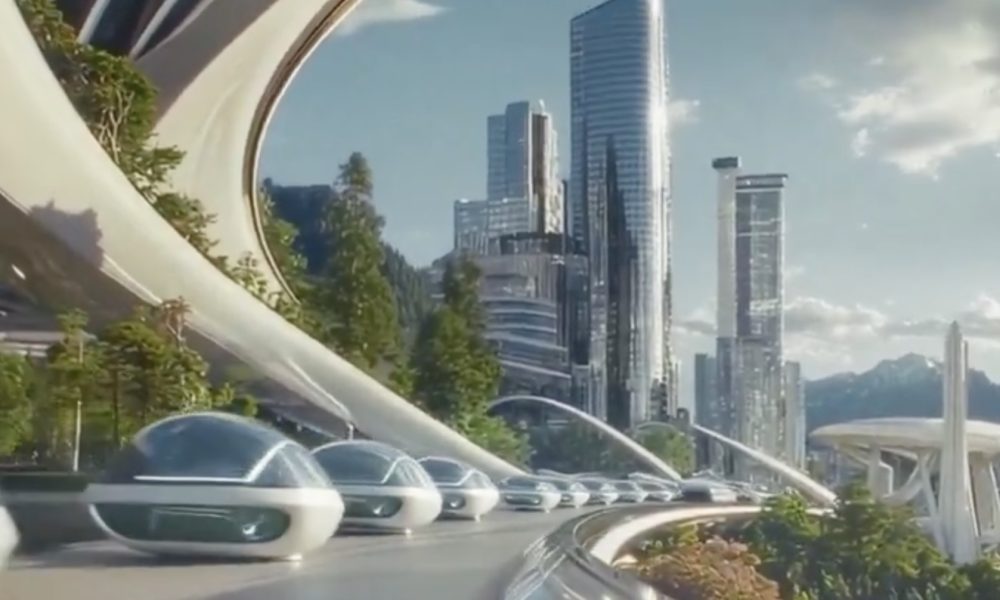
Musk’s Sunday post arrived as a reply to an AI-generated video depicting human colonies on other worlds. He shared it with the caption “This is the future we shall bring into being.” That is the context in which this tunnel was announced: not an engineering briefing, not a city council presentation, but a social media thread about interplanetary civilization.
Boring Company has delivered working infrastructure in Las Vegas and is building in Nashville. Those are real projects with real permits and real machines in the ground. But they are also small, low-speed systems compared to what a 200-mph intercity Hyperloop would demand in engineering, safety certification, and regulatory approval.
No route has been filed. No environmental review has been announced. No timeline has been offered beyond the implication that it could happen. Texas transportation officials have not commented.
The $3 billion raise changes the financial conversation. It does not change the physics conversation, or the permitting conversation, or the question of whether a tunnel boring company that currently operates modified Teslas at freeway speeds can deliver a vehicle system running above 200 mph underground.
For now, the Austin-to-San Antonio Hyperloop is a social media post underneath a science fiction video. The Boring Company has turned social media posts into real products before, from flamethrowers to perfume to tunnels under the Las Vegas Convention Center. It has also turned them into nothing at all.
The pattern is familiar enough that the only honest response is to wait for a boring machine to show up at a job site. That has not happened yet.
Share this Story