
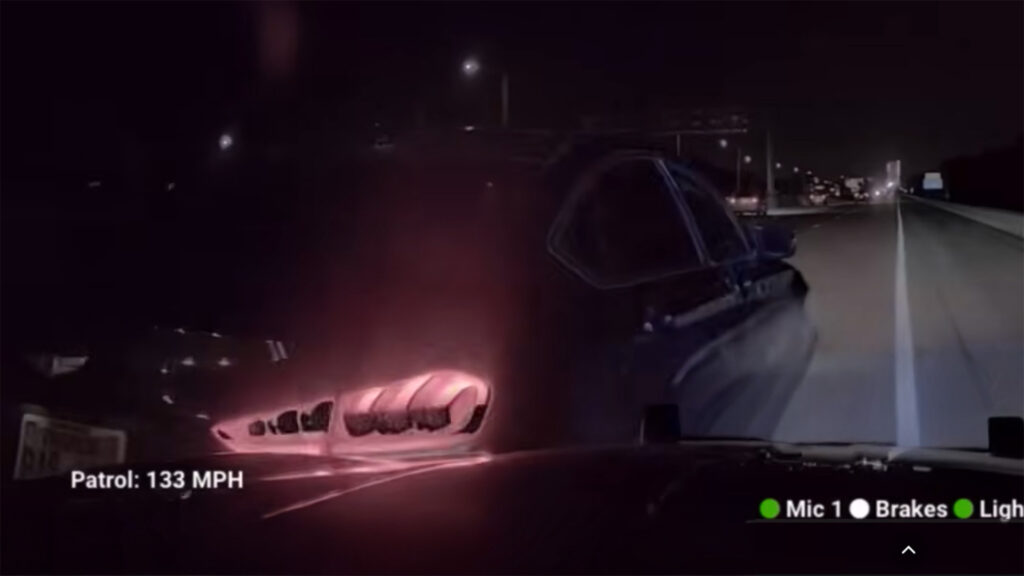


An Arkansas state trooper attempted a PIT maneuver at 133 mph on April 24, and the dashcam footage looks exactly like you’d expect — which is to say, catastrophic.
Trooper Collier Wright made contact with a suspect’s Ford Fusion at 9:31 PM on a highway that was not empty. Three civilian vehicles were directly ahead. Within seconds, both the suspect’s car and Wright’s patrol vehicle were crashing into barriers, with Wright’s cruiser ricocheting across lanes at over 100 mph before grinding backward along a concrete K-rail.
Nobody in those three civilian cars was killed. That’s not skill. That’s luck measured in inches.
The PIT maneuver — Precision Immobilization Technique — is designed to rotate a fleeing vehicle sideways, breaking its traction and bringing it to a stop. At 35 mph, it works like a textbook diagram. At 133 mph, textbooks don’t apply.
Vehicles at that speed don’t rotate neatly. They become projectiles with unpredictable trajectories, and so does the patrol car executing the maneuver.
Most law enforcement agencies in the country understand this. The California Highway Patrol caps PIT maneuvers at 35 mph. North Carolina’s Highway Patrol draws the line at 55.
Many departments classify anything above their speed threshold as deadly force — the same legal and ethical category as firing a weapon. Arkansas State Police apparently operates with a longer leash.
One possible explanation circulating: the suspect was roughly a mile from the state line. Jurisdictional pride — or jurisdictional desperation — may have factored into Wright’s decision to make contact at a speed where the margin for error is functionally zero. It’s a reason, not a justification.
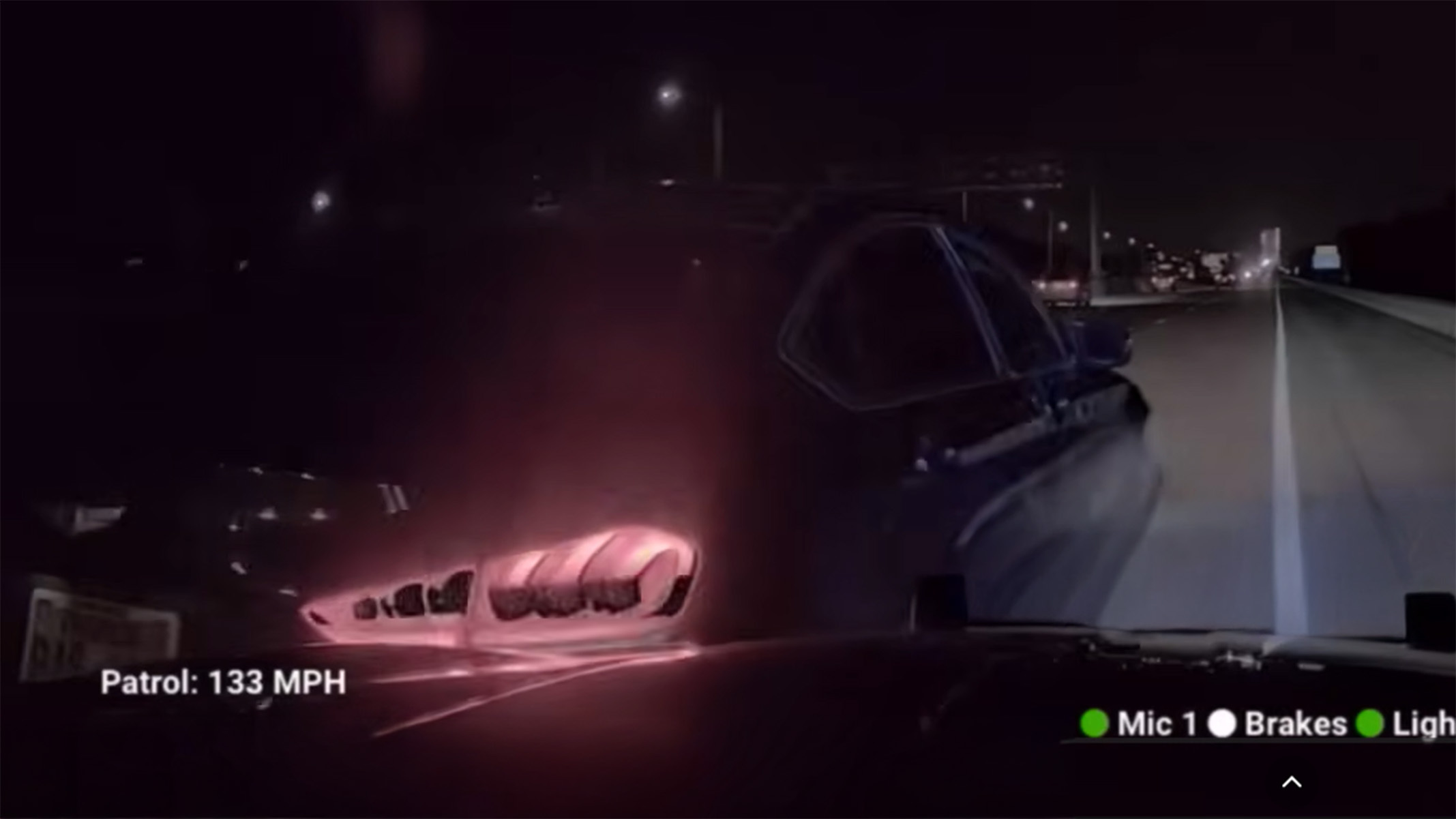
The dashcam video, now spreading widely online, shows the full sequence. The suspect hits the right wall and disappears from frame. Wright’s vehicle immediately loses stability, careens into the right barrier, then slingshots across all lanes into the left barrier.
The sound of metal on concrete doesn’t stop for a long time. Whether officers actually apprehended the suspect afterward remains unclear.
This isn’t the first time Arkansas State Police pursuit tactics have drawn scrutiny. The department has faced previous questions about high-speed chases involving powerful patrol vehicles and aggressive engagement decisions. Each incident adds another data point to a pattern that other states addressed years ago with explicit speed caps and use-of-force classifications.
The physics are not complicated. Kinetic energy scales with the square of velocity. A PIT at 133 mph involves roughly 14 times the energy of one at 35 mph.
That energy has to go somewhere. On April 24, it went into concrete barriers, across active traffic lanes, and through sheer chance alone, not into the passenger compartments of three civilian vehicles whose drivers had no role in any of this.
There is no national standard governing when a PIT maneuver becomes too dangerous to attempt. The patchwork of state and departmental policies means a tactic classified as deadly force in California is apparently still on the table at triple-digit speeds in Arkansas. That gap exists because nobody with the authority to close it has chosen to.
Trooper Wright has not responded to media inquiries. The footage, however, has said plenty.



Share this Story