
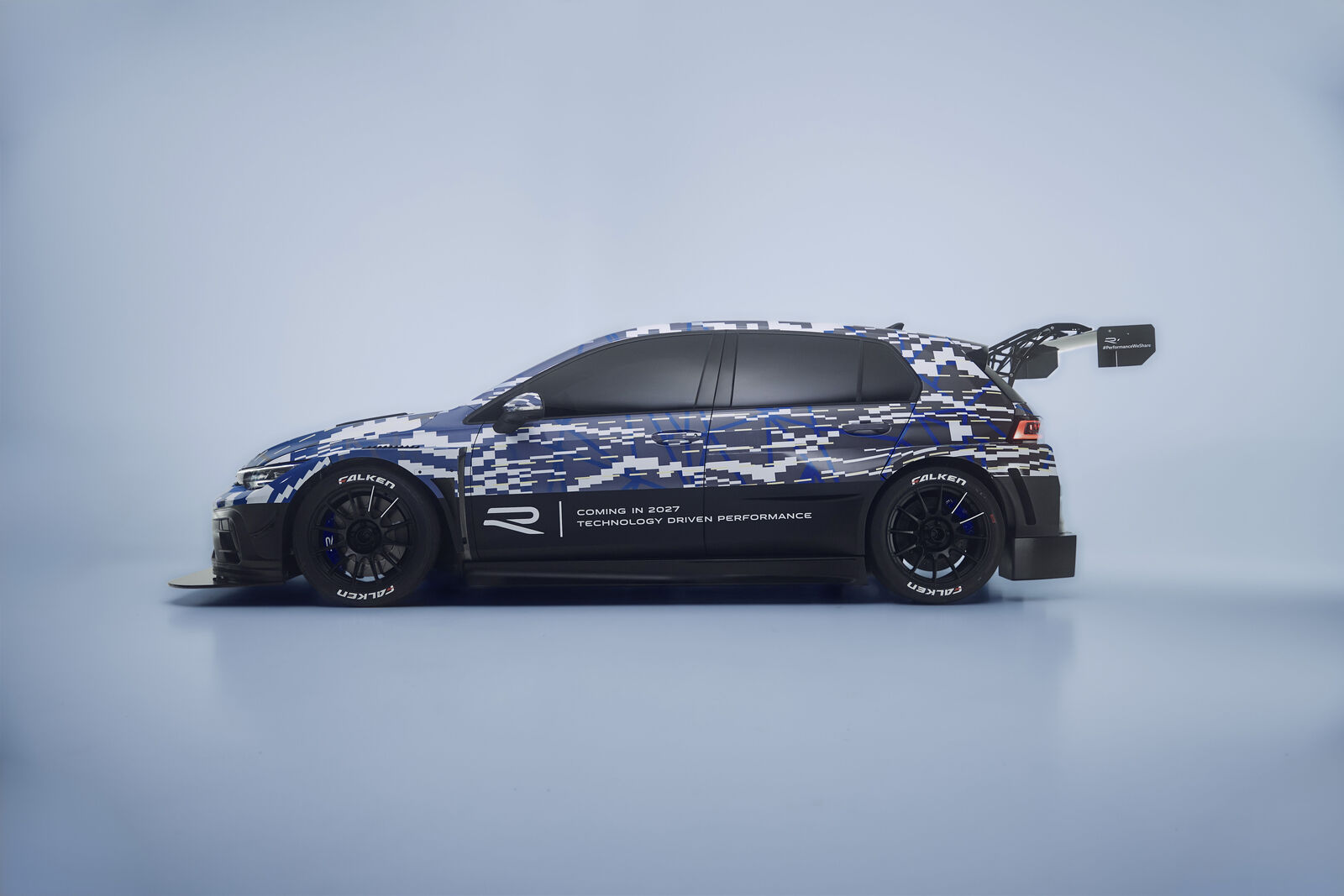


Volkswagen R is going back to the Nürburgring 24 Hours. Not with a concept. Not with an electric record car. With a proper all-wheel-drive Golf R built to race the Nordschleife in 2027.
The timing is no accident. Next year marks 25 years since Volkswagen launched the R brand with the Golf R32 in 2002, a car that paired a 3.2-liter VR6 with all-wheel drive and the first DSG gearbox ever fitted to a Golf. The anniversary gives VW a neat excuse to do something it hasn’t done in this form: field a Golf R in the most punishing endurance race in Europe.
For the past three years, Volkswagen’s Nürburgring program has revolved around the Golf GTI Clubsport, a front-wheel-drive car running in lower-tier classes. The shift to the Golf R signals a deliberate escalation. More power, more traction, more ambition.
Details on the race car are thin. VW is being coy about the technical package, offering only a show car dubbed the Golf R 24H as a teaser. It was unveiled at the Ring Boulevard, and Reinhold Ivenz, head of Volkswagen R, called it “the most spectacular Golf R to date.” That’s a bold claim for a car nobody’s seen the guts of yet.
Volkswagen is developing the racer with Max Kruse Racing, the same outfit that’s been its partner on the GTI Clubsport program. Benjamin Leuchter, MKR co-founder, factory-adjacent driver, and longtime VW development tester, will again be central to the effort. Leuchter’s fingerprints are on virtually every recent hot VW that’s turned laps on the Nordschleife.
The stated goals are modest on paper: demonstrate R performance in competition, validate technical development under racing conditions, deepen the relationship with MKR. No class wins mentioned. No podium targets. That kind of language usually means the car is being built to survive first, compete second. At the 24 Hours, that’s not a bad strategy.
Volkswagen R has a patchy but occasionally brilliant motorsport résumé. The Polo R WRC won four consecutive World Rally Championship titles from 2013 to 2016. The ID.R electric prototype obliterated records at Pikes Peak, the Nürburgring, and Goodwood. Both programs were then quietly shelved, following a familiar pattern of intense investment followed by retreat.
This new effort feels more measured. There’s no factory team banner and no massive infrastructure buildout. It’s a partnership with a privateer squad that already knows the car and the track. That keeps costs controlled and expectations manageable while still putting VW’s performance badge under a spotlight it hasn’t stood under in years.
The broader context matters too. The Golf R is currently one of the best-selling performance cars in its segment, competing against the BMW M135 and Mercedes-AMG A 35. Proving it at the Nürburgring is the oldest marketing play in the German automotive handbook, and it still works.
Whether the Golf R 24H ends up being a genuine contender or a rolling billboard will depend entirely on what VW puts under that show car’s skin. Ivenz says the preparatory work has already started. The real car doesn’t need to exist yet. The story does. And at the Nürburgring, stories travel fast, especially when they involve a Golf with four driven wheels and something to prove.
Share this Story