
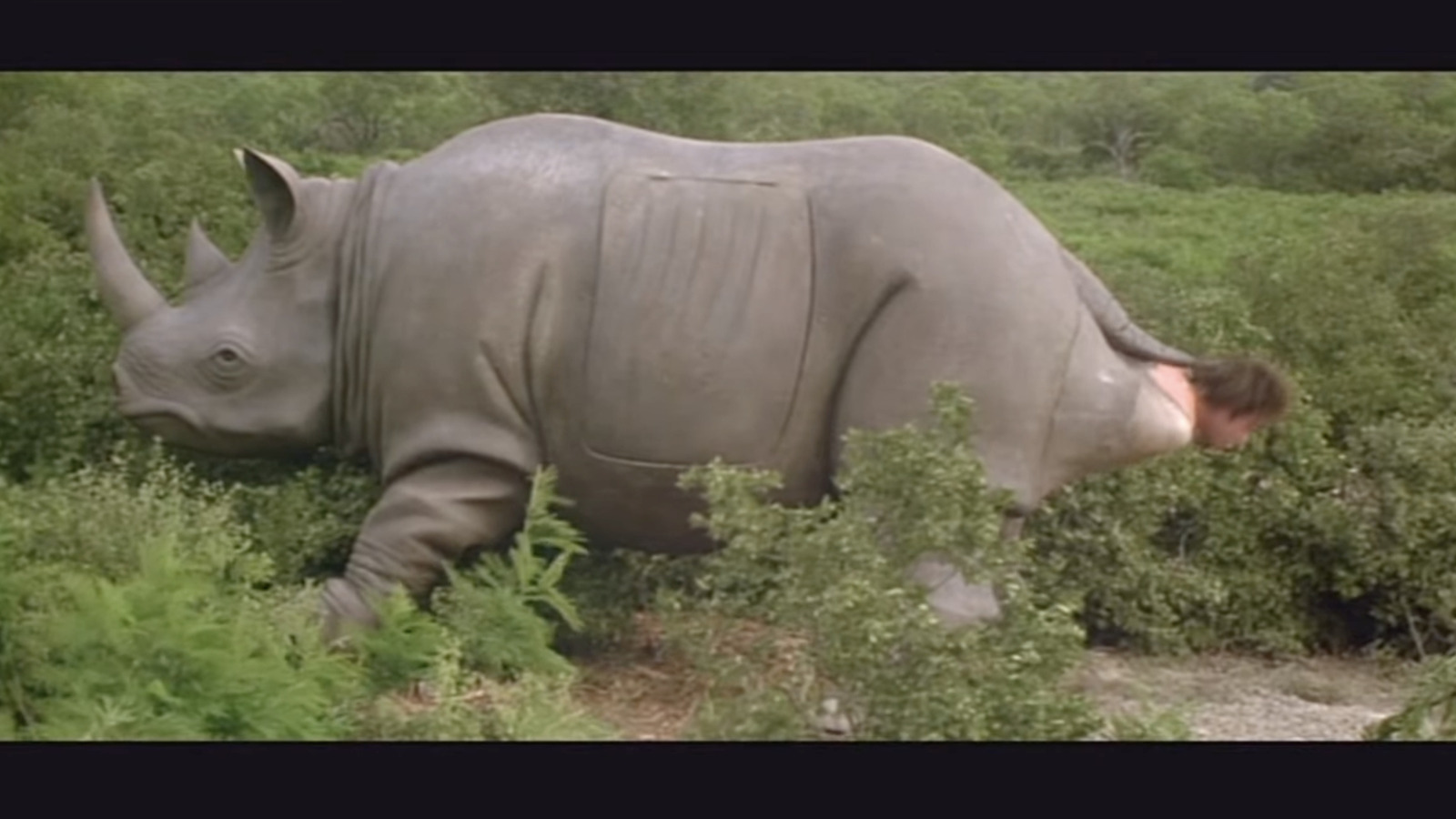


Bidding on the full-size mechanical rhinoceros Jim Carrey famously squeezed out of in 1995’s “Ace Ventura: When Nature Calls” has already hit $5,500. The expected hammer price tops out at $8,000. A base-model Honda Civic starts at $24,950.
PropStore Auction is handling the sale of what might be the most recognizable comedy prop of the 1990s — a 10-foot, tip-to-tail fiberglass and foam beast built exclusively for exterior shots of the scene where Carrey’s Ace Ventura crawls, naked and sweating, through the rear end of a mechanical rhino in front of a horrified safari family. The auction closes March 25.
The prop spent years on display at Planet Hollywood, where diners could presumably recall Carrey’s greased emergence while working through their appetizers. It has since undergone what the listing diplomatically calls “sympathetic restoration,” replacing crumbling latex with rigid Styrofoam and swapping out the original torn “butt skin sheet” — the auction house’s own clinical phrasing — with a fresh replacement.
The rhino’s neck and legs no longer move. Its paint is chipped. Grime has accumulated. The cooling fan that drove the plot gag in the first place sits dormant inside a cavity still large enough for a grown adult to sit in. This is, by any honest measure, a deteriorating movie prop approaching its 31st birthday.
And yet the pricing tells a story the auto industry would rather you not hear.
At $4,000 to $8,000, this rhino — complete with a front grille, interior door, dashboard, seat, and that infamous cooling fan — undercuts the average new car transaction price in America by roughly $43,000. It has no engine, no transmission, no axles, and no legal right to any public road. It is still a better conversation piece than anything sitting on a dealer lot with a four-figure monthly payment.
“When Nature Calls” earned $212 million worldwide on the strength of scenes exactly like this one. The butt birth sequence won Carrey an MTV Movie Award for Best Comedic Performance and embedded itself so deeply in ’90s pop culture that three decades later, an auction house can use “butt birth rhino” as a formal product description and nobody blinks.
The listing carefully documents how bolt patterns and drill-hole placements on the side hatch screen-match to the actual film footage. This isn’t a replica or a tribute piece. This is the rhino. The one the camera rolled on while a stunt team prepared for Carrey to do what only Carrey could do.
For context on the memorabilia market, a Bruce Lee “Game of Death” jumpsuit currently listed on the same platform is fetching $130,000. The rhino, which is arguably more culturally ubiquitous among anyone born between 1980 and 1995, is going for roughly what you’d pay for a decent set of winter tires on a luxury SUV.
The practical realities of ownership are, to put it gently, challenging. Ten feet of fiberglass rhinoceros doesn’t fit in a studio apartment. It barely fits in a garage. Storage costs alone could eventually exceed the purchase price. And yet someone will buy it, because the economics of nostalgia don’t work like the economics of square footage.
There’s something fitting about this prop surfacing now, in 2025 dollars that make a fake rhino look like a reasonable financial decision compared to actual transportation. The scene it starred in was about a man trapped inside a machine that stopped working, desperately searching for any way out. The audience outside watched in disbelief.
That’s not a metaphor. It’s a $5,500 rhinoceros.
Share this Story