
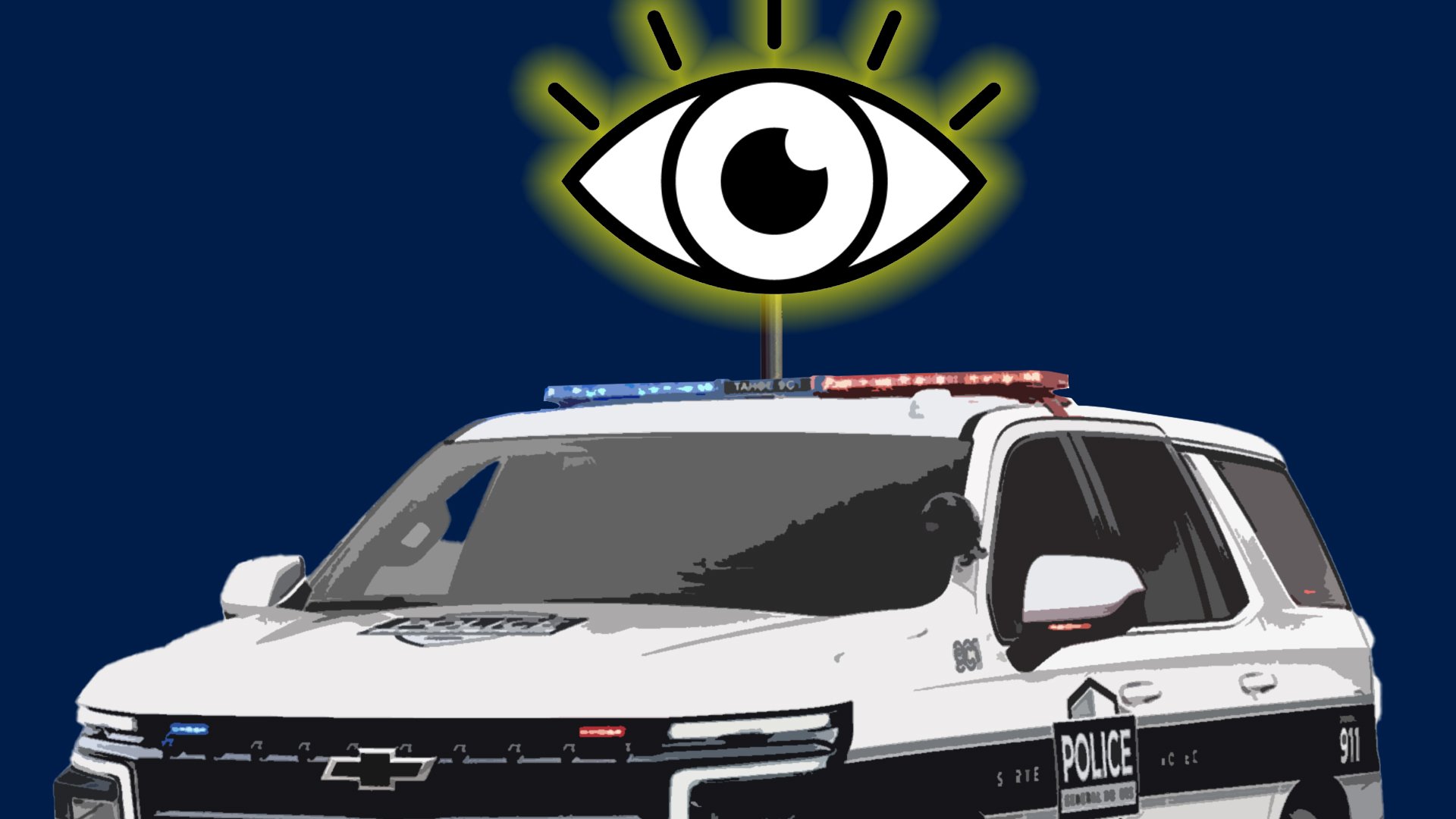


Four 2026 Chevy Tahoes. Four and a half million dollars. That works out to roughly $1.12 million per SUV, which would buy you a very nice Lamborghini Revuelto with money left over for gas. But the Texas Department of Public Safety wasn’t shopping for speed. It was shopping for surveillance.
Purchase documents uncovered by The Drive reveal that Texas DPS’s Criminal Investigations Division acquired a fleet of Tahoes equipped with FalcoNet, an Israeli-made cell surveillance system built by Cognyte. The technology intercepts connections between mobile phones and cell towers, silently vacuuming up location data and device information from anyone within range. No warrant served. No suspect identified. Just a Tahoe rolling through your neighborhood, harvesting everything.
The Tahoes themselves cost $150,000 each, already triple what a civilian Tahoe runs. They’re built on GM’s Police Pursuit Vehicle platform with a V8, heavy-duty brakes, beefed-up suspension, and a 250-amp alternator to feed the electronics bolted inside. But the trucks were the cheap part.
The real money went to Cognyte’s hardware. Four FalcoNet core systems rang up at $2.85 million. Four perpetual 5G licenses added $280,000.
A backpack-portable unit capable of running on foot cost $355,500. A flexible antenna kit, $27,000. Something called a “Cognyte PA Ranger” added another $105,000, and two additional unlicensed units tacked on $270,000 more.
Texas DPS framed the purchase as an emergency. The authorization memo, dated March 2026, requested expedited approval, claiming that “delaying the procurement process could result in unacceptable safety risks to personnel and compromise operational readiness.” The language drips with urgency — “emergency,” “immediate,” “mission success” — but offers zero specifics about what threat actually demands a $4.5 million surveillance buy on a rush timeline.
That vagueness matters because the legal ground under this technology is already cracking. The Supreme Court ruled in Chatrie v. United States that people maintain a reasonable expectation of privacy in location data and that even short-term tracking qualifies as a Fourth Amendment search. FalcoNet doesn’t track one suspect. It tracks everyone.
Every phone pinging a tower within its reach becomes data in the system, guilty and innocent alike.
Florida’s Department of Law Enforcement already runs FalcoNet. Texas is now the second known state customer. The system is modular, packaged in Pelican cases with software-defined radio base stations, power distribution units, and directional antennas, designed to deploy from vehicles, backpacks, or aircraft.
The core module draws 260 watts at full transmission power, fits in a standard rack drawer, and connects through standard RF and LAN ports.
From the outside, these Tahoes will likely look like any other unmarked police SUV. Antenna concealment options include false roof panels, fake cargo boxes, and low-profile puck antennas. For $4.5 million, blending in is part of the package.
The tension here isn’t really about Chevrolet Tahoes or even their price tags. It’s about a state law enforcement agency spending millions on mass-surveillance hardware, invoking an unspecified emergency to skip normal procurement review, and deploying technology whose constitutionality remains actively contested in federal courts. All of it happened with zero public disclosure until a reporter found the receipts.
Police have always needed tools. But there’s a canyon between a tool that targets a suspect and one that sweeps up an entire neighborhood’s phone data because a Tahoe drove past. Texas DPS apparently decided that canyon wasn’t worth pausing to consider, or at least not worth explaining to the public footing the bill.





Share this Story