
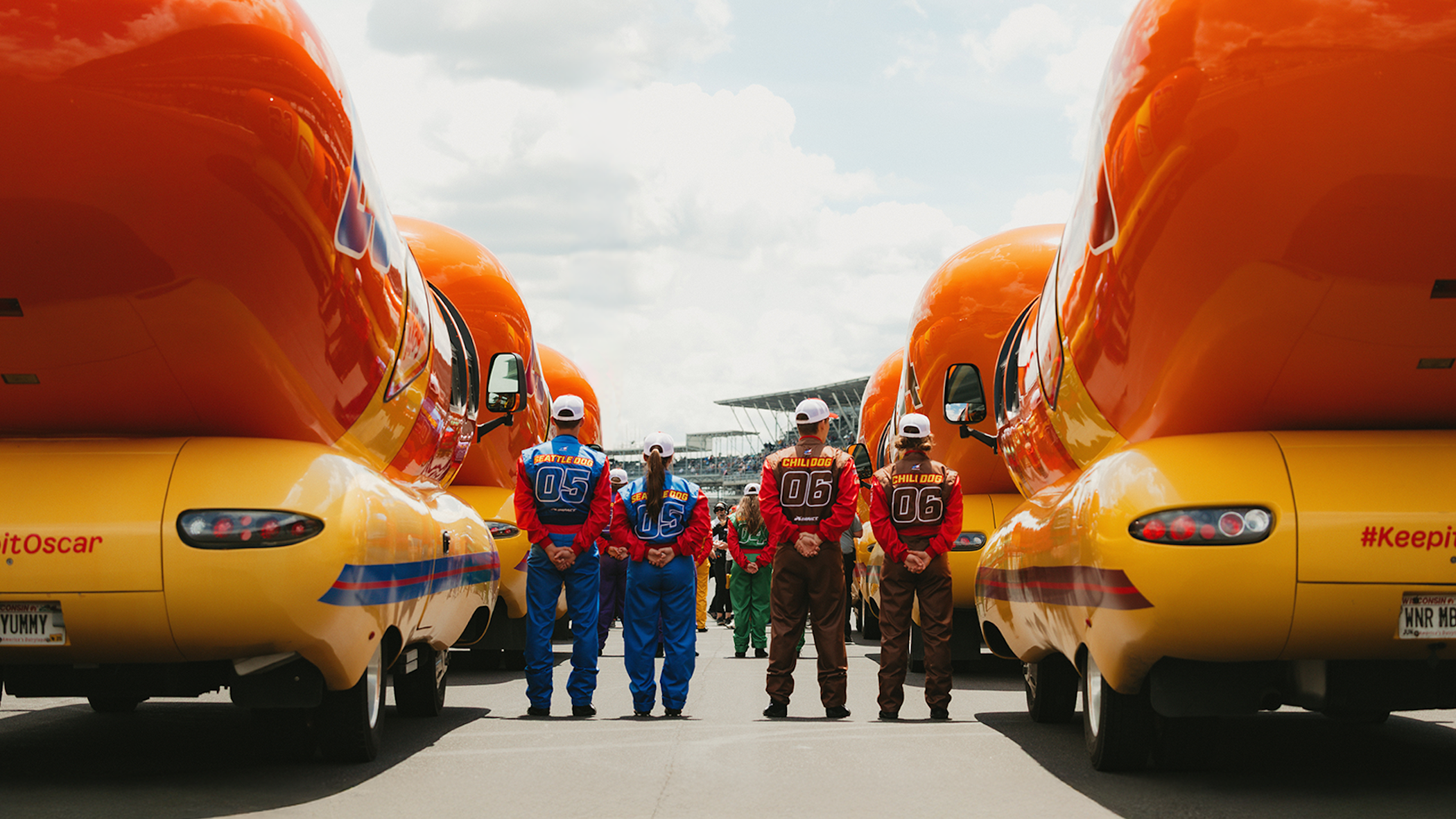


For the second consecutive year, the Indianapolis Motor Speedway — hallowed ground where legends like A.J. Foyt, Mario Andretti, and Al Unser Sr. carved their names into racing immortality — hosted six giant hot dogs on wheels tearing around the 2.5-mile oval.
Oscar Mayer’s Wienie 500, staged ahead of the 2025 Indianapolis 500, sent its fleet of Wienermobiles through a five-mile, two-lap sprint around the Brickyard. The event opened with a barbershop quartet belting the iconic Oscar Mayer jingle, joined by comedian Andy Richter in his role as honorary “Commander in Beef.”
The six-car field represented regions across America. Chi Dog ran for the Midwest, New York Dog carried the East Coast, and Slaw Dog repped the Southeast. Seattle Dog covered the Pacific Northwest, Chili Dog the South, and the lone newcomer was Corn Dog, a Southwest entry replacing last year’s Sonoran Dog.
Each Wienermobile carried a two-person crew of “Hotdoggers,” Oscar Mayer’s roving brand ambassadors who spend a year driving these 27-foot fiberglass franks across the country. The No. 6 Chili Dog team — going by the call signs Zoweenie and Hot Diggity Hunter — told Car and Driver they had exactly one day of practice at the track before race day. They also revealed the existence of a “bun box,” described as “like a glovebox, but a lot more fun.”
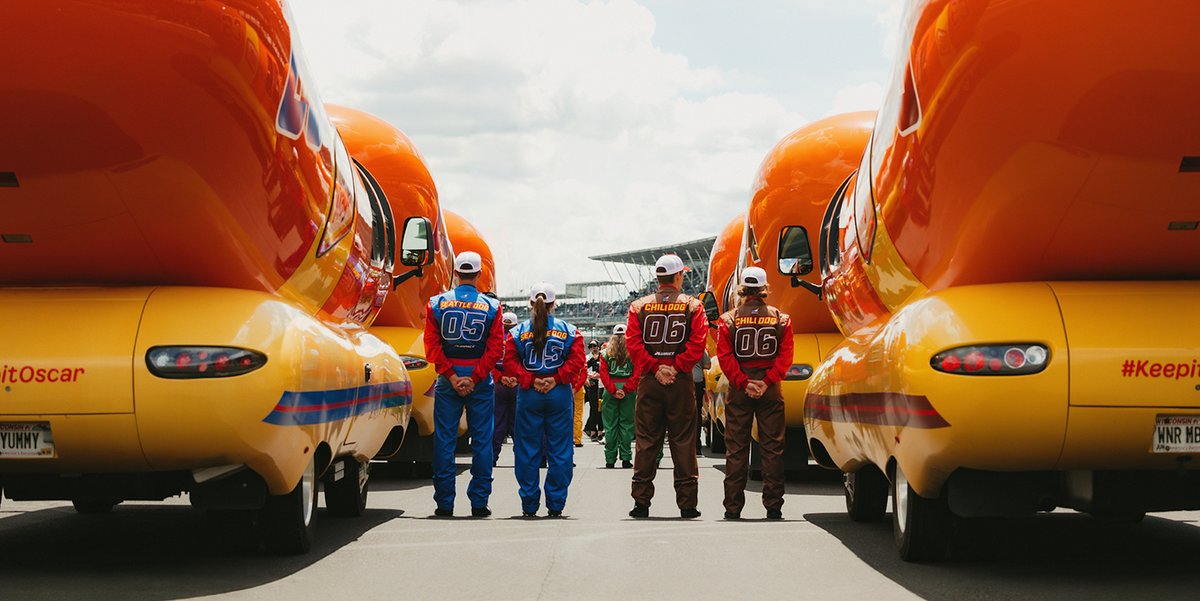
The coaching staff, at least, was legit. IndyCar drivers Nolan Siegel, Sting Ray Robb, and Scott McLaughlin gave the Hotdoggers private driving lessons ahead of the event. Teaching someone to hustle a Wienermobile around IMS is probably not in any racing driver’s standard contract, but it’s the kind of gig you don’t turn down.
IndyCar’s broadcast team called the race, and by all accounts leaned hard into the innuendo potential that a hot dog race inherently provides. Car and Driver’s report suggested viewers with delicate sensibilities might want to hit mute. The race itself featured what was described as “buns-to-buns action,” with the Midwest’s Chi Dog apparently driving aggressively enough to draw attention.
The winning team received the Borg-Wiener trophy — a riff on the Borg-Warner Trophy that goes to the actual Indy 500 winner — and sprayed mustard instead of milk in the victory celebration at what was called the Wieners Circle.
It’s a corporate stunt, obviously. Oscar Mayer knows exactly what it’s doing. The Wienermobile has been one of America’s most recognizable marketing vehicles — literally — since 1936. Putting six of them on the most famous racetrack in the world, with real IndyCar announcers calling the action, is the kind of brand play that generates millions of impressions for the cost of a few tires and a day’s track rental.
But here’s the thing about the Wienermobile: nobody hates it. In a world saturated with advertising that people pay money to avoid, a 27-foot hot dog rolling down the highway still makes people pull out their phones and smile. That’s almost 90 years of earned goodwill, and turning the Brickyard into a temporary deli counter for a second straight year only adds to it.
The real Indy 500 follows shortly, where 33 drivers will push single-seat machines past 230 mph in one of motorsport’s most dangerous and prestigious events. The Wienie 500 is its ridiculous warm-up act, and somehow, that feels exactly right.
Share this Story