
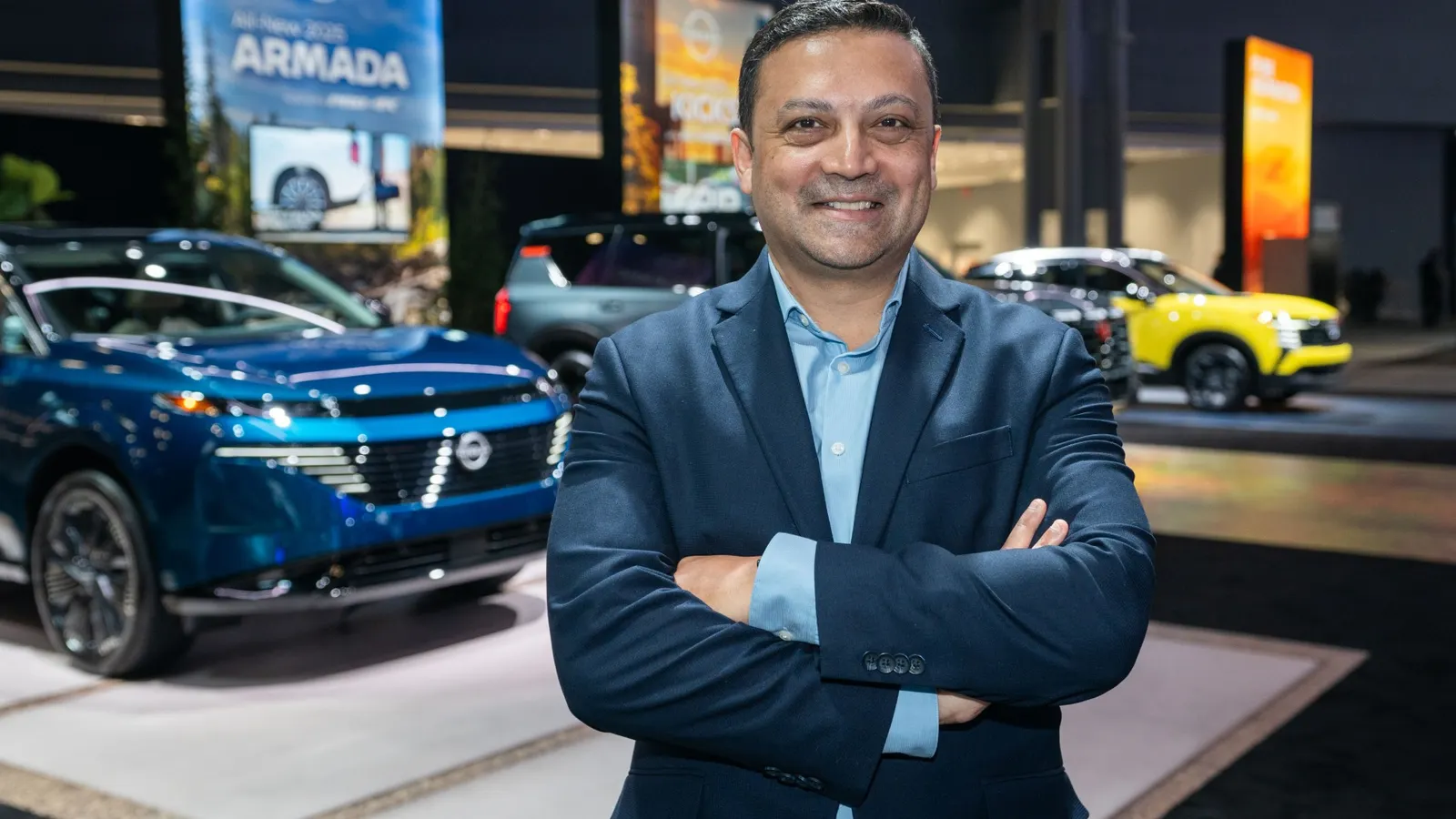


Nissan is killing the Altima. The Versa is already dead. The Maxima is gone. And the Ariya EV has been pulled from U.S. showrooms entirely. What’s left of the automaker’s American lineup is being rebuilt around a single thesis: hybrids now, EVs maybe later, and body-on-frame trucks for everyone.
Ponz Pandikuthira, Nissan Americas’ senior vice president and chief product and planning officer, laid out the roadmap in a recent interview with WardsAuto. The picture that emerges is a company that survived a failed Honda merger, abandoned two planned EV sedans, and is now sprinting toward a dramatically different product portfolio.
The centerpiece is the all-new Rogue arriving around November with Nissan’s e-Power series-hybrid powertrain, a system where the gas engine never drives the wheels directly, instead powering an onboard generator that feeds electric motors. Nissan claims 40 mpg. With hybrids now accounting for 35% to 40% of the compact SUV segment, the company had no choice.
The current Rogue Plug-In Hybrid, borrowed from Mitsubishi’s architecture, was always a stopgap. Pandikuthira essentially admitted as much, calling it a tool to keep online shoppers from skipping Nissan dealers altogether.
The e-Power architecture carries a longer game. Because it’s a series hybrid, it can more easily scale into an extended-range EV with a larger battery and a plug. But Pandikuthira says the math doesn’t work yet, arguing that a 25-to-30 kWh battery pack is still too expensive and too bulky for a vehicle in Rogue’s price class.
On the truck side, the Xterra is coming back, and it’s going full frame. Pandikuthira confirmed it will share its body-on-frame platform with the Frontier pickup, and hinted at up to five derivatives — two- and three-row SUVs for both Nissan and Infiniti — with gas and hybrid options across the family. The Xterra gets a V6 and possibly a parallel hybrid tuned for torque and capability rather than efficiency alone.
The sedan retreat is stark. The new Sentra, described as more “grown-up,” is expected to carry Nissan’s entire car-buying audience by itself. Two EV sedans that were planned for the Altima and Maxima space have been shelved, with Pandikuthira suggesting a resurgence in that segment might not come until 2029 or 2030.
Tariffs loom over all of it. The Kicks and Sentra are built in Mexico, where margins are already thin. Pandikuthira said Nissan is shifting to more U.S.-sourced content even for Mexican-assembled vehicles, and that the long-term play is a build-where-you-sell strategy anchored by plants in Tennessee and Mississippi.
Japanese imports get hit too, but a favorable yen-to-dollar exchange rate is absorbing most of that pain for now.
Then there’s the autonomy play. Nissan’s next ProPilot system promises more hands-free highway driving, but the real ambition is a fully self-driving system developed with British firm Wayze, targeted for around 2028. Pandikuthira described it as capable of handling suburban surface roads at 35 to 55 mph — not a replacement for an attentive driver, but a serious leap beyond lane-centering cruise control.
Strip away the corporate optimism and the picture is clear. Nissan is a company that bet early on EVs with the original Leaf, watched the market stall, and is now pivoting hard to the powertrains Americans are actually buying. The Ariya sits in limbo. Two electric sedans are ghosts. The sedan lineup itself is collapsing to a single nameplate.
What Nissan is building instead — hybrid crossovers, body-on-frame trucks, and a leaner portfolio — is a concession to reality. Whether it’s enough to fuel a genuine turnaround or merely slow the bleeding depends entirely on execution. Nissan has had the right ideas before. It’s the follow-through that’s always been the question.
Share this Story