
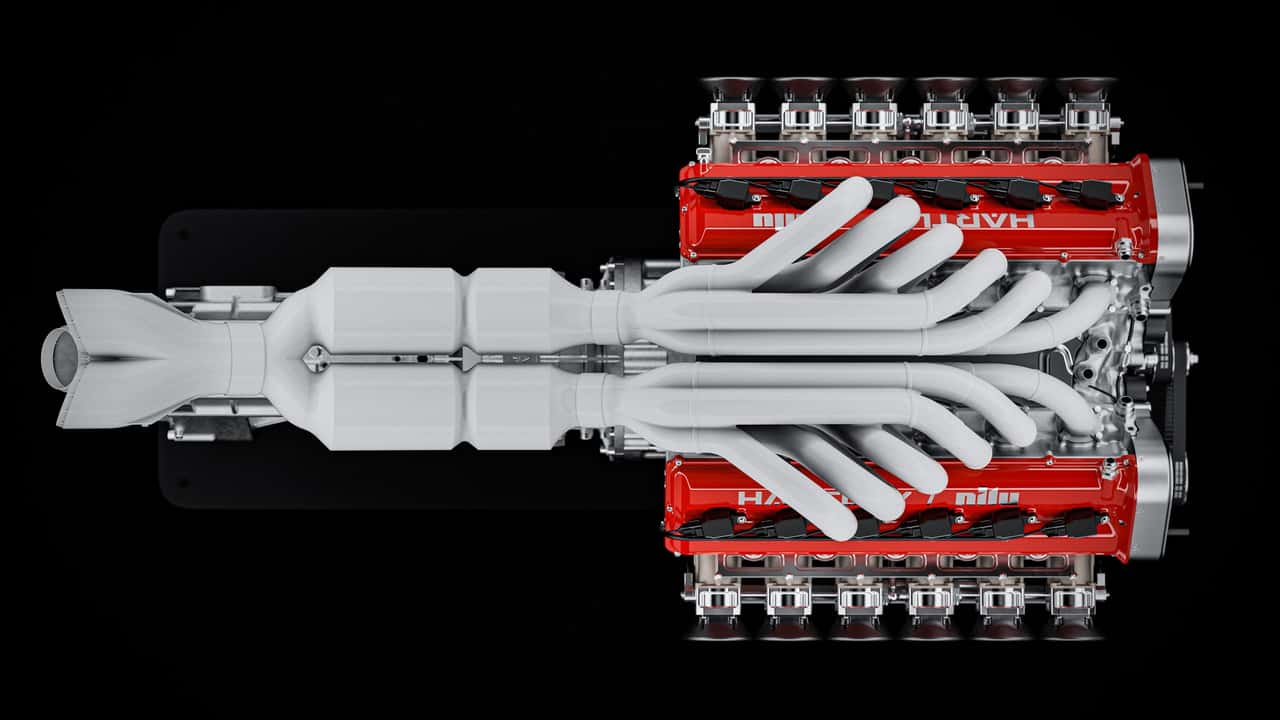


A 6.5-liter naturally aspirated V12, built in New Zealand, just exceeded 1,070 horsepower on its first dyno run. The redline sits at 11,000 rpm. There are no turbochargers.
When Nilu27 surfaced in 2024 with talk of a hypercar powered by a screaming naturally aspirated twelve-cylinder mated to a manual gearbox, the automotive world offered its standard response to startups making big promises: polite skepticism. The graveyard of vaporware hypercars is deep and well-populated. But Nilu27 just took a meaningful step past the PowerPoint phase.
The engine was built by Hartley Engines, a New Zealand outfit with serious credentials in bespoke engine development. That it hit its power target on the very first fire-up is notable. Engines this ambitious, with a bespoke block, 11,000-rpm ceiling, and no forced induction, typically need rounds of calibration before they deliver.
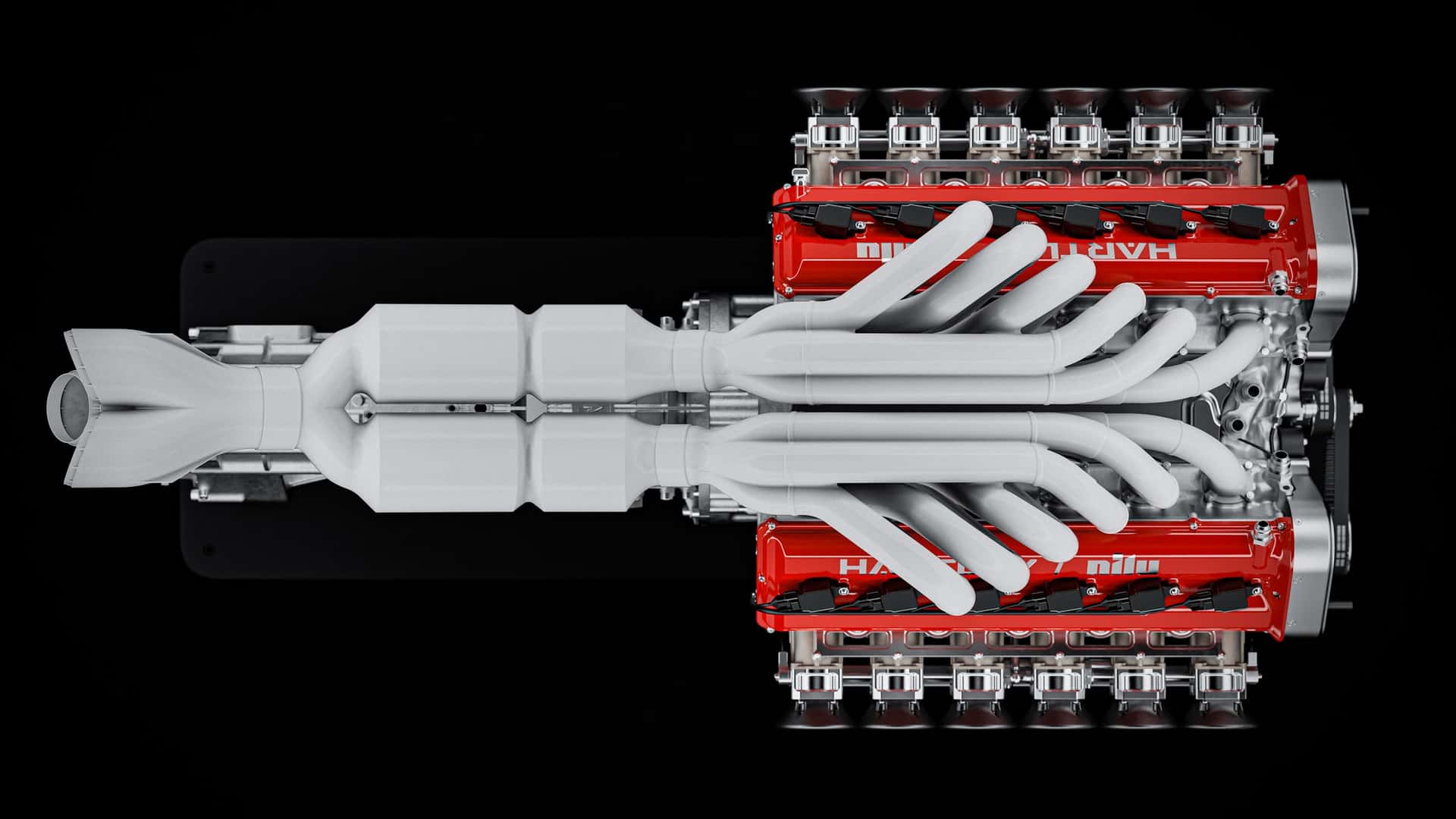
Nilu27 calls it a Hot V configuration, meaning the exhaust manifolds route through the valley between the cylinder heads rather than exiting outboard. That term usually belongs to turbocharged engines where packaging the turbos inside the V makes thermodynamic and spatial sense. Without turbos in the picture, the label is unconventional, but the layout itself still offers packaging advantages and likely contributes to the engine’s compact footprint.
Simon Waegner, Nilu27’s CTO and COO, didn’t hide his enthusiasm. I’ve been in the automotive and hypercar industry for more than 25 years, and I’ve never seen a brand new engine configuration fire up and run this smoothly on the first attempt,” he said. That’s the kind of quote that either ages beautifully or becomes a punchline. For now, the dyno numbers back him up.
The next step is shipping the engine from New Zealand to Nilu’s R&D facilities in Germany, where it will be mated to a seven-speed manual gearbox and dropped into the first driving prototype. That transition, from engine on a stand to powertrain in a rolling chassis, is where many startup dreams stall out. Integration, cooling, electronics, crash structures, and regulatory compliance all conspire to slow progress or kill momentum entirely.
The broader context is what makes Nilu27 interesting rather than just another spec-sheet fantasy. At a moment when the hypercar segment is splitting between electric mega-torque machines and increasingly rare combustion holdouts, a startup choosing a naturally aspirated V12 with a stick shift is either brilliant counterprogramming or a romantic suicide mission. There is clearly a market, small but fanatical, that wants combustion taken to its absolute zenith before the curtain falls.
Whether Nilu27 can actually deliver a finished, road-legal car remains the central question. Plenty of companies have fired an engine on a dyno and never shipped a single vehicle. The path from here involves crash testing, homologation, supply chain management, and the relentless cash burn that kills underfunded startups.
Still, an engine that makes four-figure horsepower without forced induction, revs past where most road car engines have ever dared, and exists in physical hardware rather than a render farm? That’s not nothing. That’s the hardest part done, assuming everything else goes right.
The clock is ticking. The prototype needs to drive.

Share this Story