
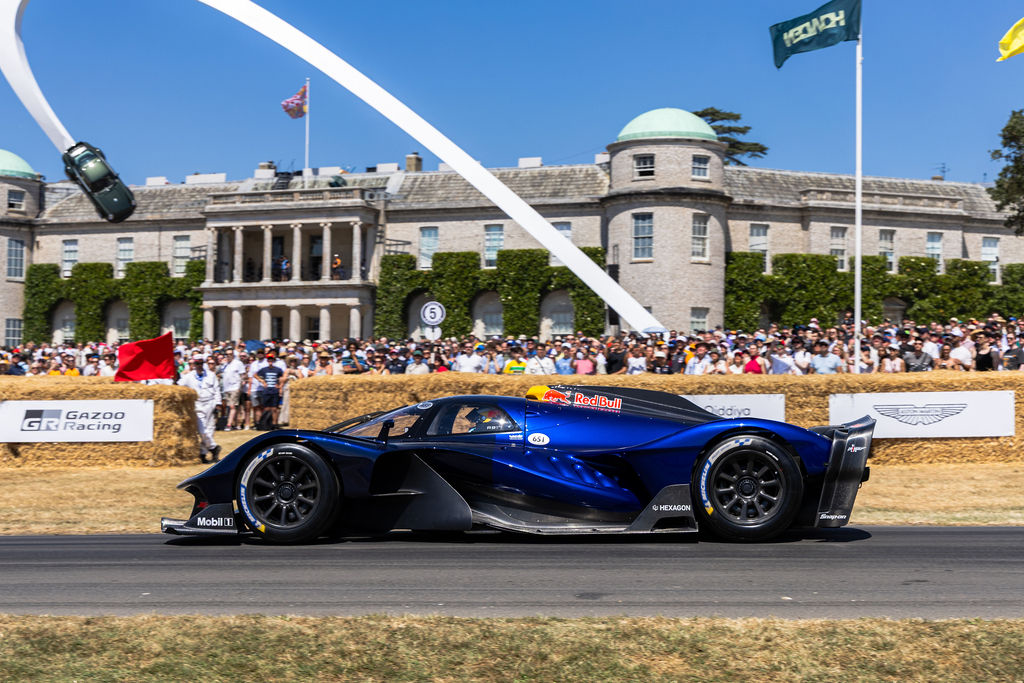


Adrian Newey clipped the grass at Turn 2. The man who shaped the most dominant Formula 1 cars of the last three decades was behind the wheel of his own creation, the Red Bull RB17, pushing a prototype that has logged just 500 kilometers through its first public appearance at the Goodwood Festival of Speed. He left Red Bull for Aston Martin sixteen months ago. They still invited him to drive.
That detail alone tells you everything about where this project sits in the automotive universe. The RB17 is not a car born from a corporate product plan. It is a fever dream committed to carbon fiber, and the man who dreamed it retains a gravitational pull that transcends employment contracts.
This is his passion project, this is his vision for this car,” said Rob Gray, technical director at Red Bull Advanced Technologies. When we came to talk about who was going to drive here, he was an obvious candidate.
The car that rolled onto Goodwood’s famous hillclimb was not finished. It was a running prototype with functional doors, mirrors, and safety equipment, enough to make a spirited but untimed run up the hill. But even in this raw state, the RB17 announced itself with what may have been the loudest engine note on the entire estate.
That noise comes from a bespoke 4.5-liter Cosworth V-10, naturally aspirated, paired with a 200-horsepower hybrid motor integrated into the gearbox. Red Bull originally planned a twin-turbo V-8 when the project was first announced in 2022. Then rationality and romance collided.
Cosworth ran simulations. The V-10 delivered better throttle response and occupied less space than a V-12 while offering structural rigidity as a stressed member of the chassis. And it screamed like an F1 car from the sport’s greatest sonic era.
“There was a lot of simulation and analysis that went into the engine choice, but then there was also a bit of heart,” admitted Cosworth commercial director Chris Willoughby. “And the heart definitely said V-10, naturally aspirated, high-revving was the way to go.”
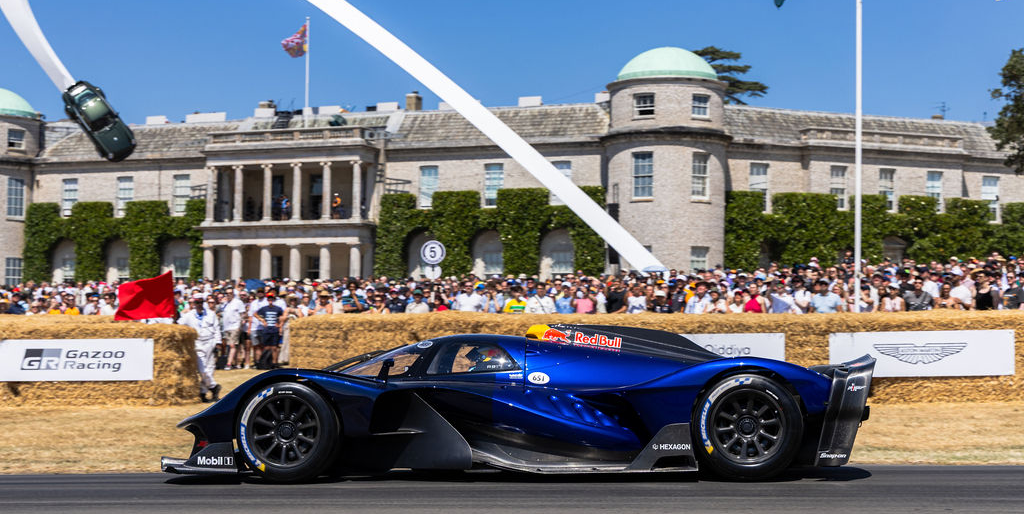
At Goodwood, the engine only revved to 10,000 rpm. It is capable of well beyond 12,000. Cosworth borrowed F1 technology — gear-driven cams, pneumatic valve springs — but engineered longevity into a powerplant that won’t be scrapped after a single qualifying session.
One quiet piece of racing knowledge even paid environmental dividends. Pushing piston rings closer to the top of the piston eliminates spaces where unburned hydrocarbons hide, cutting emissions while extracting more power.
The aerodynamics have evolved significantly since the show car debuted at Goodwood in 2024. A semi-detached rear wing, massive ground effects, and an active diffuser that can dial back downforce to reduce tire wear now define the package. Red Bull designed multiple driving modes so that a buyer who currently runs a Porsche GT3 on track days can climb in without immediately binning a $7.5 million machine into a barrier.
Red Bull reserve driver Yuki Tsunoda also took the RB17 up the hill. Max Verstappen did not, though a decade of his driving data fed the simulations that shaped the car’s development. Rumors circulated at Goodwood that a separate company may attempt to homologate the RB17 for road use, though nothing was confirmed.
Fifty customer cars are planned, but the timeline has slipped badly. Deliveries were originally promised for 2025. Assembly only began in May 2026, with realistic delivery dates now pointing to 2027 or 2028 at a starting price equivalent to roughly $7.5 million at current exchange rates.
That is an enormous sum for a track-only machine with no racing series to enter and no license plates to bolt on. It is also, as Red Bull is happy to point out, cheaper than a new Formula 1 car — one that would come with a turbocharged V-6 instead of a wailing V-10. For the sort of buyer who attends Goodwood in a panama hat, the math apparently works. Whether 50 of those buyers materialize before the cars are actually built remains the only question Adrian Newey’s genius cannot answer.
Share this Story