
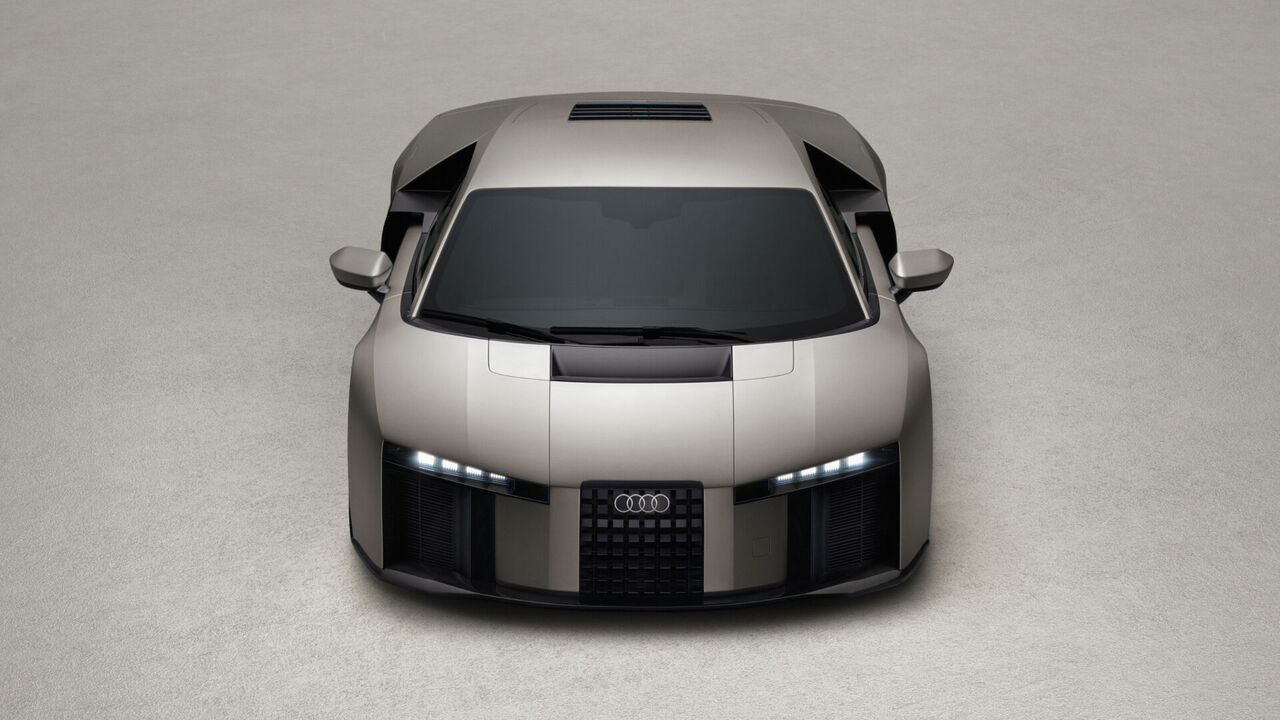


One thousand and one horsepower. Limited to 499 units. Deliveries starting in the first half of 2027. Audi just pulled the sheet off the Nuvolari, the most powerful production car it has ever built, and the subtext is louder than the engine.
This is Audi admitting the R8 left a hole. A big one.
The Nuvolari is named after Tazio Nuvolari, the legendary Italian racer whose reckless brilliance defined prewar grand prix racing. It’s a high-performance hybrid. Not a full EV.
That choice alone tells you everything about where Audi’s head is right now. The company that once staked its future entirely on battery-electric vehicles is putting a combustion engine and an electric motor together in its technological flagship, targeting north of 350 km/h.
CEO Gernot Döllner called it “a statement for the future of Audi” and “Vorsprung durch Technik in the age of electrification.” CTO Rouven Mohr talked about “new benchmarks.” The press release was thick with corporate ambition.
Strip that away and you find something more interesting: preliminary fuel consumption figures of 11.3 liters per 100 km in combined weighted mode, ballooning to 14.7 liters with a dead battery. The CO₂ class? G — the worst on the European scale.
That is the tension at the heart of this car. Audi is building a halo machine that screams performance and whispers hybrid, but the efficiency numbers land somewhere between irrelevant and embarrassing. For a supercar buyer spending what will surely be north of half a million euros, none of that matters. For Audi’s corporate emissions averages, it might.
The technical bones are genuinely ambitious. Audi claims Formula 1-derived innovations throughout, including something it calls “quattro predictive ride” — a world first, according to Mohr — along with active aerodynamics and a carbon-bodied Audi Space Frame. The near-production prototype shown in Antibes represents Audi’s new design language in its purest form: taut surfaces, minimal ornamentation, monolithic proportions.
The timing matters. Audi entered Formula 1 this season with its Sauber partnership, and the Nuvolari is clearly meant to ride that wave, converting paddock credibility into showroom desire. Ferrari does this reflexively. McLaren built a business model around it. For Audi, the supercar-as-brand-statement playbook is newer territory, and the stakes are real.
Ingolstadt has been hemorrhaging narrative ground to rivals. Mercedes-AMG has the One. Ferrari has the SF90 and its successors. Porsche — Audi’s own corporate sibling — owns the hybrid hypercar space with the 918’s legacy. Lamborghini, another VW Group stablemate, dropped the Revuelto. Audi needed an answer, and the Nuvolari is it.
Production of 499 cars guarantees exclusivity and virtually eliminates commercial risk. This isn’t a volume play. It’s a credibility play.
Every unit will sell before the paint booth warms up. The real question is whether the technology demonstrated here — the hybrid architecture, the predictive chassis, the active aero — filters into cars that actual customers cross-shop at dealerships.
Marco Schubert, Audi’s sales and marketing board member, framed the Nuvolari as a move to become “the most desirable premium automotive brand.” That’s a tall claim from a company whose recent lineup has leaned heavily on electric SUVs that struggle to distinguish themselves from the competition.
A 1,001-PS hybrid supercar named after a dead racing legend won’t fix Audi’s broader challenges. But it does something the Q6 e-tron never could: it makes people pay attention.
Share this Story