
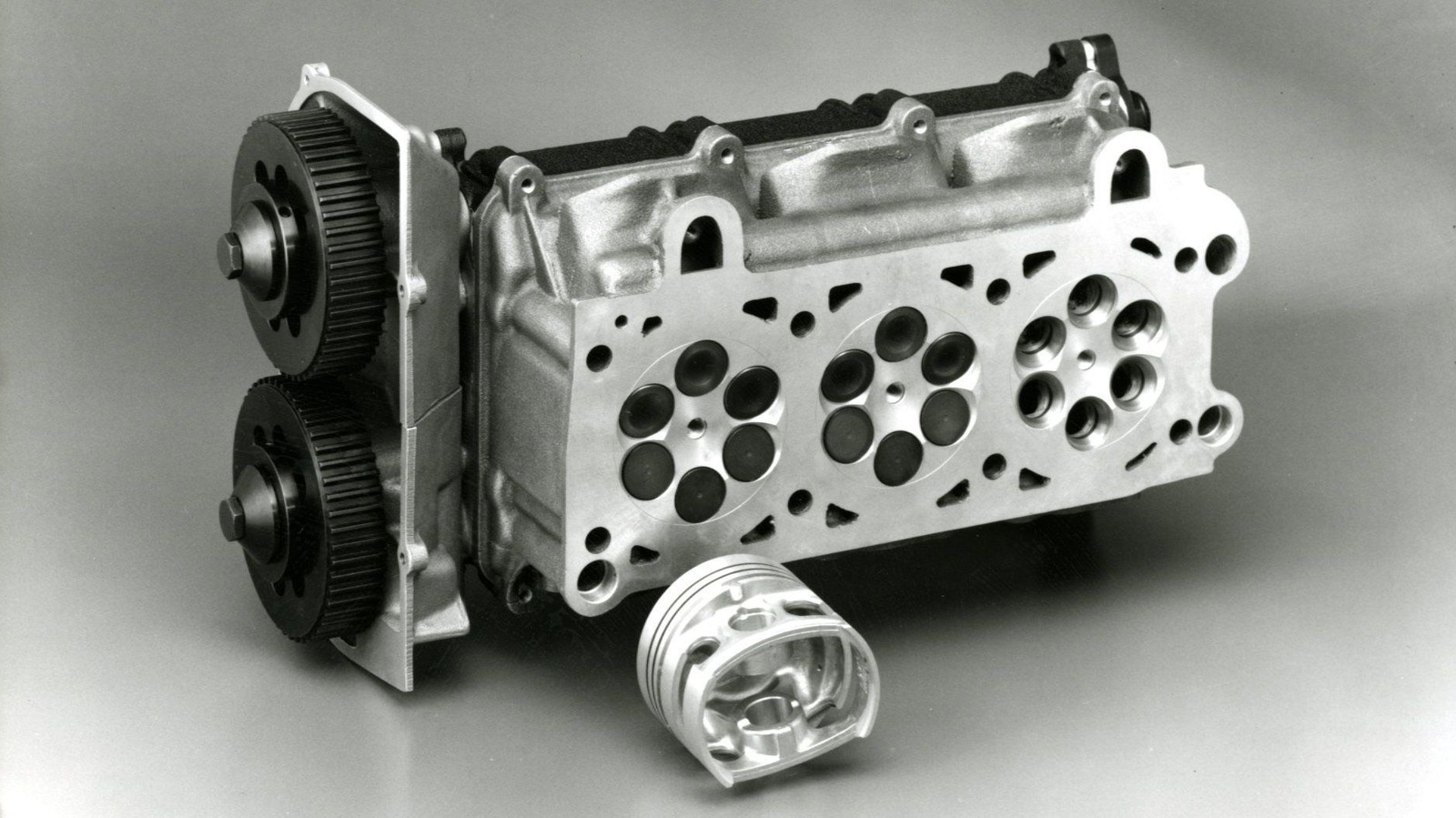


Back in the 1980s, Maserati engineers did something nobody else dared. They built a V6 engine with six valves per cylinder, a total of 36 valves crammed into a 2.0-liter twin-turbo package. They called it the 6.36, and on paper, it was a masterpiece.
The claims were genuinely impressive. Maserati said the prototype cranked out 257 horsepower at 7,200 RPM, a massive jump from the 180 horses the earlier three-valve Biturbo engine managed. A patented cam-rocker arrangement operated three valves simultaneously off a single cam lobe, which theoretically kept mechanical complexity in check despite the absurd valve count.
Maserati also boasted a 34% improvement in gas circulation area compared to a conventional four-valve-per-cylinder layout. More air in, more exhaust out, more power everywhere. It sounded like the future of internal combustion.
Then it got shelved. Quietly. No fanfare, no explanation that satisfied the curious. Just a promising prototype consigned to the dustbin of automotive history.
The reason likely has everything to do with physics and diminishing returns, a lesson Yamaha learned around the same time while developing its legendary FZ750 motorcycle. Yamaha’s engineers didn’t stop at five valves per cylinder during testing. They went to six, then seven, building a 28-valve V4 with dual spark plugs that could theoretically scream to 20,000 RPM.
It was a disaster. Detonation problems plagued the closely spaced exhaust valves. Development costs spiraled into absurdity. The engineers discovered a hard truth that applies across all engine design: past five valves per cylinder, total valve opening area actually decreases rather than increases.
Five valves hit the sweet spot. Three smaller intake valves offered more total circumference than two larger ones, improving volumetric efficiency by roughly 10% over a four-valve design. But add a sixth valve, and you’re fighting geometry itself. The valves get so small and so tightly packed that you lose the very airflow advantages you were chasing.
This is why Ferrari used five valves per cylinder in the glorious 355. It’s why Audi, Volkswagen, and Mitsubishi all experimented with five-valve heads through the 1990s and early 2000s. None of them went to six.
Maserati’s situation was particularly precarious. This was a company clinging to survival, kept alive largely by the Biturbo line that was itself earning a brutal reputation for unreliability. Pouring resources into a six-valve engine that defied the engineering consensus wasn’t bold innovation. It was a luxury Maserati simply couldn’t afford.
What makes this story fascinating isn’t just the technical dead end. It’s what it reveals about the mentality of small Italian automakers in that era. There was a genuine belief that sheer ingenuity could overcome the laws of thermodynamics and the constraints of a balance sheet.
Sometimes that worked beautifully. Often it didn’t.
The 6.36 never got the chance to prove itself on the road, which means we’ll never know if Maserati’s patented valve arrangement might have solved the detonation and packaging problems that killed Yamaha’s experiments. Maybe Italian stubbornness would have found a way. Maybe the engine would have been a rolling time bomb even worse than the Biturbo mills that preceded it.
Either way, the six-valve engine stands as one of the most ambitious what-ifs in modern engine design. It pushed past a boundary that every other manufacturer recognized as a wall, and Maserati hit that wall hard enough to walk away for good. In the decades since, nobody else has seriously tried to go beyond five valves per cylinder. The 6.36 is proof that in engine design, more isn’t always more.


Share this Story