
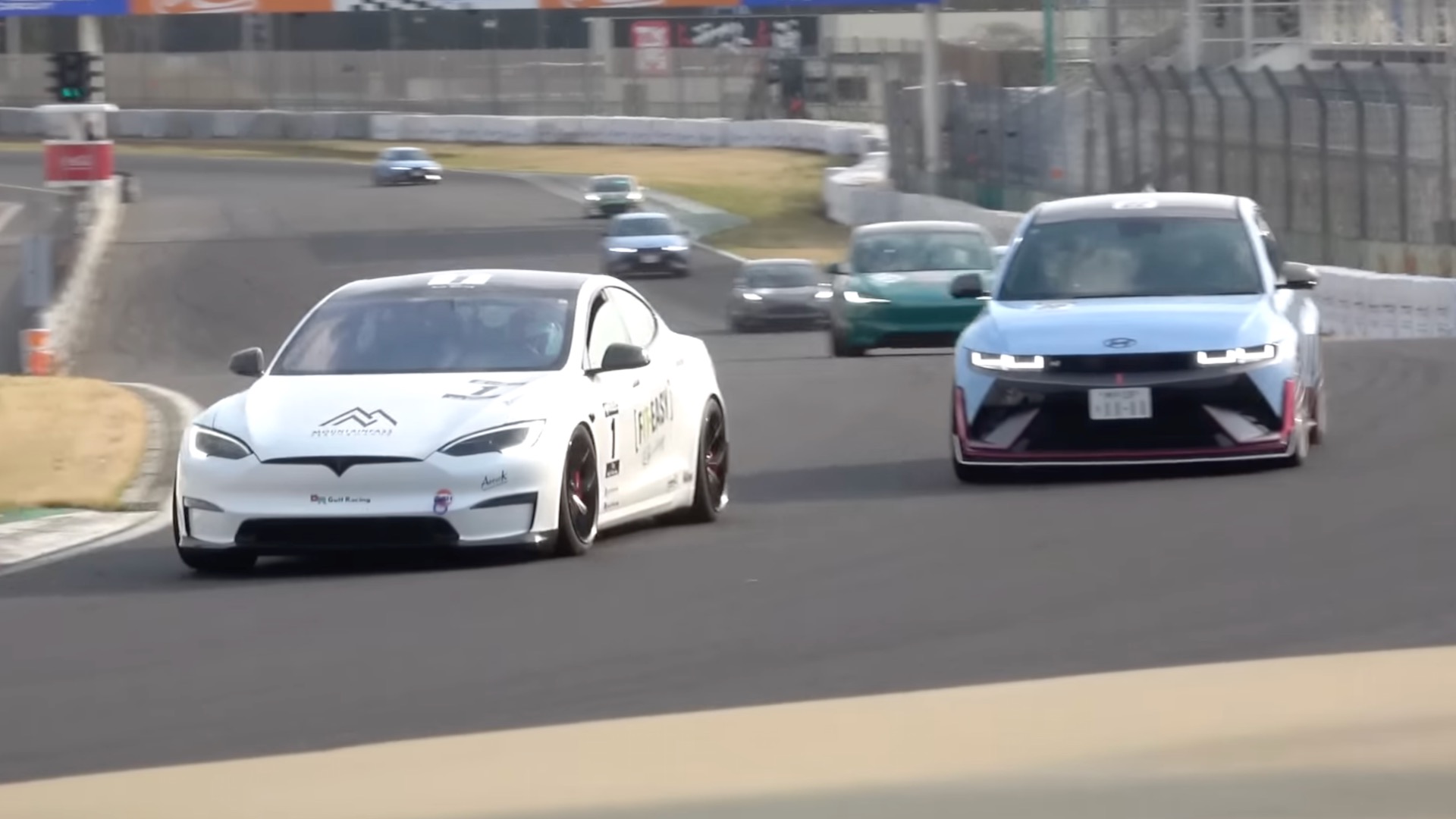


Fifty-five kilometers. Twenty-seven laps. A Tesla Model S Plaid sharing a grid with Nissan Note hatchbacks. And a jazz fusion soundtrack where engine noise should be. That’s the formula the Japan Electric Vehicle Race Association stumbled onto, and it might be the most honest answer yet to the question nobody in motorsport wants to ask out loud: how do you make electric racing watchable?
JEVRA kicked off its 2026 All Japan EV-GP season at Tsukuba Circuit in late March, and footage that recently surfaced on YouTube has been turning heads for all the right reasons. Not because the cars are fast — though a Model S Plaid on a tight circuit is no joke — but because the production choices surrounding the racing are inspired.
The silence problem that has dogged every EV racing series since Formula E’s inaugural season in 2014 gets solved here with a decision so simple it’s almost embarrassing. Instead of piping in fake engine sounds or relying on the high-pitched whine of electric motors, JEVRA’s broadcast lays down a jazz fusion score that sounds like it belongs in an Ace Combat game or a Shibuya coffee shop. It works. Absurdly well.
Then there’s the commentary. Even if you don’t understand a word of Japanese, the energy is unmistakable. The announcers match the urgency of the racing itself, screaming through close passes with a conviction that Formula E’s polished English-language broadcasts have never quite managed. F1 learned decades ago that commentary cadence matters more than content. JEVRA’s booth crew apparently got the memo.
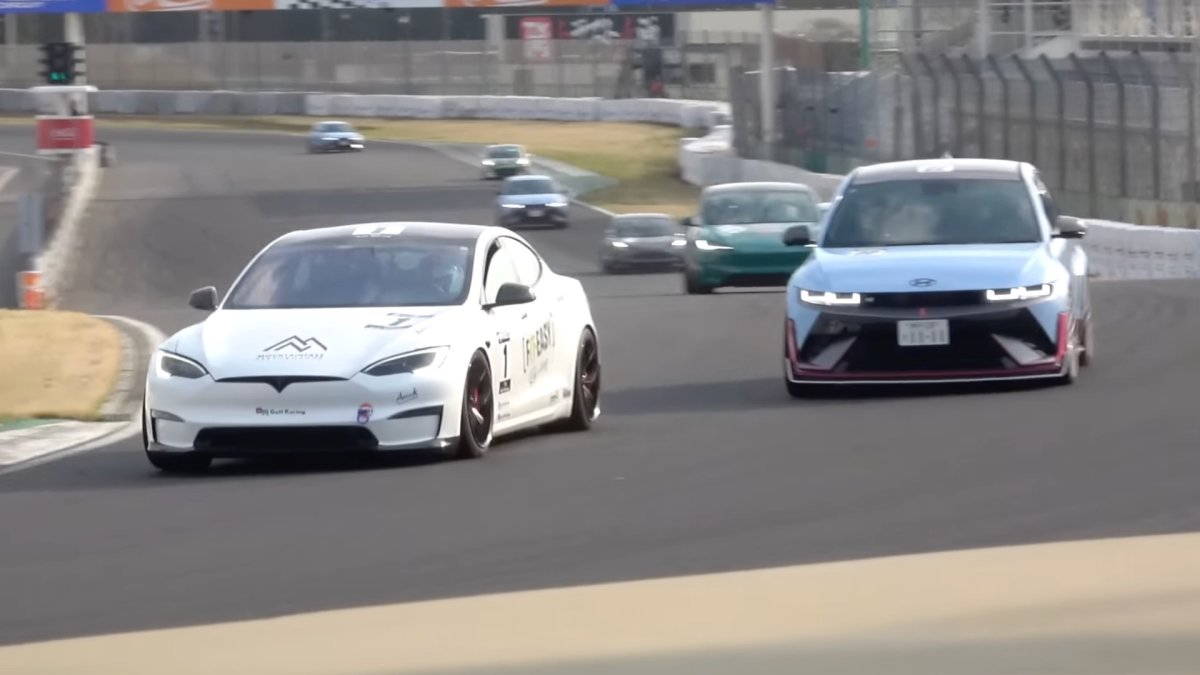
The cars themselves are the real charm. This is not a spec series with purpose-built silhouette racers. The grid at Tsukuba included Tesla Model 3 Performances, Hyundai Ioniq 5 Ns, and those little Nissan Note e-Power hatchbacks, most running with full interiors and barely any visible modifications. Numbers on the doors, roll up, race.
It’s club racing in its purest form, the kind of grassroots competition that built entire motorsport cultures before corporate hospitality suites took over. JEVRA divides entries into classes by output, from the 150-kilowatt EV-4 class up to EV-1 for cars making more than 401 kW. There are even provisions for range-extended EVs like the BMW i3 REx and Mazda MX-30, plus Nissan’s e-Power series hybrids.
The rulebook acknowledges reality instead of pretending batteries are something they’re not. That 55-kilometer race distance is the other quiet admission. Any longer and the field would be nursing state-of-charge instead of racing.
So JEVRA keeps it short. Rallycross built a global following on events measured in minutes, not hours. There’s no rule that says endurance is the only legitimate format.
Electric GT tried to launch a production-based EV racing series a few years back with FIA backing and big ambitions. It collapsed before it ever really started, buried under the weight of its own seriousness. JEVRA has been running since 2010 with almost no international profile, doing it on a shoestring with stock hatchbacks and a killer soundtrack.
The Ioniq 5 N was built for exactly this kind of thing. So were the Porsche Taycan and Lucid Air Sapphire. The hardware exists. The audience exists, if the product respects their time and intelligence.
What’s missing in every other market is the willingness to stop overthinking it — to accept that EV racing doesn’t need to replicate what combustion motorsport already does. It needs a jazz fusion band and someone behind a microphone who actually gives a damn.
Share this Story