


Automobili Mignatta showed up to the 2026 Goodwood Festival of Speed with sketches, not a finished car, and still managed to generate more honest excitement than half the electrified hypercars on the lawn.
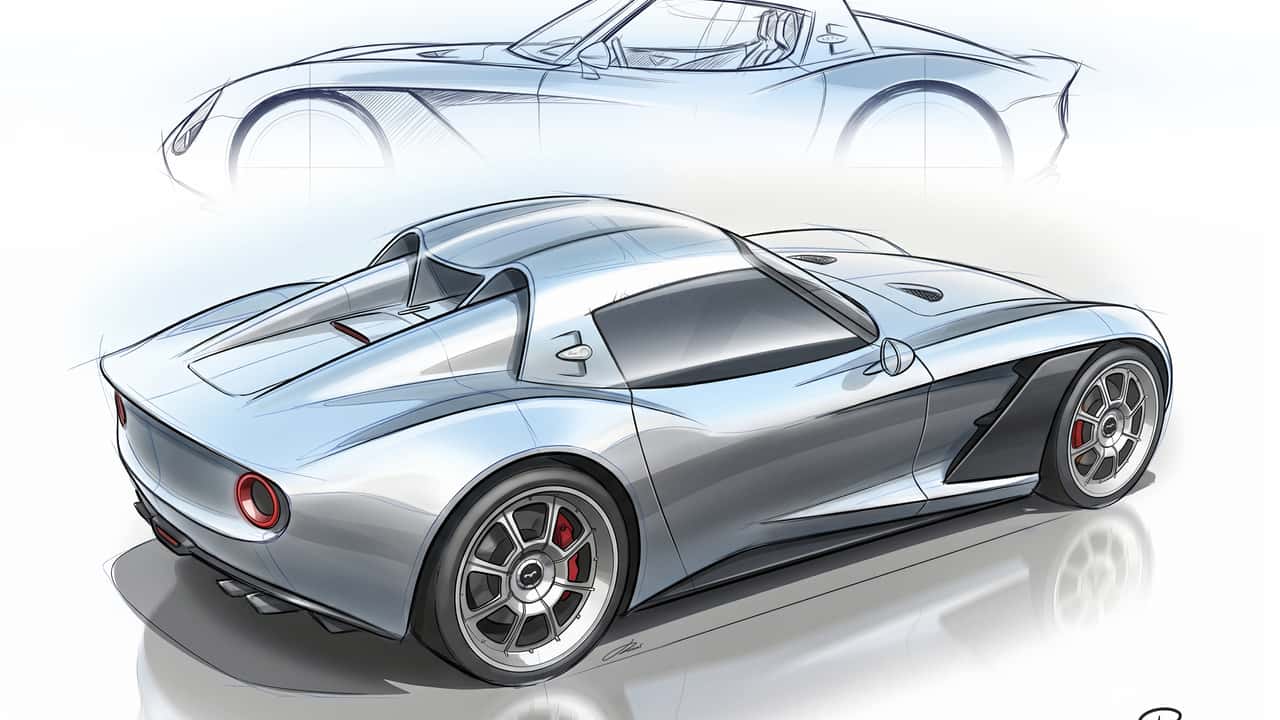
The young Piedmont-based coachbuilder used Goodwood to tease its upcoming Rina Coupe, a closed-roof companion to the existing Rina Barchetta. It’s due in 2027, which means we’re still a year out from seeing the real thing. But the formula is already locked in: a naturally aspirated 5.0-liter V8 making 493 horsepower, a six-speed manual transaxle, and a carbon-fiber monocoque.
No turbochargers. No paddle shifters. No apologies.
The sketches reveal a profile that draws heavily from the Italian grand tourers of the 1960s. There’s a double-bubble roof, a Kamm-style rear end, and twin round taillights. It’s a deliberate throwback, the kind of design language that either reads as reverent or derivative depending on your tolerance for nostalgia.
One early commenter compared it to a late-nineties Dodge Viper built from prototype Camaro parts, which is harsh but not entirely unfair.
Mignatta isn’t a household name. It’s a tiny operation, the kind of outfit where ambition outpaces infrastructure by a wide margin. But the company seems to understand something that larger manufacturers have abandoned in their sprint toward electrification: there’s a small, wealthy, intensely loyal market for cars that treat the driver as the point of the exercise.
Alongside the Coupe preview, Goodwood also hosted a refreshed Rina Barchetta. This version wears a new light-colored livery designed to showcase the car’s surfaces and honor the Piedmontese “battilastra,” the artisan metalworkers who once shaped Italian sports car bodies by hand. Forged-carbon details, new wheels, a redesigned shifter gate, and machined-from-solid interior components round out the updates.
A carbon-fiber driveshaft was on display at the stand, a detail that signals Mignatta is serious about weight reduction even if its production numbers will likely be measured in dozens.
The timing is interesting. Nearly every major European manufacturer is either deep into electrification or hedging with hybrids. Ferrari still sells naturally aspirated V12s but has also launched the electric 296 GTB and is building a full EV.
Lamborghini has gone plug-in hybrid across its entire range. Even Pagani’s next car will carry some form of electrification. Into this landscape walks Mignatta with a car that has no battery, no motor-generator unit, and a clutch pedal.
It’s a bet that analog purity still has commercial value. And at this end of the market, where buyers collect cars the way others collect watches, it probably does. The question isn’t whether people want a naturally aspirated V8 with a manual gearbox. They do.
The question is whether a startup nobody has heard of can actually build and deliver one at the quality level the price point demands.
Mignatta has not disclosed pricing, but a carbon-monocoque, hand-built Italian supercar with a bespoke drivetrain won’t be cheap. The company is competing less with Ferrari or Lamborghini than with the handful of boutique revivalists, firms like Singer and Kimera, that have proven there’s gold in the analog niche if you execute flawlessly.
Sketches at Goodwood are a long way from cars on driveways. But in a year when the festival’s hill climb featured more electrified machinery than ever, Mignatta’s little stand felt like a quiet act of defiance. Whether it becomes a real car or stays a beautiful promise depends entirely on what happens between now and 2027.

Share this Story