
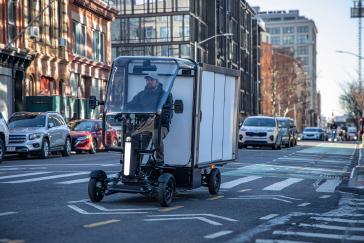


Honda isn’t bringing a new Civic or CR-V to steal headlines at the New York International Auto Show next week. It’s bringing a four-wheeled electric cargo bike designed to replace your UPS van.
The Fastport eQuad, a zero-emission micromobility vehicle engineered for bike-lane use, will get its own dedicated press event on April 1 at the show’s EV Hybrid Test Track. That’s prime real estate at an auto show traditionally reserved for six-figure SUVs and concept cars dripping with LED lighting. Honda is using it to showcase a delivery quadricycle with swappable batteries and a pedal-assist drivetrain.
This is not a side project. Honda established Fastport as a standalone business-to-business operation back in 2023, and the unit now has its own chief of operations, Jamie Davies, who will lead the walk-around and demo rides across two full days. The company is positioning Fastport as a Fleet-as-a-Service platform, meaning commercial customers don’t just buy the hardware — they subscribe to the entire logistics ecosystem.
The pitch is straightforward: replace traditional delivery vans one-for-one with eQuads that can thread through congested urban corridors without idling in traffic or circling for parking. Honda says the vehicle combines a pedal-by-wire assist system with regenerative braking, modular cargo configurations, and an enclosed rider cabin. Think of it as a cargo e-bike on steroids, with weather protection and enough engineering pedigree to carry the Honda name.
Swappable Honda Mobile Power Pack batteries are the key enabler. Rather than plugging in and waiting, fleet operators swap depleted packs for charged ones, keeping vehicles in motion. Honda has been quietly building out its Mobile Power Pack ecosystem for years, deploying it in everything from portable generators to small EVs in Asian markets. Fastport is the clearest signal yet that Honda sees those batteries as a platform, not a product.
The fine print is revealing. Honda’s own materials note that bike-lane use “is subject to local regulations,” which is a polite way of saying the regulatory landscape is a patchwork mess. New York City, the show’s host city and arguably the most important last-mile delivery market in the country, has been tightening rules around e-bikes and commercial cycling infrastructure at the same time. Whether a four-wheeled enclosed vehicle qualifies for bike-lane access in every target city remains an open question.
Still, the economics are hard to argue with. Urban delivery vans burn fuel sitting in gridlock, rack up parking tickets, and face increasing restrictions in low-emission zones that cities from New York to Los Angeles are either implementing or studying. A fleet of eQuads operating in bike lanes sidesteps most of those costs entirely.
Honda is not the first to chase this idea. European cities already have cargo bike fleets from companies like DHL and Amazon, and startups on both sides of the Atlantic have been building electric cargo quads for years. But none of them have a major automaker’s manufacturing scale, dealer network, or battery supply chain behind them.
That’s the real play here. Honda is embedding itself into urban commercial infrastructure at a level below the automobile, betting that the future of city logistics doesn’t look like a smaller van — it looks like a bigger bike. Whether fleet operators and city regulators agree will determine if this is visionary or premature.
Demo rides are available by emailing fastport@na.honda.com or signing up at the track. Bring your curiosity and your skepticism in equal measure.
Share this Story