
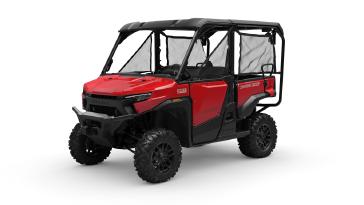


Ten years into the Pioneer 1000 platform, Honda just did something no one asked for on paper but everyone who’s worked a July afternoon in a UTV will understand immediately. It built a fully enclosed, climate-controlled side-by-side with factory HVAC.
The 2026 Pioneer 1000 Elite, announced out of Honda’s Alpharetta, Georgia headquarters, is the company’s first side-by-side to ship with a sealed cabin, heating, ventilation, and air conditioning straight from the factory. Not a dealer-installed aftermarket kit. Not a bolt-on accessory catalog special. A production machine with climate control engineered into the chassis from the ground up.
Honda says the Elite’s suspension and chassis were developed specifically to handle the weight and balance implications of the enclosed cabin. That’s a telling detail. It means this isn’t a Deluxe with doors and a compressor bolted on.
Pricing hasn’t been announced, and that alone tells you something. When a manufacturer leads with MSRP, they think they’re competitive. When they hold it back, they’re managing expectations.
The Deluxe trims start at $20,999 for the three-seat version and climb to $23,199 for the five-seat camo edition. Expect the Elite to land well north of $25,000, possibly pushing into territory that overlaps with base-model compact trucks.
The entire 2026 Pioneer 1000 lineup gets a serious mechanical overhaul beyond the Elite’s party trick. Throttle-by-wire replaces the old cable system across all trims, enabling cruise control, drive modes, and a variable speed limiter. Honda’s Dual Clutch Transmission carries over, but the electronic throttle sharpens its shifts.
Cockpit heat and noise have been reduced, a tacit admission that previous models cooked their occupants and droned on longer rides.
A new Pro-Connect cargo bed improves accessory compatibility. Interior storage has been expanded. The control layout has been reorganized for what Honda calls “more intuitive” operation. These are the kinds of incremental refinements that matter to people who spend eight hours a day in the seat.
Honda is leaning hard on the “made in America” angle. The Pioneer 1000 is planned in Georgia, developed in Ohio, and assembled in Timmonsville, South Carolina. In a political climate where domestic manufacturing carries real marketing weight, that supply chain story isn’t accidental.
The Deluxe models hit dealers in May. The Elite won’t arrive until late 2026, which means Honda is announcing a vehicle it can’t deliver for at least six months. That’s a calculated move to freeze buyers in place, to keep someone shopping a Polaris Ranger or Can-Am Defender from pulling the trigger before they’ve seen what Honda’s bringing.
The side-by-side market has been creeping toward this moment for years. Aftermarket cab enclosures and heater kits have been a booming business, proof that owners wanted protection from the elements long before any manufacturer was willing to engineer it in. Polaris has flirted with enclosed cabs, and Can-Am has pushed luxury features, but a full factory HVAC system from a major OEM is a line in the sand.
Honda has always been the conservative player in the UTV space, arriving late but arriving polished. The original Pioneer 1000 launched a decade ago as a reliable, capable, slightly boring alternative to flashier competitors. It found its audience precisely because it was a Honda — overbuilt, undermarketed, and stubbornly dependable.
The 2026 lineup suggests Honda is done being the quiet option. An enclosed cabin with air conditioning transforms the Pioneer 1000 from a seasonal tool into a year-round vehicle. It blurs the line between side-by-side and low-speed truck in ways that should make every OEM in the segment pay attention.
Whether buyers will pay the premium remains the only real question. Honda apparently isn’t ready to answer it yet.
Share this Story