
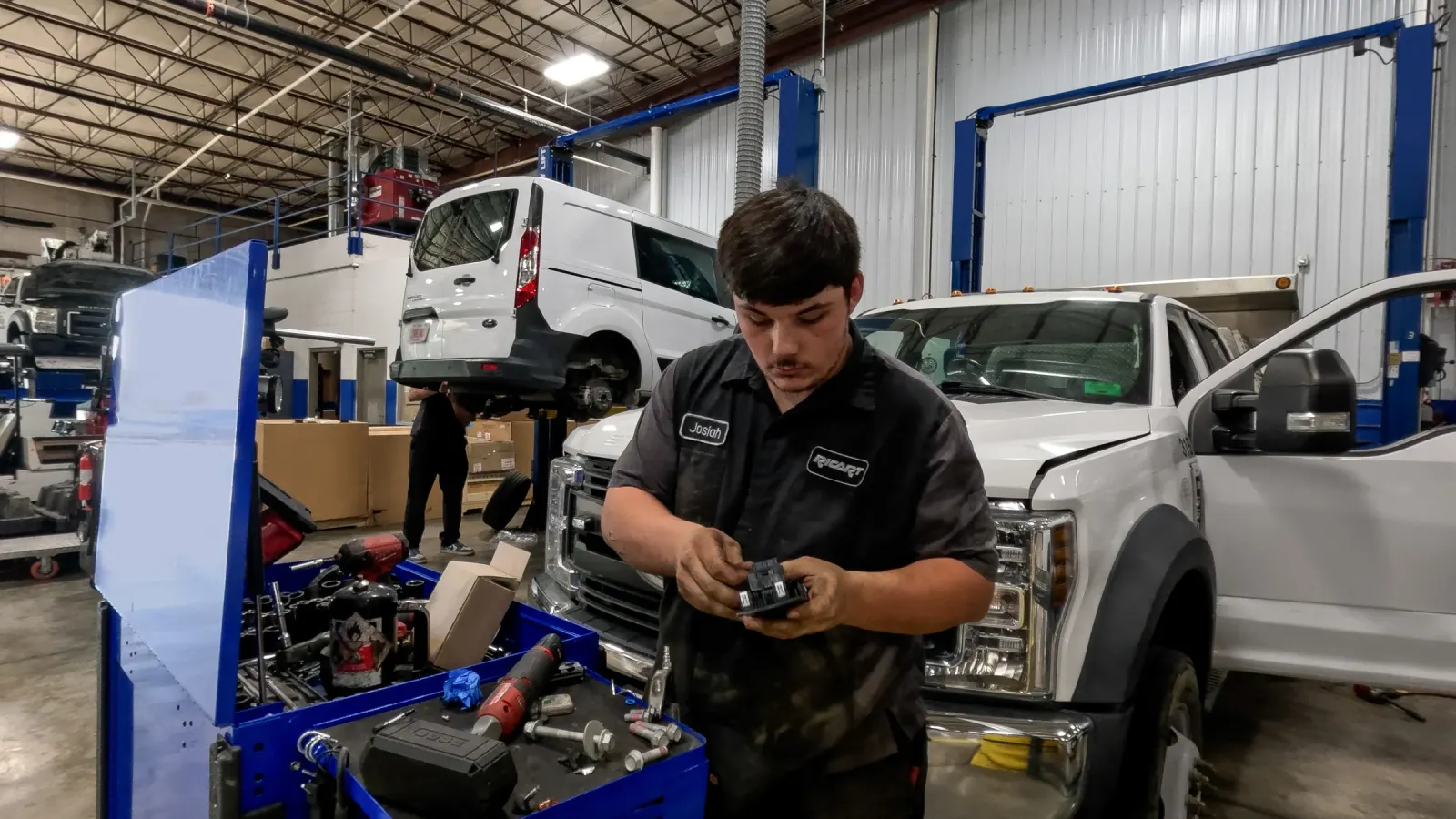


Ford Motor Co. has 5,000 dealership service bays sitting idle — equipped with lifts, tools, and nobody to operate them. CEO Jim Farley admitted as much back in January, even noting that the jobs pay up to $120,000 a year. Now the automaker is writing checks to fix a problem money alone hasn’t solved.
Ford and Bloomberg Philanthropies announced a $5 million joint investment to train Detroit public school students for automotive technician careers. The goal is modest but specific: 300 new technicians over three years, trained through modernized classrooms, credentialed before they graduate, and funneled directly into a dealership workforce that’s losing talent faster than it can replace it.
The U.S. auto industry needs more than 350,000 new technicians by 2029, according to Ford’s own estimates. Michigan alone needs 7,000. The Bureau of Labor Statistics projects 70,000 annual openings for auto techs through 2034, driven mostly by retirements and workers fleeing to other industries.
Those numbers reveal the uncomfortable math. The median pay for an auto service technician was $49,670 in 2024 — that’s $23.88 an hour. Ford can wave around its $120,000 figure for top earners, but the national reality is far less glamorous, and young workers know it.
The technician shortage isn’t just about training pipelines. It’s about an industry that spent decades treating its service workforce as an afterthought while pouring billions into engineering, design, and executive compensation.
Now vehicles are rolling off the line packed with sensors, software stacks, and high-voltage battery systems that require diagnostic skills closer to IT work than wrench-turning. The job has gotten harder. The average pay hasn’t kept up with that complexity.
Ford’s program with Detroit Public Schools Community District is designed to tackle multiple barriers at once. Ford’s Customer Service Division will set technical training standards. Ford Philanthropy will cover tool costs and transportation — two quietly significant obstacles for students from lower-income households who might otherwise never make it into a shop.
This isn’t Ford’s first move. Since 2023, Ford Philanthropy and Ford dealers have invested over $11 million in Auto Tech Scholarships supporting 2,200 students nationally. The company says it’s committing $300 million in 2025 to skilled trades workforce development across technician training, manufacturing apprenticeships, and related corporate programs.
That $300 million figure sounds massive until you consider the scale of the problem. Every unfilled service bay is lost revenue — not just for Ford, but for the dealer network that generates a significant chunk of the automaker’s downstream income. Service and parts have always been the quiet profit center of the franchise model. When bays go dark, margins follow.
Ford Philanthropy President Mary Culler and Customer Service Division VP Daniel Justo framed the Detroit initiative as a potential blueprint for other communities. They’re right that it could be. But blueprints don’t build houses.
The deeper question is whether the industry can make this career genuinely attractive to a generation that has more options than ever. A high school credential program in Detroit won’t close a 350,000-technician gap. It’s a deliberate, well-funded start, but only if the dealership ecosystem on the other end of the pipeline is ready to retain these workers with pay, respect, and advancement that matches the skills now required.
Ford is investing in its own survival infrastructure. The vehicles keep getting smarter. Somebody has to fix them.






Share this Story