
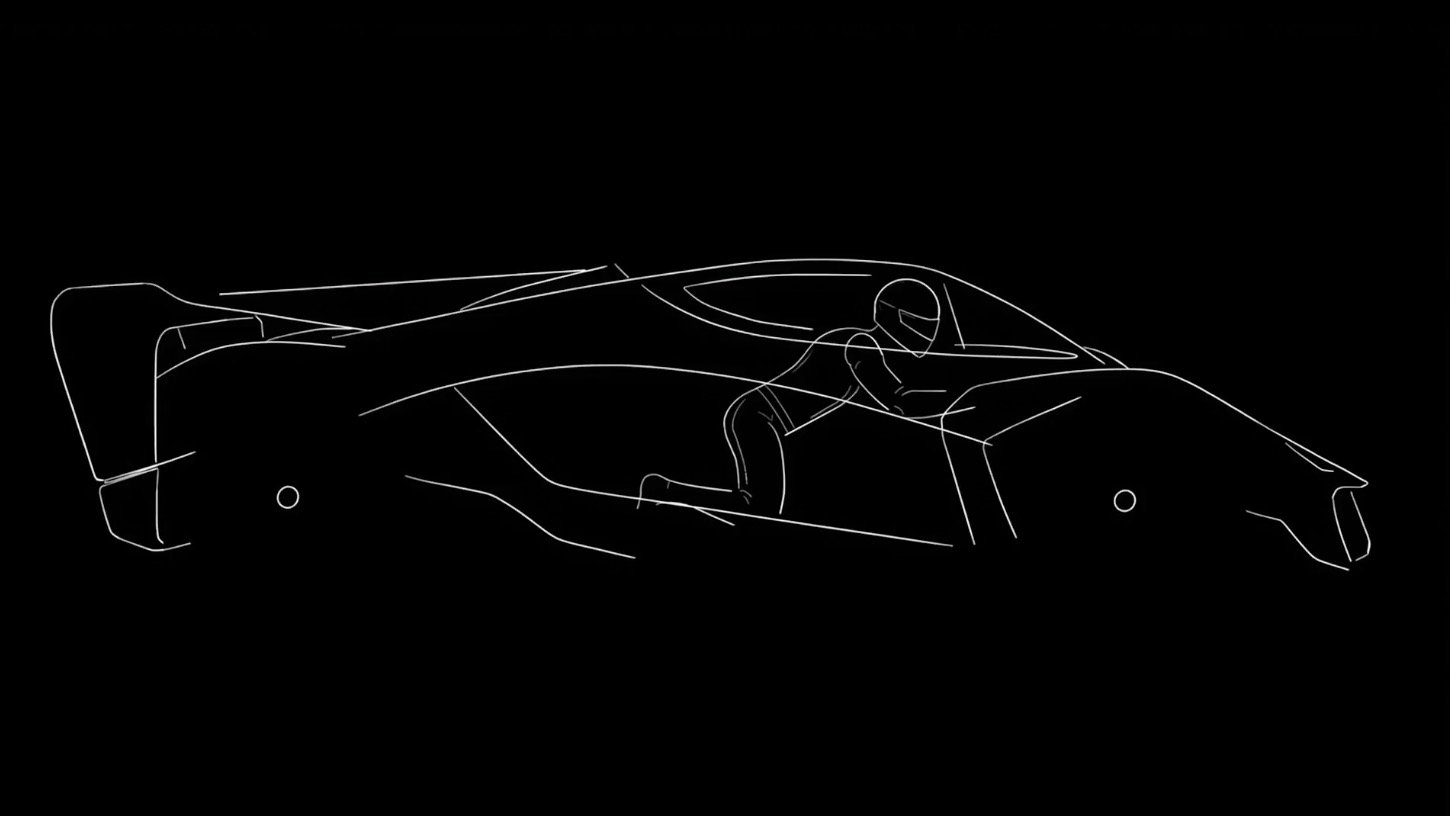


A company nobody has heard of wants to reinvent how you sit in a supercar. Netherlands-based Sanrivatti is pitching what it calls the “Apex Position,” a motorcycle-style straddle seating arrangement that it claims will fuse driver and machine in ways no conventional supercar can match.
It’s a bold premise. It’s also, at the moment, almost entirely theoretical.
Sanrivatti founder Santiago Sánchez Rivero told Top Gear that the inspiration comes from two-wheeled dynamics. “On a high-performance motorcycle, rider and machine move as one,” he said. By contrast, even the world’s most capable performance cars frequently separate driver and machine through layers of architecture, packaging, systems technologies, and convention.
The company promises “immersive ergonomics” and “controls designed around natural human movement.” It claims staff with résumés from McLaren, Lotus, Bentley, and Singer. What it hasn’t disclosed is anything about the car’s powertrain, construction, platform, or even a firm reveal date. No specs. No timeline. No prototype photos beyond renders.
That’s a lot of philosophy and not much hardware.
The idea of borrowing motorcycle sensations for a four-wheeled vehicle isn’t new. The Dutch-built Carver, founded in 1994, used a tilting mechanism on a tandem-seat three-wheeler to replicate the lean of cornering on a bike. It went bankrupt in 2024. Mercedes-Benz explored active camber adjustment with its F400 Carving concept back in 2001. Neither became a production reality that lasted.
Meanwhile, companies like Ariel and BAC have spent years proving you can strip a car down to its essentials and deliver a raw, unfiltered experience without reinventing human posture. The Atom and Mono are about as connected as four wheels get, and they exist — in showrooms, on tracks, with known quantities under their bodywork.
Then there’s the obvious counterpoint: motorcycles already exist. So do three-wheelers like the Polaris Slingshot and Morgan Super 3, which offer open-air, wind-in-your-face driving without asking buyers to bet on an unproven startup’s vision of ergonomic revolution.
Sanrivatti’s real play seems to be differentiation at any cost. In a supercar market saturated with mid-engine exotics, electric hypercars, and restomods, the company is banking on novelty as its entry ticket. A straddle-seat supercar would certainly be unlike anything from Ferrari, Lamborghini, or Porsche. It would make the center-seat McLaren F1 look like a Camry by comparison.
But novelty alone has never been enough in this segment. Buyers spending supercar money want engineering credibility, proven performance, and a brand story they can believe in. Sanrivatti has none of those yet. What it has is a concept, some impressive-sounding hires, and a vocabulary heavy on buzzwords like “heightened awareness” and “enhanced connection.”
The automotive landscape is littered with startups that launched with gorgeous renders, compelling narratives, and zero production cars. Some eventually delivered. Most didn’t. Sanrivatti’s straddle concept is genuinely unusual, and unusual gets attention. But attention without a drivable prototype is just marketing.
Until there’s a real car with real specs and a real price, Sanrivatti remains exactly what it appears to be: an interesting idea looking for an engine, a chassis, and a reason to exist beyond being different.

Share this Story