
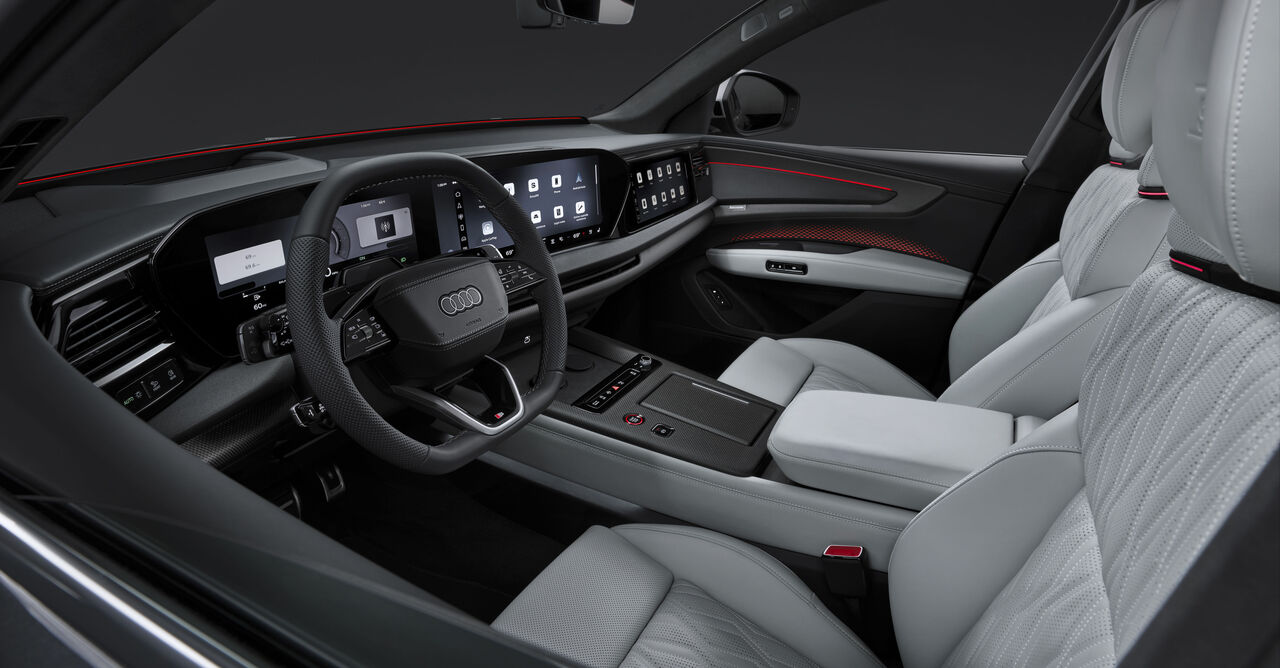


Audi just told you everything you need to know about its biggest SUV without mentioning a single horsepower figure, torque number, or zero-to-sixty time. The Q9’s first official reveal focuses entirely on what happens after you sit down. That silence on performance speaks volumes about where the premium SUV arms race has shifted.
The Q9 is Audi’s first large full-size SUV, slotting above the Q8 and aimed squarely at the BMW X7, Mercedes-Benz GLS, and the ever-present Cadillac Escalade. CEO Gernot Döllner framed it bluntly: “With the Q9, ‘Vorsprung durch Technik’ is increasingly defined by the in-car experience.” Translation — tech leadership now means rear-seat luxury, not lap times.
The headline feature is electric doors on all four corners, a first for Audi. They open via key fob, the myAudi app, the MMI screen, brake pedal, or seatbelt buckle. Surround sensors detect obstacles — parked cars, approaching cyclists — and halt the door mid-swing. It’s a parlor trick until the first time it saves your paint in a parking garage. Then it’s indispensable.
Seating comes in six- or seven-seat configurations. The six-seat layout gives the second row two electrically adjustable individual chairs with active ventilation in both cushion and backrest — business-class language Audi is wielding deliberately. The seven-seater fits three child seats across the middle row, a practical nod to the families who actually write the checks for vehicles like this. Third-row seats fold electrically, because in 2026, reaching back to yank a seatback release lever apparently crosses the indignity threshold.
The panoramic sunroof spans roughly 1.5 square meters and ditches the traditional roller blind entirely. Nine individually controllable glass segments switch from transparent to opaque electronically, blocking more than 99.5 percent of UV radiation. Park the car, and the roof goes opaque automatically. Start it again, and your last setting returns.
On the top trim, 84 LEDs embedded in the roof cycle through 30 colors synced to the ambient lighting. Subtle it is not.
Bang and Olufsen supplies the audio, upgraded from 3D to what Audi calls 4D sound. Headrest speakers isolate phone calls and navigation prompts to individual occupants. Seat-mounted actuators let you physically feel the bass — a trick lifted from high-end home theater, now standard luxury-SUV fare.
An LED interaction light strip spanning the dashboard width pulses with the music’s rhythm and pulls color from album artwork. It’s either brilliant or deeply annoying, depending on your tolerance for synesthesia on the autobahn.
Materials lean hard into texture over gloss. Alpaca wool, Dinamica microfiber, Nappa leather, fine grain ash, and carbon fiber weave with basalt gray accents fill out the options list. Audi specifically noted a shift away from glossy surfaces toward matte finishes — a quiet admission that piano black trim was a fingerprint catastrophe the industry should have abandoned years ago.
Cargo duty gets a new aluminum rail system in the trunk with sliding hooks and adjustable three-dimensional anchors. Two Qi2.2 wireless charging pads and 100-watt USB-C ports handle device power. Every Q9 ships with a roof rack for the standard rails — a small inclusion that signals Audi expects these trucks to actually be used, not just parked at valet stands.
The full reveal comes this summer. Powertrain details, pricing, and platform specifics remain under wraps. But the deliberate choice to lead with interior comfort over mechanical specifications tells you exactly where Audi thinks this fight will be won.
The Q9 isn’t selling you a driving machine. It’s selling you a place to be while the driving happens — and in this segment, that might be the smarter bet.


Share this Story