
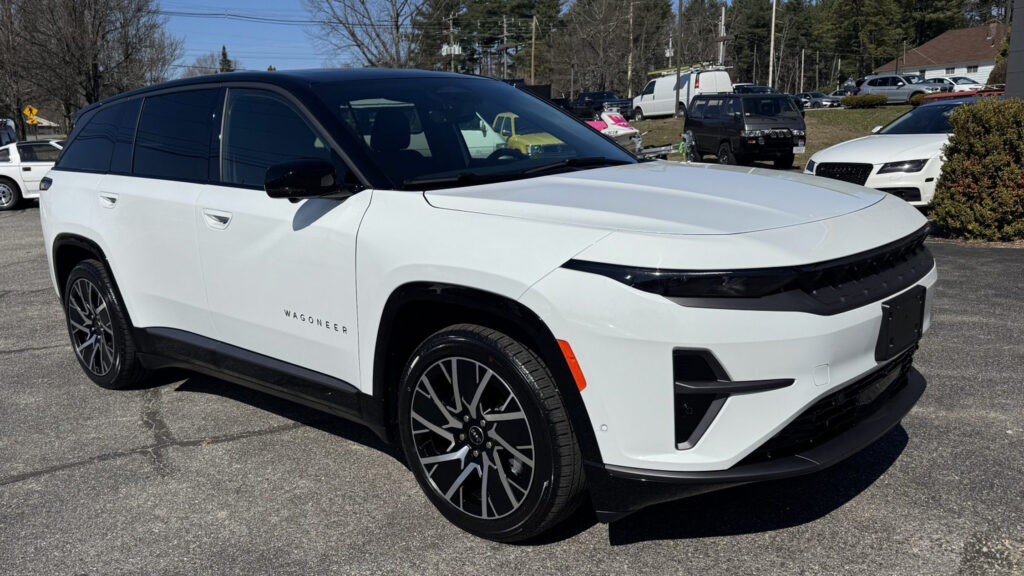


A 2025 Jeep Wagoneer S Limited 4XE with 91 miles on its odometer just sold at auction on Bring a Trailer for $38,500. The original sticker was likely near $70,000. That’s roughly half the car’s value vaporized before the first oil change — except there is no oil to change.
This is a vehicle with 500 horsepower, 524 lb-ft of torque, a 100-kWh battery, dual motors, and all-wheel drive. It had the Dark Appearance package, illuminated signature grille, panoramic sunroof, heated Neo Ultra seats, and a full suite of driver-assistance tech. By any spec-sheet measure, it’s a serious machine. The market disagrees.
Walk into a Jeep dealership right now and you’ll pay north of $65,000 for a zero-mile Wagoneer S Limited. Someone just got the same truck — delivery miles, every option box checked — for the price of a nicely equipped Compass. The original buyer absorbed a loss that borders on catastrophic.
This isn’t an isolated data point. It’s a symptom. Stellantis has been bleeding brand equity across its North American portfolio for years, and the Wagoneer S sits at the intersection of two compounding problems: a parent company struggling with inventory bloat and consumer trust, and an EV market that punishes anything without a Tesla badge or a Hyundai price tag.
The Wagoneer S launched into a segment already crowded with the Cadillac Lyriq, BMW iX, and Tesla Model X — all of which carry stronger residual values or more established EV credibility. Jeep’s electric pivot was supposed to signal a bold new direction. Instead, it’s produced a vehicle that depreciates like a rental-fleet Chrysler 200.
Stellantis knows the math isn’t working. Ram trucks and the Chrysler Pacifica remain the company’s North American lifelines. Jeep still moves Wranglers and Grand Cherokees in respectable numbers, but the electric offerings haven’t found traction with buyers willing to pay full freight.
High inventory levels, aging lineups across Dodge and Chrysler, and a revolving door of leadership decisions have left dealers holding product that customers either don’t want or won’t pay sticker for.
For the auction buyer, $38,500 for a 500-horsepower electric Jeep SUV is a screaming deal. The technology works. The range is competitive. The interior is genuinely well-appointed. None of that mattered when the gavel fell.
Depreciation this steep on a nearly new vehicle sends a clear message to every future buyer considering a Wagoneer S at MSRP: don’t. Why would anyone pay $65,000 or more at a dealership when the secondary market is flooded with barely-touched examples at 45 cents on the dollar? It creates a vicious cycle — cratering resale values discourage new purchases, which craters resale values further.
Jeep built a genuinely competitive EV. Dual motors, real off-road DNA in the software, a battery big enough to matter. But competence doesn’t sell cars. Confidence does. And right now, buyers don’t have confidence that a Wagoneer S will hold its value past the first traffic light.
The person who bought this truck for $38,500 got a remarkable machine for Kia money. The person who sold it learned what happens when a storied nameplate launches an electric vehicle into a market that hasn’t decided to trust it yet. Stellantis can build the hardware. Convincing buyers to pay for it is an entirely different engineering problem — and one they haven’t solved.

Share this Story