
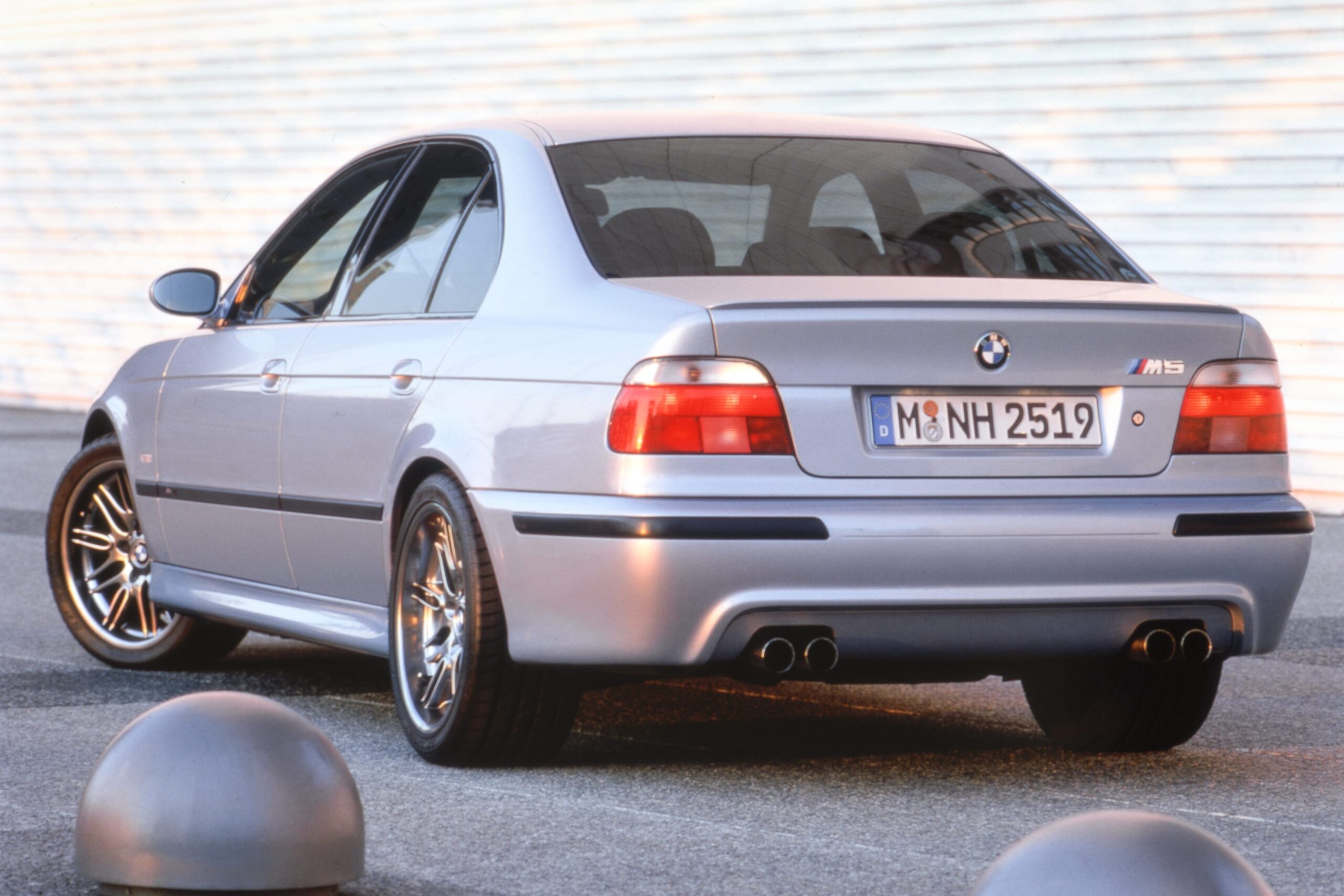


Car and Driver just resurfaced its February 1999 first drive of the 2000 BMW M5, written by the late Tony Swan, and reading it a quarter-century later feels like opening a time capsule from a civilization that no longer exists. A civilization where 394 horsepower in a sedan was considered outrageous, where a six-speed manual was the only gearbox offered, and where $75,000 bought you the most potent four-door on Earth.
Swan, who died in 2018, opened with a reference to Edward G. Robinson in Key Largo. The gangster wanted one thing: more. BMW’s M division, Swan argued, delivered exactly that — two more cylinders than the outgoing straight-six M5, eighty-four more horsepower, a 5.0-liter V-8 with individual throttle butterflies, a semi-dry sump, and double-VANOS variable valve timing on all four cams.
The numbers told the story. BMW claimed 0-to-62 in 5.3 seconds. Swan figured it would dip below five, putting it in Corvette territory — hence the nickname.
Today, a base-model Tesla Model 3 Performance does it in 2.9 seconds, and nobody blinks. The goalposts haven’t just moved; they’ve been relocated to a different stadium. But straight-line speed was never really the point of Swan’s review, and it isn’t the point of revisiting it now.
What jumps off the page is the engineering philosophy. BMW’s M division built a specific block casting for the M5’s V-8 — wider bore, longer stroke, different from the 540i’s 4.4-liter unit in every meaningful dimension. They fitted three oil pumps to keep the bearings lubricated under hard cornering and predicted 1.20 g of lateral grip from a 3,800-pound sedan, a number Swan noted no factory four-door had achieved in Car and Driver testing up to that point.
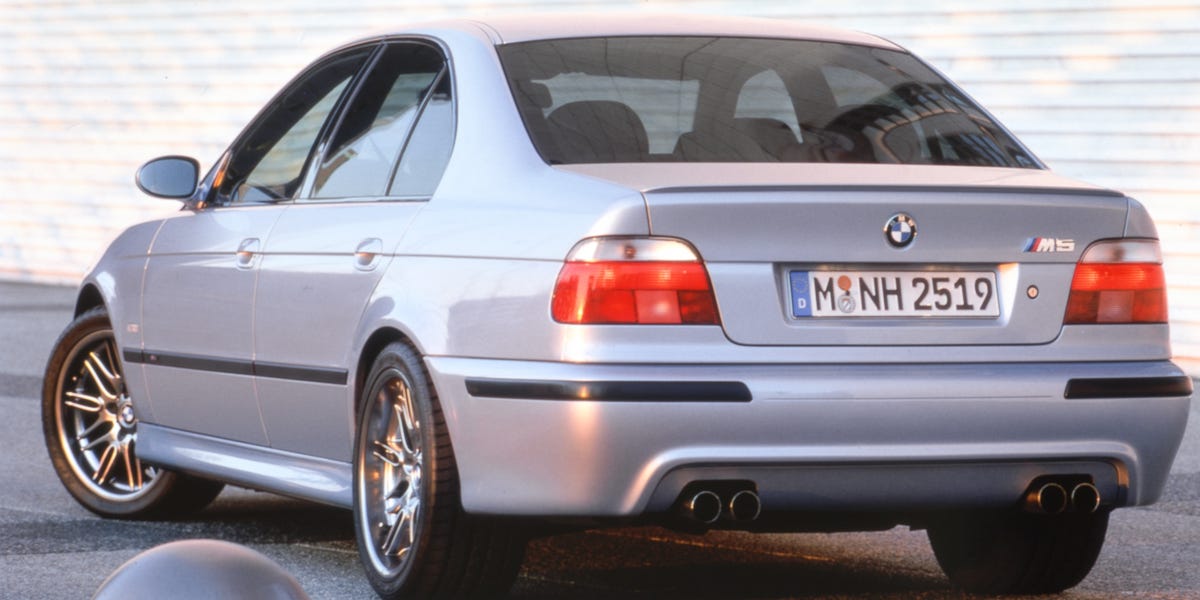
The restraint was the other revelation. The exterior wore a deeper front air dam, subtle fender flares, four exhaust tips, and a whisper of a rear spoiler. No massive grilles swallowing the front end, no angry creases screaming for attention.
Swan called it “The Ultimate Executive Express,” and meant it as high praise. The M5 looked like a well-tailored suit, not a costume.
Compare that discipline to what BMW sells today. The current M5, the G90, is a plug-in hybrid weighing north of 5,300 pounds, packing 717 horsepower through an eight-speed automatic and all-wheel drive. It is ferociously fast in a straight line but roughly 1,500 pounds heavier than the car Swan drove through Bavaria in the rain, and it costs north of $120,000 before you start ticking option boxes.
Nobody is arguing the new car isn’t quick or technologically impressive. But Swan’s review captures a moment when M cars were built on a simpler contract with the driver: a naturally aspirated engine, a manual gearbox, rear-wheel drive, and just enough electronic intervention to keep things civilized. The “Sport” button on the E39’s dashboard, which sharpened throttle response and steering effort, struck Swan as almost ironic — sport mode in a car wearing an M badge?
That irony has compounded with interest. Today’s M5 has so many drive modes, suspension settings, and hybrid calibrations that the infotainment system practically needs its own user manual.
Swan wrote that the E39 M5’s acceleration had “an electric-motor feel — no peaks, no valleys, just a sense of endless upsurge.” He meant it as a compliment about the V-8’s power delivery. He couldn’t have known he was also describing the literal powertrain architecture BMW would eventually adopt for the M5’s future.
The 2000 M5 was the last of a particular breed — rear-drive, naturally aspirated, manual-only, under 4,000 pounds. Every M5 since has been faster in measurable ways and further from that original contract in ways no stopwatch can capture. Swan’s prose still hits because it documents the exact moment before the escalation began.
More, as Johnny Rocco insisted, was coming. Whether it was all better is a question BMW is still answering.
Share this Story