
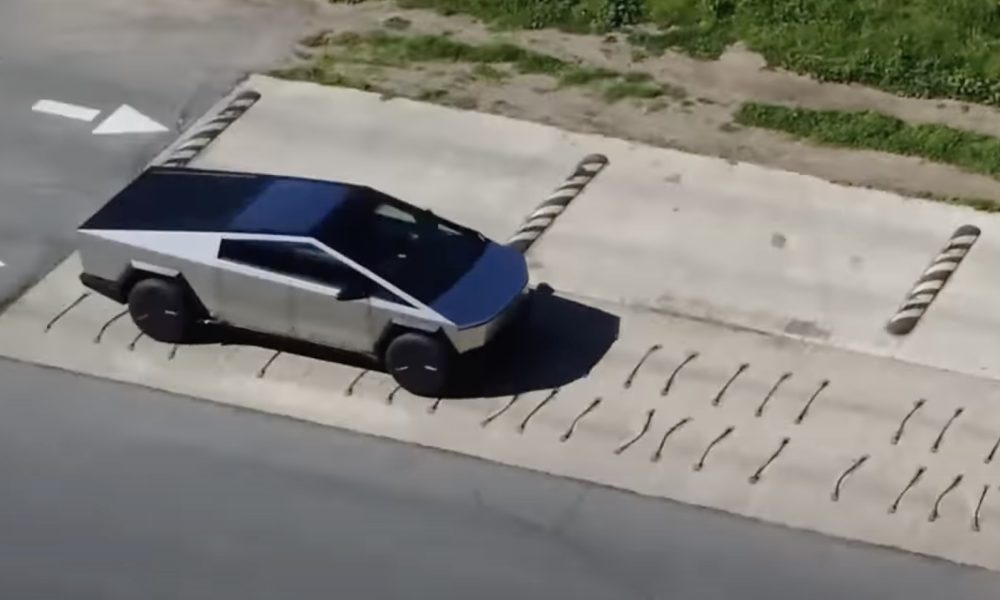


Patent US12654505B2 doesn’t sound like much until you read what it actually describes: a hybrid suspension system that can yank a wheel upward before it plunges into a pothole. Tesla’s latest published filing, credited to engineers Brian Lee Doorlag, Avraham Kagan, and Justin Sill, outlines a suspension actuator that blends active motor-driven control with passive springs and adaptive dampers in a way no production vehicle currently does.
The core idea is an electric motor driving a belt-and-ball-nut assembly that adjusts strut length in real time. Sensors, including accelerometers and wheel position monitors, feed data to a control unit that commands the motor instantly. It extends or retracts the suspension to counter whatever the road throws at it.
But the clever part isn’t the motor. It’s how Tesla keeps the motor from killing the battery.
A low-rate air spring runs in parallel with the actuator, shouldering most of the vehicle’s static weight. Without it, the electric motor would burn energy constantly just fighting gravity. The air spring handles the boring, steady-state load so the motor can focus on dynamic adjustments like sudden dips, mid-corner weight transfers, and frost-heaved pavement.
Then there’s a second layer: a passive spring and adaptive damper mounted in series between the actuator and the wheel. These filter out high-frequency vibrations before they ever reach the active motor, preventing it from chasing every pebble and tar strip. The adaptive damper, likely magnetorheological or electronically valve-controlled, fine-tunes itself for comfort or stability as conditions change.
Traditional passive suspensions force engineers to pick a compromise between ride comfort and handling precision. Fully active systems solve that trade-off but devour power and add complexity. Tesla’s patent splits the difference by assigning each component a specific job: the air spring manages weight, the passive elements absorb rapid-fire inputs, and the active actuator handles the big, low-frequency events that actually make passengers uncomfortable.
The pothole defense mechanism is the most eye-catching application. When sensors or predictive mapping detect a pothole ahead, the control system retracts the strut, pulling the wheel upward to minimize the downward plunge. The series spring and damper cushion what remains of the impact while the air spring keeps the body stable.
The result, at least on paper, is a vehicle that steps over road craters rather than crashing through them. Tesla has been building fleet-sourced road roughness maps for years. Integrated with this suspension, those maps could trigger preemptive adjustments before the wheel ever reaches the damaged pavement, meaning your car learns from every Tesla that hit that pothole before you.
The technology builds on adaptive dampers and air suspension already fitted to the Cybertruck, but pushes much further toward fully active control. Future applications could include refreshed Cybertrucks or next-generation models where both on-road refinement and off-road capability matter.
Patents, of course, are not products. Automakers file thousands of patents that never see daylight. But this one aligns tightly with Tesla’s existing hardware trajectory and its obsession with using software and sensor data to extract performance gains that traditional automakers chase with heavier, more expensive mechanical solutions.
The real tension is between ambition and execution. Bose spent decades developing electromagnetic suspension that worked brilliantly in demos but never reached production due to cost, weight, and complexity. Audi, Mercedes, and several others have fielded active and semi-active systems with mixed commercial results.
Making a hybrid suspension that is simultaneously effective, affordable, reliable, and light enough for an EV where every pound cuts range remains the unsolved puzzle. Tesla’s patent suggests a thoughtful engineering approach to that puzzle. Whether it reaches production wheels is another question entirely.
But the architecture, offloading static loads to pneumatics, filtering noise passively, and reserving active intervention for the inputs that actually matter, is the kind of systems thinking that separates good suspensions from great ones.
Share this Story