
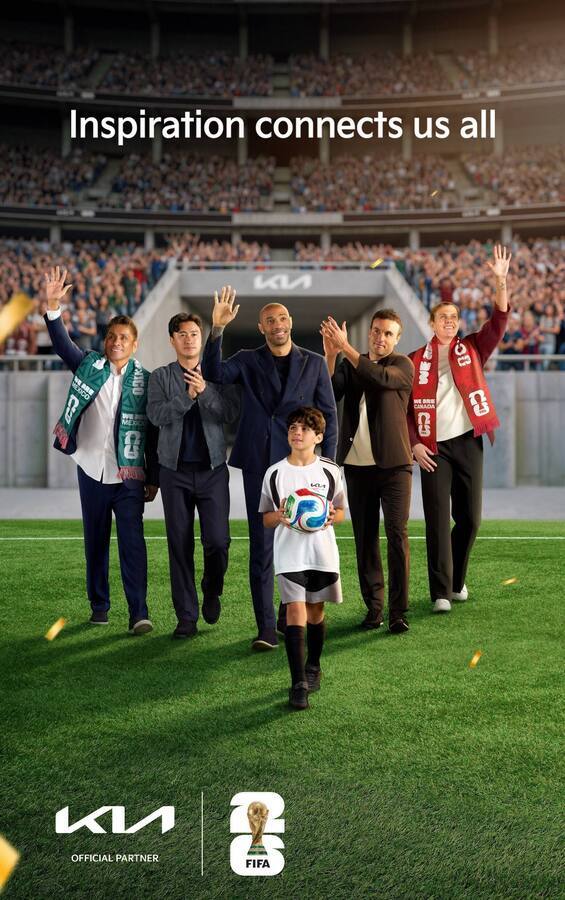


The FIFA World Cup 2026 kicked off today across three nations, and Kia showed up with a fleet, a film, and a plan to make sure you can’t experience this tournament without touching its brand.
The Korean automaker is deploying 660 vehicles across the United States, Canada, and Mexico — not as background logistics, but as rolling billboards dressed in tournament themes. Shuttle services in Los Angeles and Vancouver will ferry fans between venues in Tellurides, Carnivals, and EV9s, turning a ride to the stadium into what Kia calls “an immersive brand touchpoint.” That phrase alone tells you everything about where automaker sponsorships have gone.
Kia dropped its Hero Film to coincide with the tournament’s opening, a cinematic piece built around a young player walking onto football’s biggest stage through the brand’s Official Match Ball Carrier program. The OMBC initiative has been placing kids on the pitch at FIFA events for years, and the film leans hard into that emotional territory — anticipation, nerves, the whole arc of a dream realized. It’s slick, it’s calculated, and it extends a campaign Kia has been building since December 2025 under the tagline “Inspiration Connects Us All.”
But the real play here isn’t a two-minute video. It’s the physical footprint.
At stadiums and FIFA Fan Fest locations, Kia is rolling out photo experiences, interactive LED walls, and country-themed vehicle displays. The exhibition booths use a triangular architectural design meant to symbolize the three host nations — a detail that sounds like a design brief that got approved in a boardroom at 11 p.m. but will probably photograph well on social media.
Fifty vehicles will run the L.A. shuttle circuit. Twenty more in Vancouver. The fleet mix tells its own story: Telluride and Carnival for the American market, EV9 and EV5 leading the charge in Canada, where electrification messaging plays differently.
Kia isn’t just moving people. It’s staging product demos disguised as public transit.
This is what a FIFA Official Mobility Partner contract looks like in 2026. Kia has held the relationship since 2007 and locked it in through 2030. The deal covers transportation, autonomous driving tech, and what the company vaguely describes as “future mobility services” at all FIFA global events.
Nearly two decades in, the partnership has evolved from logo placement on pitch boards to a full-spectrum marketing operation. Minsoo Kim, Kia’s executive vice president heading global brand and customer experience, framed it in predictably grand terms: “We are bringing our brand vision to life — while pushing beyond mobility to create deeper, more powerful connections that resonate worldwide.”
Strip away the corporate language and the strategy is transparent. Three billion people will watch this World Cup. Kia wants every possible touchpoint — the ride to the game, the experience outside the stadium, the content on your phone — stamped with its name.
The broader fleet supporting tournament operations includes Sportage, Sorento, K4, K4 Hatchback, Niro, and Sonet models spread across all three countries. That’s a deliberate showcase of Kia’s full lineup depth, from subcompact crossovers to three-row family haulers to flagship EVs.
For an automaker selling roughly three million vehicles a year across 190 markets, the World Cup isn’t a sponsorship. It’s a product launch event that someone else organized and four billion eyeballs already plan to attend.
Kia didn’t invent the playbook of turning sports sponsorships into experiential retail. But deploying 660 vehicles across three countries while wrapping the fan journey in branded shuttle rides and photo booths suggests the company has stopped reading the playbook and started writing the next chapter.

Share this Story