
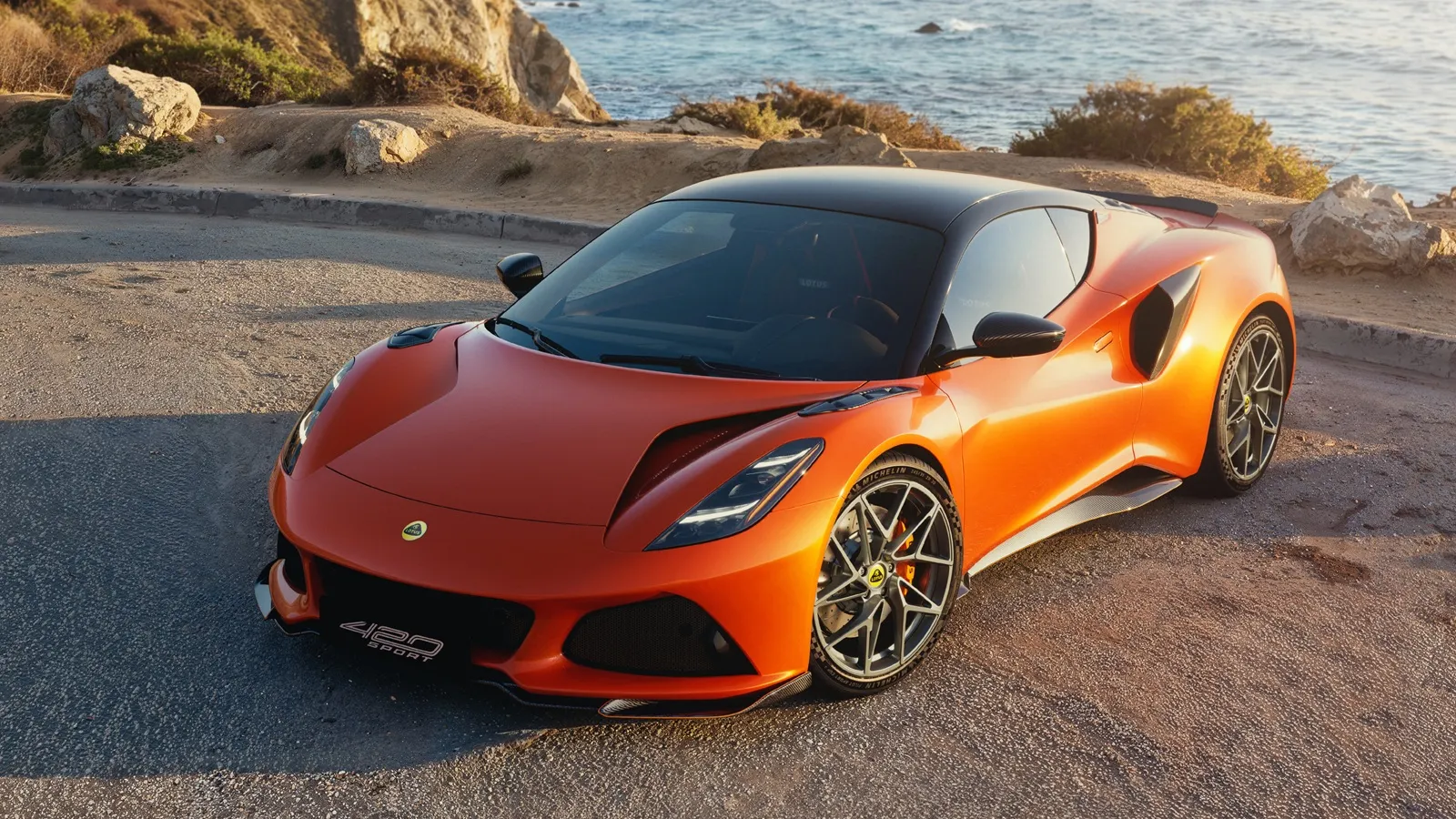


Two weeks after Lotus publicly abandoned its EV-only strategy and teased a 1,000-plus horsepower hybrid, the British sports car maker is doubling down on internal combustion with a car that makes no apologies for burning gasoline.
The Emira 420 Sport squeezes 414 hp and 368 lb-ft of torque from a Mercedes-AMG-derived 2.0-liter turbocharged four-cylinder. That makes it the most powerful four-cylinder car Lotus has ever built. It claims 0-62 mph in 3.9 seconds and a top speed of 186 mph, numbers that would have been absurd from a naturally aspirated four-pot a decade ago.
The bump over the existing AMG-powered Emira First Edition is modest on paper, just 14 hp and 14 lb-ft, but Lotus didn’t stop at the engine calibration. The 420 Sport sheds 55 lbs over the standard car and gains an equivalent measure of aerodynamic downforce, all without increasing drag. For a company that built its entire identity on the Colin Chapman mantra of “simplify, then add lightness,” this is the kind of math Lotus fans actually care about.
Cooling improvements target sustained track performance, the chronic weak spot of turbocharged mid-engine cars pushed hard on hot days. Lotus hasn’t published lap times yet, but the combination of reduced mass, improved aero, and a chassis already praised by nearly every outlet that’s driven an Emira suggests this car will be genuinely quick where it counts. Not just in a straight line sprint to impress social media.
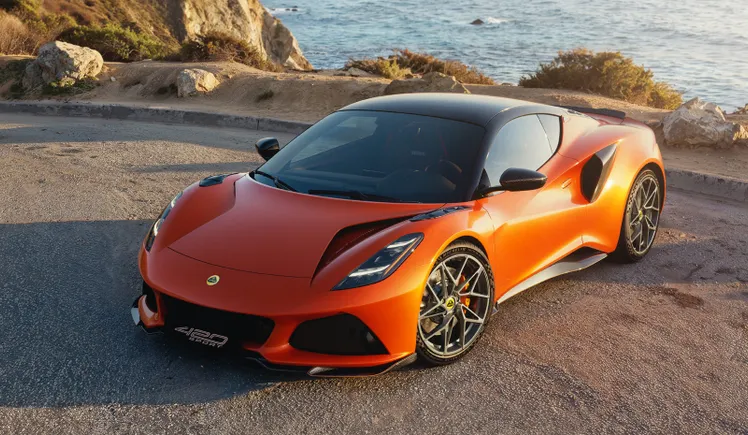
Inside, 12-way adjustable seats and carbon fiber shift paddles replace the standard items. The cabin tilts toward the driver, a layout philosophy Lotus has refined over decades. It’s not drowning in screens or ambient lighting theater. It’s a cockpit.
Pricing starts at $122,900 in the U.S., £105,900 in the U.K., and €129,900 in the EU. Customer deliveries begin in August. Those numbers position the 420 Sport squarely against the Porsche 718 Cayman GT4 RS, a car with two more cylinders and a naturally aspirated flat-six, but also a considerably higher price tag depending on the option sheet.
The timing here is impossible to ignore. Lotus CEO Qingfeng Feng just told the world the company is walking back its electric-only commitment under the Focus 2030 plan. Now, less than a month later, the halo car in the Emira range is a gasoline-burning, track-focused machine with an AMG heart. For a brand that Geely acquired specifically to electrify, this pivot says more about market reality than any corporate strategy deck ever could.
Lotus also announced a removable tinted glass roof panel now available across the entire Emira range. It’s a small but telling addition that signals the company sees a long commercial life ahead for this platform, not a placeholder waiting to be replaced by a battery.
The Emira was always the transitional car, the one Lotus said would be its last combustion model. That language has quietly disappeared. In its place is a 414-hp four-cylinder track weapon priced to compete and built to last in a lineup that now includes the promise of a hybrid hypercar.
Lotus isn’t transitioning away from the internal combustion engine anymore. It’s investing in it.
Share this Story