


A turbocharged V-6, built entirely by General Motors, has already turned over on a dyno in Charlotte, North Carolina. GM president Mark Reuss confirmed the milestone at the Miami Grand Prix, calling it “the first Formula 1 American engine running on our soil.” It is a genuinely significant moment, and one immediately complicated by the sport’s own shifting politics.
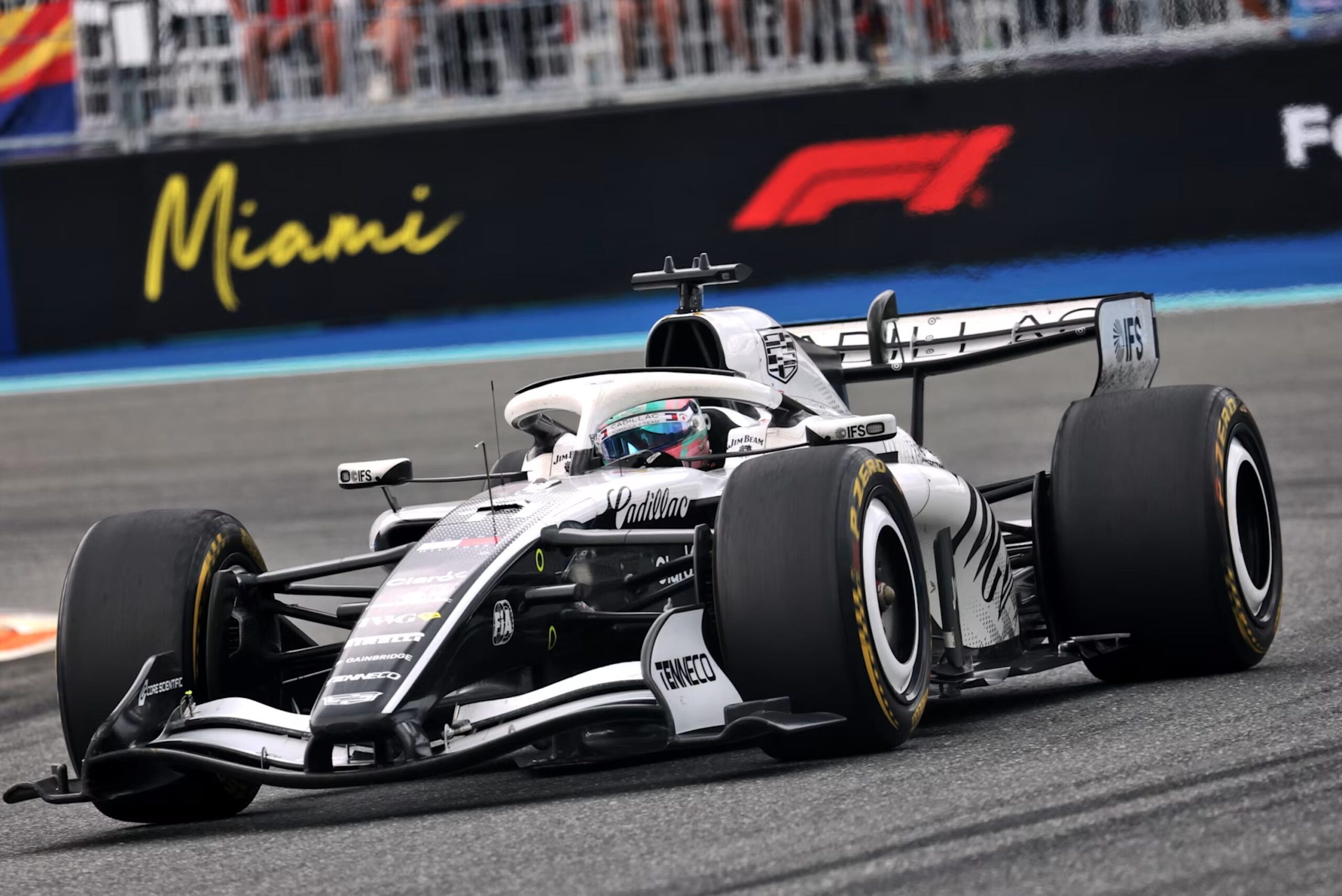
Cadillac joined the 2026 F1 grid running Ferrari power units under a supply deal that extends through 2028. The plan was always to transition to a homegrown engine for 2029, and the Charlotte facility was purpose-built for exactly that. Single-cylinder testing came first, then a full V-6 assembly.
The power unit building itself just finished construction, loaded with additive manufacturing capability designed to accelerate iteration cycles. So far, so good. Except the goalposts are already moving.
FIA president Mohammed Ben Sulayem declared at Miami that Formula 1 will return to V-8 engines, possibly as soon as 2030 and no later than 2031. “V-8 is coming,” he said flatly. Mercedes and Red Bull have voiced support.
That timeline means Cadillac’s brand-new V-6 could be obsolete within a single season of competitive use.
Reuss wasn’t rattled. “Whether it’s V-6 or V-8, the series will decide,” he said, before adding with unmistakable confidence: “We can do either; we know how to make a V-8.” Given GM’s track record with everything from the LT6 flat-plane crank to the supercharged LT4, nobody’s going to call that bluff.
But knowing how to build a road-car V-8 and knowing how to build a 15,000-rpm F1 power unit with integrated energy recovery are two very different engineering problems. Cadillac is now developing two concurrent F1 powertrains from a standing start while simultaneously trying to be competitive on Sundays with borrowed Ferrari hardware.
The Charlotte operation is Reuss’s hedge against exactly this kind of regulatory whiplash. He’s deliberately cross-pollinated GM’s motorsport programs — NASCAR, IndyCar, IMSA, and now F1 — under one roof, sharing aerodynamicists, simulation engineers, and control systems specialists. The idea is to learn faster than any rival by refusing to silo expertise.
It’s a smart organizational play, and it builds on real credibility. Cadillac’s V-Series.R hypercar landed on the Le Mans podium in its debut year and swept every IMSA GTP trophy in 2023. Russ O’Blenes, the veteran running GM Performance Power Units LLC, cut his teeth on those hybrid endurance programs. The electrification knowledge transfers directly to F1’s energy recovery systems.
Still, the operation is young. Over 300 specialists are now spread across facilities in Indianapolis, Charlotte, Warren, Michigan, and Silverstone, England. Aero models are generating data and parts manufacturing is underway, but no American constructor has won an F1 race since the 1970s. Preparation and ambition are table stakes; results take years.
The deeper tension here isn’t whether GM can build an engine. It’s whether F1’s regulatory apparatus will hold still long enough for any newcomer to catch up. Cadillac committed billions based on a V-6 hybrid formula, and now the sport’s leadership is publicly promising a V-8 switch almost immediately after that engine would debut.
For established manufacturers who’ve spent a decade developing the current power unit architecture, that’s annoying. For a team building its first F1 engine from scratch, it’s a moving target that demands twice the resources and twice the risk.
Reuss seems unbothered. The V-6 is running, the building is finished, and if the FIA changes the rules, Charlotte will simply build something else. That’s either supreme confidence or the calm before a very expensive storm.
Share this Story