
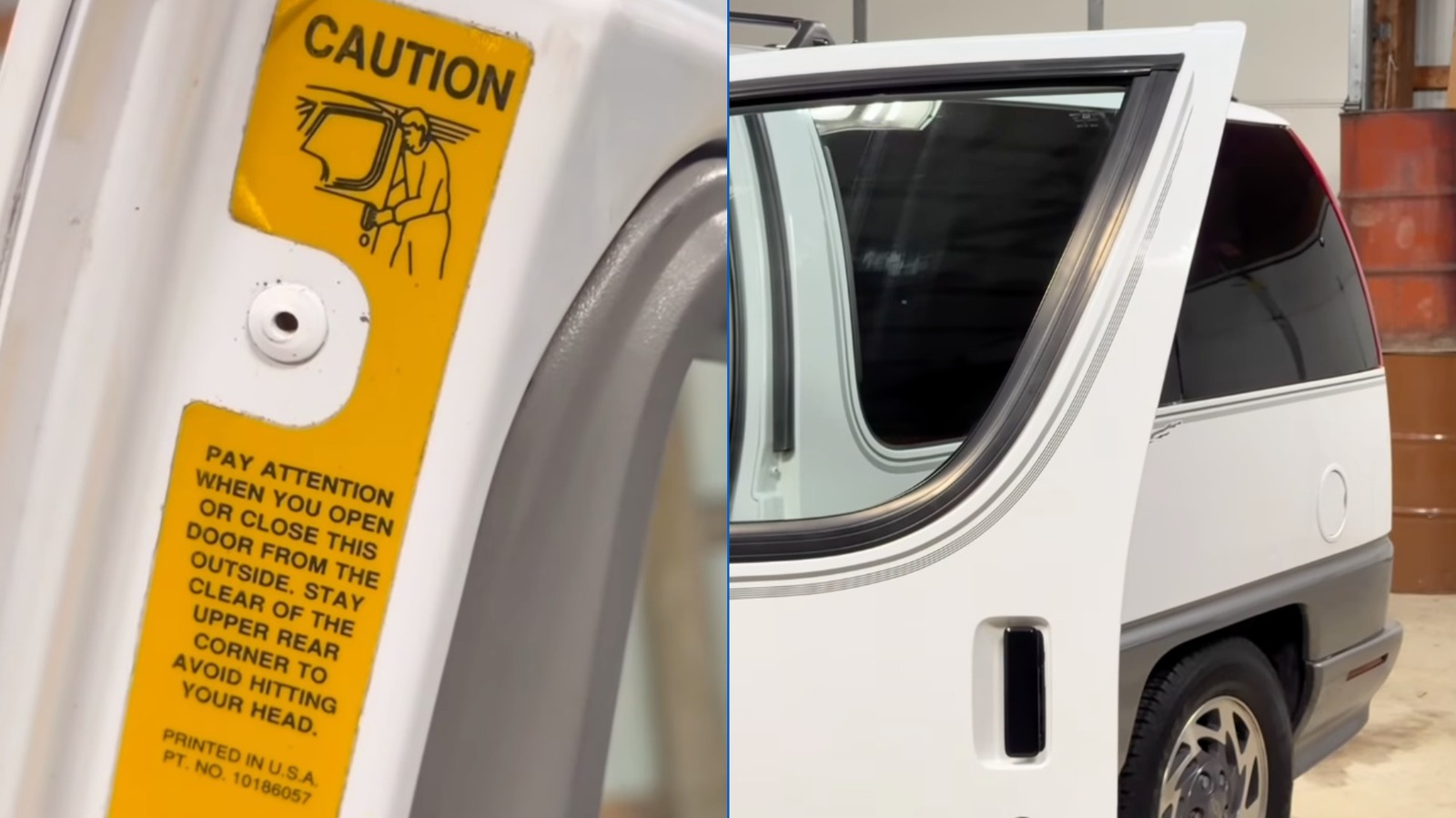


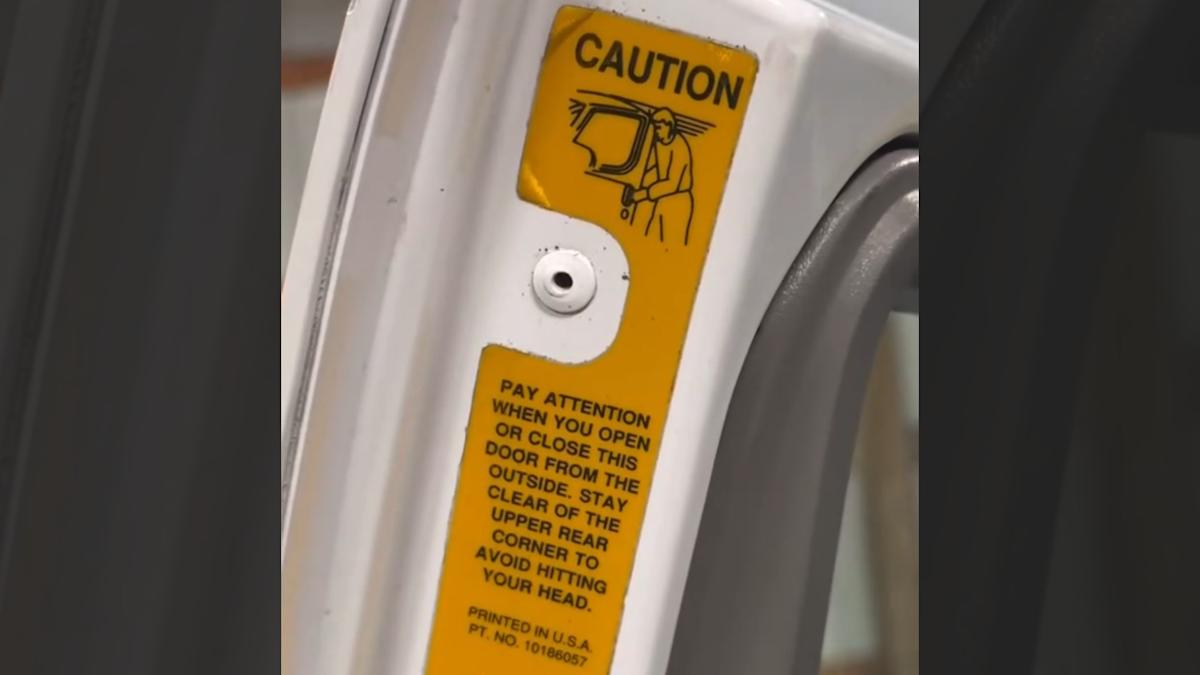
GM part number 10186057 is not a hinge redesign, not a door stop, not a recall-mandated engineering correction. It is a yellow warning sticker. And it was General Motors’ official answer to a minivan door that routinely clocked people in the head.
The so-called Dustbuster vans — the Chevrolet Lumina APV, Pontiac Trans Sport, and Oldsmobile Silhouette — rolled into showrooms in the early 1990s as GM’s first serious unibody minivan attempt. They shared a dramatic wedge shape meant to out-style Chrysler’s boxy but dominant Caravan and Voyager. The design was bold, but the execution had a catch.
GM’s stylists swept the front doors back into the roofline, creating a trailing upper edge that extended several inches beyond the door handle. Open the door, step out, turn to close it, and the top of that frame was waiting right at face level. Physics and geometry conspired against anyone in a hurry.
Rather than re-engineer the door, GM cataloged a warning label. The sticker revealed itself only when the offending door was already open — a bit like a smoke alarm that goes off after the house has burned down. It advised passengers to exercise caution while exiting, which is the automotive equivalent of putting a “Caution: Hot” label on a cup of coffee and calling it mission accomplished.
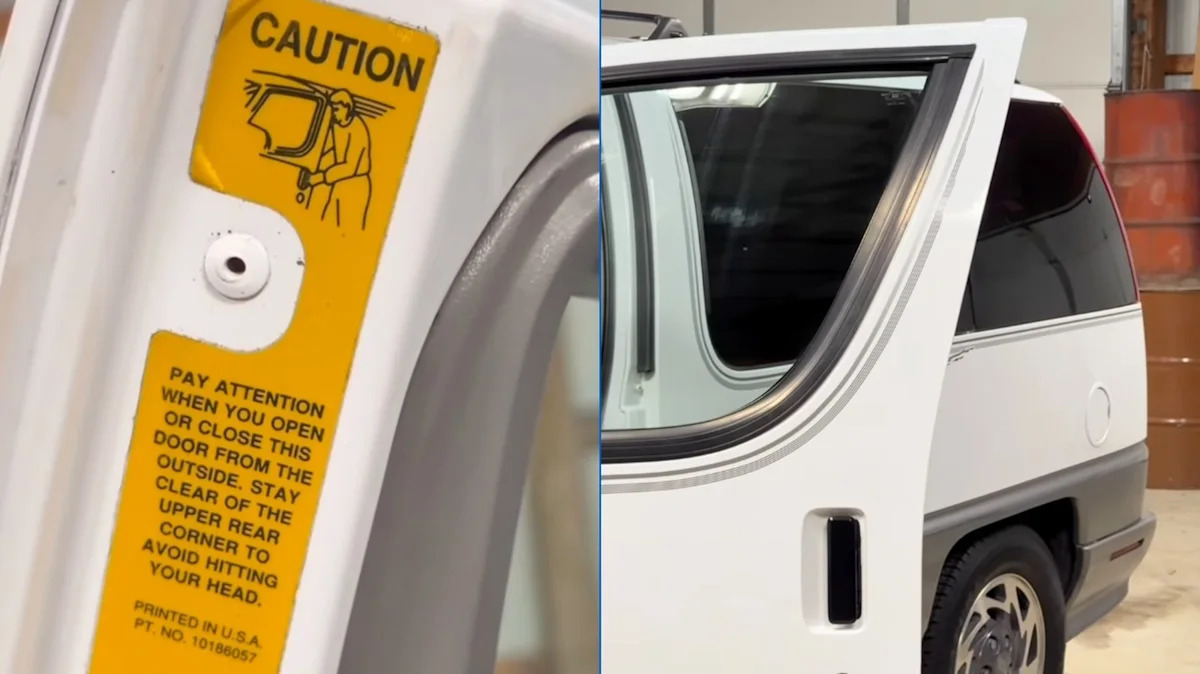
The irony runs deeper than the door design itself. Oldsmobile’s marketing at the time specifically trumpeted GM’s industrial design excellence with the Silhouette. The company was proud of this shape — proud enough to sell it across three brands, three trim levels, and three price points. Not proud enough, apparently, to fix the part of it that physically assaulted its owners.
These vans were genuinely striking machines. The massive raked windshield, the triangular quarter windows, the Lancia Stratos-esque door glass — there was real ambition in the design language. GM wanted desperately to leapfrog Chrysler’s minivan monopoly, and playing it safe wasn’t going to cut it.
Toyota tried the same thing with the mid-engined Previa. Neither approach worked. Chrysler kept selling Caravans and Voyagers by the hundreds of thousands while GM and Toyota chased design awards nobody was handing out.
The Dustbusters lasted from 1990 to 1996 before GM replaced them with more conventional designs. They never came close to toppling Chrysler’s grip on the segment. The face-smacking doors weren’t the reason — lackluster powertrains, questionable interior quality, and prices that didn’t match the value proposition all played their parts.
But the door problem captures something essential about GM in that era: a company that could dream big and then nickel-and-dime the follow-through.
A generation of elder millennials grew up in Chrysler minivans that leaked oil, blew air conditioning charges, and rattled themselves apart by 100,000 miles. Those vans were deeply flawed. But as one former Caravan kid recently pointed out, at least his family’s Dodge never tried to hit him in the face.
There is a whole philosophy of product development embedded in that yellow sticker. When the design creates the problem and the solution is a label telling customers to work around it, you are not engineering a vehicle. You are managing liability.
GM in the 1990s was world-class at exactly that kind of thinking, and the minivan wars proved it. Chrysler won by building what families actually needed. GM built what it thought looked cool, then stuck a warning on the part that didn’t work.
Part number 10186057 is still out there, cataloged and searchable. A small adhesive monument to a billion-dollar corporation that chose a sticker over a redesign. Some problems tell you everything you need to know about the company that created them.





Share this Story