
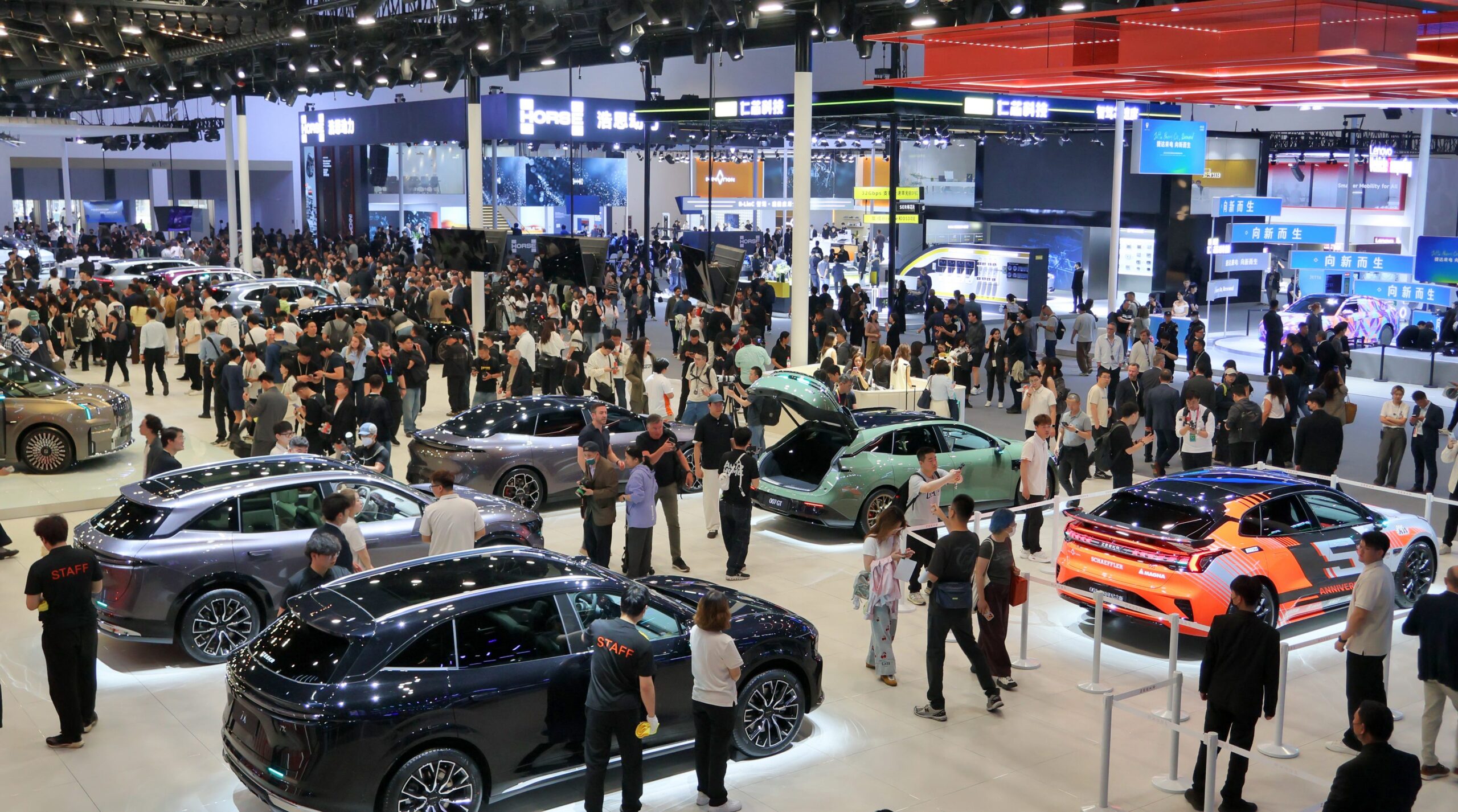


Nearly 1500 vehicles spread across two exhibition centers. Over 200 debuts. The 2026 Beijing auto show isn’t just big — it’s a declaration that China’s automakers have stopped chasing the West and started lapping it.
BYD alone showed up with enough firepower to make Porsche’s board sweat. Its subsidiary Denza unveiled the Z, a production-ready electric supercar in three flavors: hardtop coupe, soft-top convertible, and a stripped-out track weapon. The numbers are absurd — over 1000 horsepower, a claimed sub-two-second sprint to 62 mph, steer-by-wire, magnetorheological dampers, and a flash-charging system that gulps electricity at 1500 kilowatts.
That last figure alone is roughly triple what most Western fast chargers can deliver today.
But BYD wasn’t done. Its Fangchengbao brand rolled out the Formula X, a carbon-fiber convertible with tri-motor electric drive making 1000 horsepower and 737 pound-feet. It’s the production evolution of the Super 9 speedster concept from 2024, and it launches next year.
Then Fangchengbao dropped a whole family — the Formula S sedan, Formula SL large sedan, and Formula S GT wagon — all packing that same 1000-hp tri-motor architecture on an 800-volt platform. These aren’t concepts. They go on sale in China later this year.
The styling targets the Porsche Panamera directly, which tells you exactly where Fangchengbao thinks it belongs.
Count that up: one parent company, two sub-brands, at least six new performance vehicles, and a thousand horsepower sprinkled around like confetti. Three years ago, BYD was known for affordable city cars. Now it’s building an empire across every segment, from $18,000 hatchbacks to seven-figure supercars.
Speaking of that $18,000 hatchback — the Leapmotor B05 Ultra is perhaps the most quietly devastating car at the show. Roughly the size of a Mazda 3, it packs a 241-hp rear-mounted motor, hits 62 mph in about five seconds, and delivers over 300 miles of range for $18,135 in China. Stellantis, which owns about 20 percent of Leapmotor, plans to sell the standard B05 in Europe for around $31,000. Even at that marked-up price, it undercuts nearly everything comparable on the continent.
The European brands at Beijing seemed to understand the moment. Peugeot showed two concepts — a wagon called the Concept 6 and an SUV called the Concept 8 — previewing a new design language built specifically for the Chinese market. No powertrain details, no specs, just styling. That’s a company trying to stay relevant on someone else’s turf by leading with aesthetics because it can’t lead with technology or price.
Geely’s Lynk & Co unveiled a grand tourer concept called the “Time to Shine” GT. The name is cringe, but the car is serious: rear-wheel drive, sub-two-second acceleration, active aero, and a silhouette that wouldn’t look out of place in a Bentley showroom. Lynk & Co wouldn’t even confirm the powertrain type — electric, combustion, or hybrid — as though the distinction barely matters anymore.
That’s the real story out of Beijing. Chinese automakers aren’t just building competitive EVs. They’re flooding every niche simultaneously — supercars, grand tourers, sport sedans, wagons, budget hatchbacks — with technology and pricing that legacy manufacturers cannot match on either front.
The West spent years debating the transition timeline. China decided the debate was over. A show floor with 200-plus debuts isn’t a car show — it’s a census of the new world order.

Share this Story