



Ford has a problem it hasn’t had since the 1960s: building a factory prototype worthy of Le Mans. But in 2026, the challenge isn’t just speed. It’s identity.
Program lead Dan Sayers, the engineer charged with returning Ford to the top class at the 24 Hours, told Road & Track bluntly that his team’s still-unnamed LMDh car “hopefully represents a Ford and doesn’t look like an Oreca.” That’s a loaded statement when your car is, in fact, built on an Oreca chassis.
The issue is real. Three manufacturers — Acura, Alpine, and Genesis — have already fielded Oreca-based LMDh prototypes, and all three share an uncomfortably similar silhouette, right down to the elevated front wing section Acura introduced in its previous DPi era. Ford is the fourth OEM to climb into the same architectural bed, and the risk of visual anonymity is obvious.
Sayers insists Ford’s aerodynamics team and design studio have “a lot of input” into the body shape and that the work is done in complete isolation from what Oreca has delivered to other partners. He joked that he hopes Oreca’s work “gets better each time,” then quickly pivoted to reassurances about privacy walls and independent engineering. The engines are different, and the cars, he says, are different.
Whether the car actually looks different is a question that won’t be answered until a full reveal later this year, timed roughly to the prototype’s first on-track shakedown. Ford isn’t just selling performance here — it’s selling the mythology of the GT40, of American muscle storming the French countryside. A car that looks like a rebadged customer chassis won’t carry that weight.
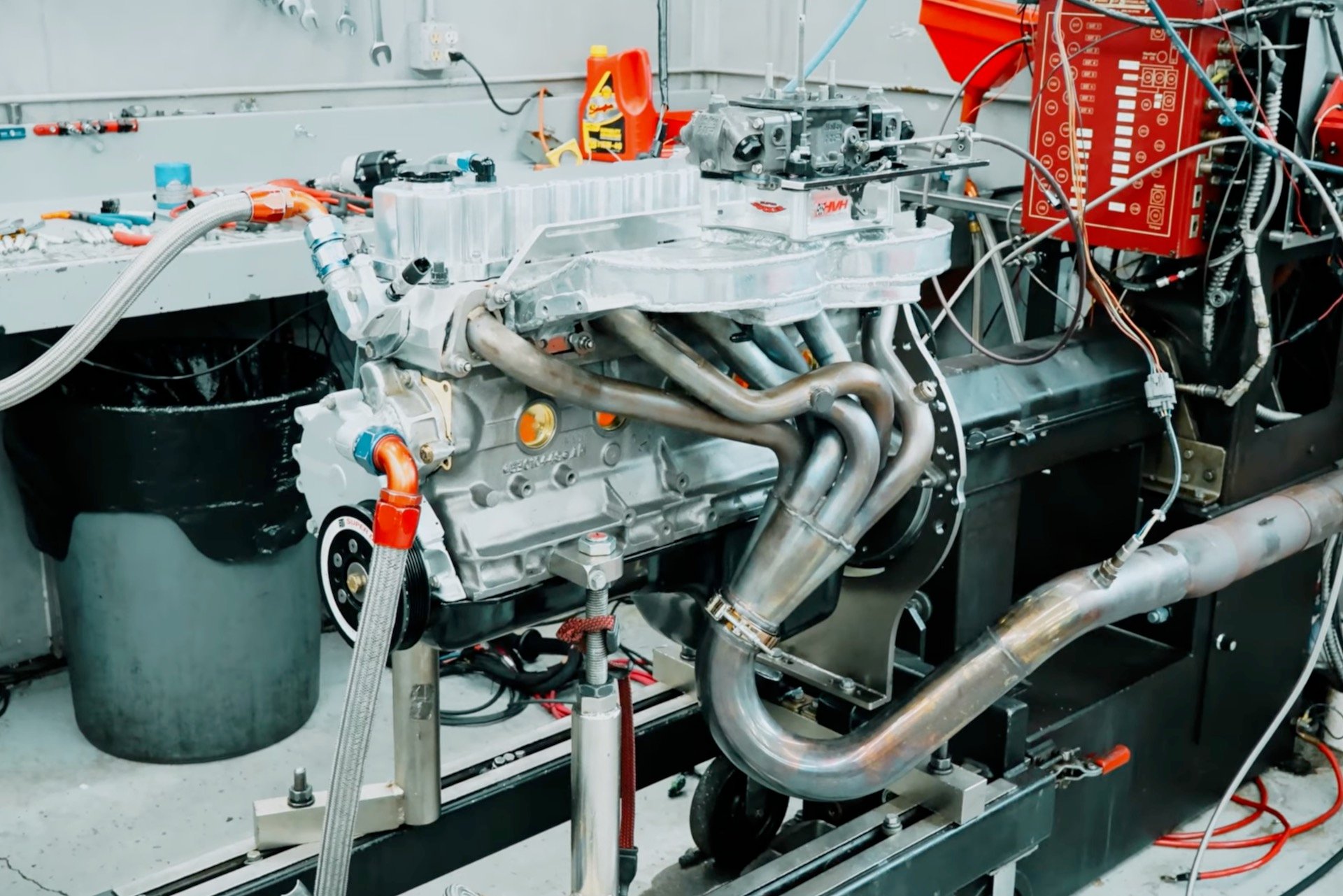
The program’s architecture reveals how seriously Ford is treating the effort. Engine development runs through U.S.-based Ford Racing, while UK-based Venture Engineering will house the hypercars and support factory operations between WEC rounds. Sayers confirmed the powertrain — a 5.4-liter V-8 distantly related to the road-car Coyote block — and the hybrid system are both on dynamometers now.

The engineering hires tell their own story. Leena Gade, who engineered Audi’s dominant prototype campaigns, is on board. So is Jean-Philippe Sarrazin, fresh off a 2024 WEC championship with Porsche Penske Motorsport and the 963 — the very car Ford is now trying to beat. Sayers called Sarrazin’s LMDh-specific knowledge critical.
Then there’s Logan Sargeant, the former F1 driver who will spend 2026 racing a GT-class Mustang in WEC before stepping up to the prototype. Sargeant, 25, is the only American named to the program so far, and he’d be the first American to win Le Mans overall since Davy Jones in 1996. He grew up around Ford trucks and doesn’t hide the emotion.
“To have the opportunity to win at Le Mans with Ford will be amazing,” Sargeant said. “I’m going to be pushing hard to make that a reality.”
Sargeant also offered an interesting nugget: conversations with other drivers suggest Oreca-based LMDh cars drive quite differently from GT machinery, more so than Dallara-based prototypes. His 2026 GT season isn’t just a placeholder — it’s an education in the championship’s rhythms, rules, and quirks before the real assignment begins.
The racing debut is targeted for the opening round of the 2027 WEC season next spring, building toward a Le Mans entry in June. Ford wants what Ferrari achieved in 2023 — a debut victory at La Sarthe, snapping a decades-long absence from the top step.
Ferrari did it with a bespoke hypercar built entirely in-house. Ford is doing it with a shared chassis, a leased workshop in England, and the hope that its aero team can sculpt something that doesn’t remind everyone of the three other cars wearing the same skeleton. The engineering talent is there. The ambition is real. The question is whether a car born from a common platform can carry an uncommon legacy.


Share this Story