
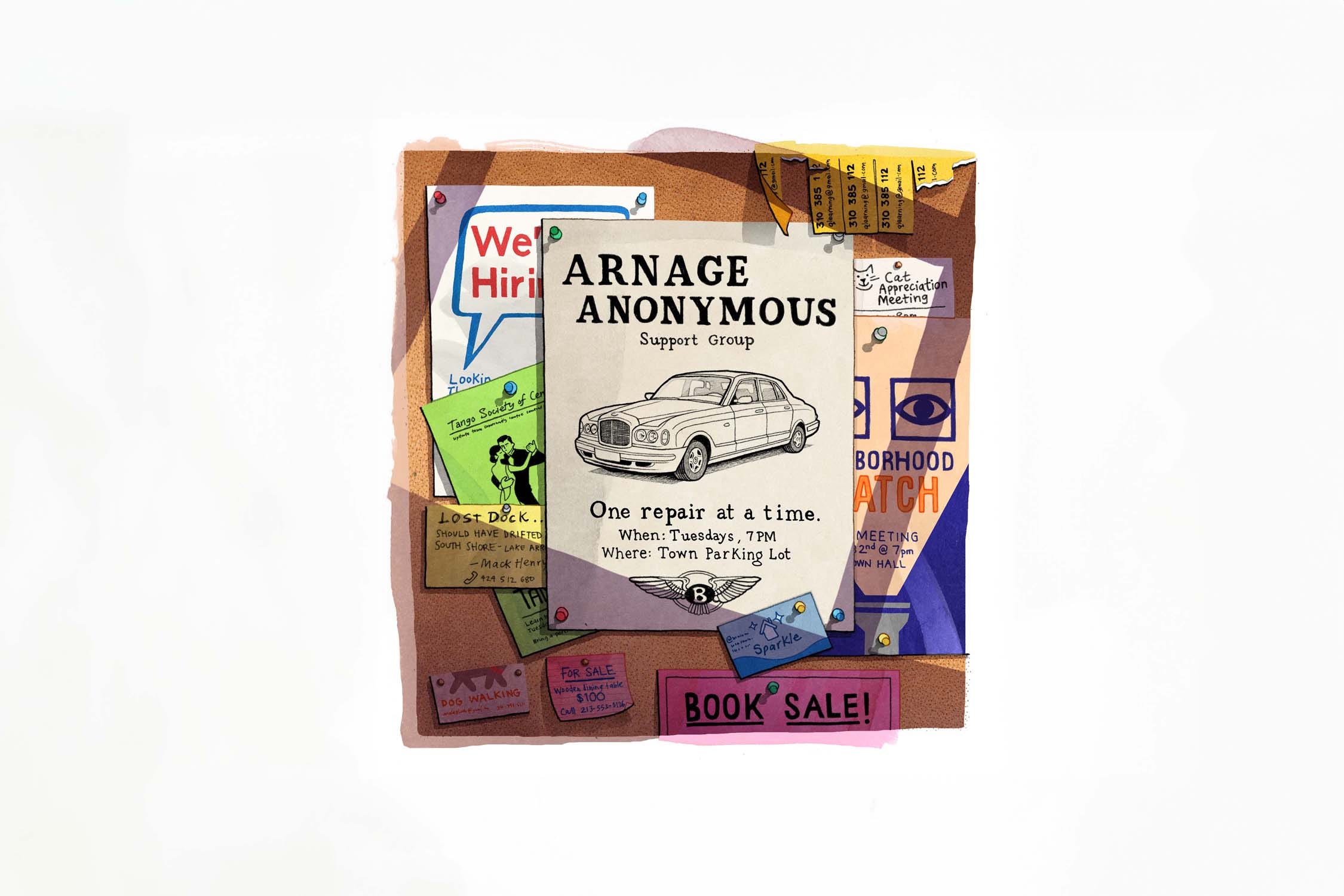


A $500 siren box from England. A USB drive that only works on a laptop tricked into thinking it’s February 2014. A NASA engineer enlisted to diagnose a potentially multi-thousand-dollar ECU failure. This is what owning a massively depreciated 2002 Bentley Arnage T looks like six months in, and Car and Driver senior editor Elana Scherr says she regrets nothing.
Scherr bought the Arnage as a summer beater in 2025, documenting the purchase in Car and Driver’s November/December issue. Readers cheered her on the way you cheer a friend about to jump off a roof into a swimming pool — with enthusiasm and zero expectation of a clean landing.
The early days were glorious. Cold air conditioning, hand-stitched leather, necks snapping in the Harbor Freight parking lot. A failed radiator hose was the only hiccup, easily dismissed. The Arnage delivered exactly what a cheap Bentley promises: absurd presence at a fraction of the original cost.
Then the bill came due, the way it always does with these cars.
A check-engine light appeared just in time to block a California smog inspection, then vanished — only to be replaced by a throttle-control warning that threw the car into limp mode. A mass-airflow-sensor code followed. Then every warning light on the dash joined the party. And then, worse than all the lights blinking at once, they all went dark. No gauges. No lights. No power to the OBD port. The car became a two-and-a-half-ton riddle wrapped in Connolly hide.
Scherr’s husband, Tom, attacked the problem with paper clips and a test light. He traced dead circuits to a 7.5-amp fuse jammed into a 5-amp slot, which led to a corroded factory alarm module buried in the wheel well. Removing it triggered the emergency flashers, which blinked continuously until they killed the battery. Convincing the Arnage it hadn’t been stolen required that $500 siren box from U.K. supplier Flying Spares.
The throttle-control fault remains. The leading suspect is a faulty ECU — a part that could cost nearly half the car’s current value. A nephew who happens to work for NASA is inspecting the unit’s internals. That sentence alone tells you everything about the ownership experience.
Bentley offers no support for models this old. The factory assumes any serious diagnosis will be performed with a proprietary scan tool by a certified Bentley technician. The population of certified Bentley technicians willing to touch a 25-year-old Arnage is vanishingly small. The only available workshop documentation lives on that cursed USB drive with its time-travel requirement, and it contains no wiring diagrams.
Fellow Arnage owners offer solidarity but little practical help. Each car, Scherr notes, seems broken in its own unique way — a Tolstoy observation applied to British luxury sedans.
This is the fundamental lie of the depreciated exotic. A car that cost north of $200,000 new can be bought today for a fraction of that, but it still demands $200,000-car parts, $200,000-car expertise, and $200,000-car patience. Depreciation discounts the purchase price. It does not discount the complexity.
Scherr frames herself as Theseus in the labyrinth rather than Icarus plummeting into the sea. That’s the optimist’s read. The realist notes that Theseus needed Ariadne’s thread to find his way out, and Bentley didn’t include wiring diagrams.
Still, there’s something genuinely admirable about the project. In an automotive culture increasingly defined by subscriptions, software locks, and dealer-only diagnostics, two people chasing British electrical gremlins with paper clips and a multimeter feels almost radical. The Arnage doesn’t care about your convenience. It was built for a world where someone else handled the problems, and owning one now means becoming that someone else.
The Arnage sits. The nephew investigates. The credit card recovers from Flying Spares. And Scherr waits, defiant, for the next warning light — or the next blackout. At this point, either one would be progress.





Share this Story