
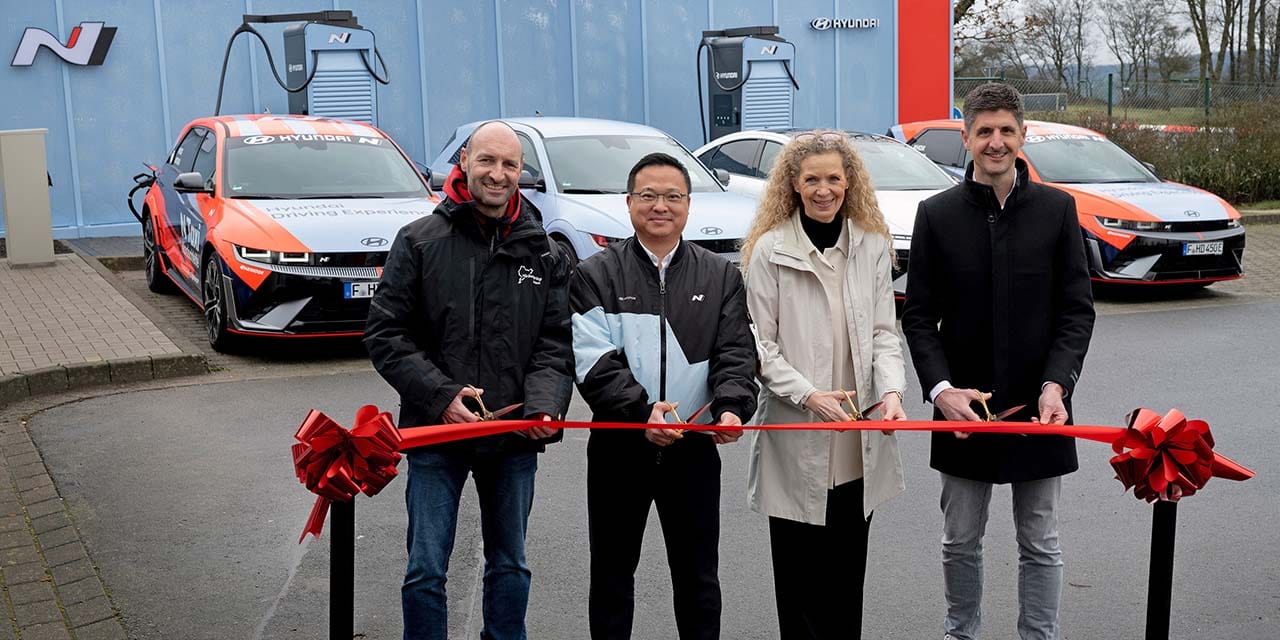


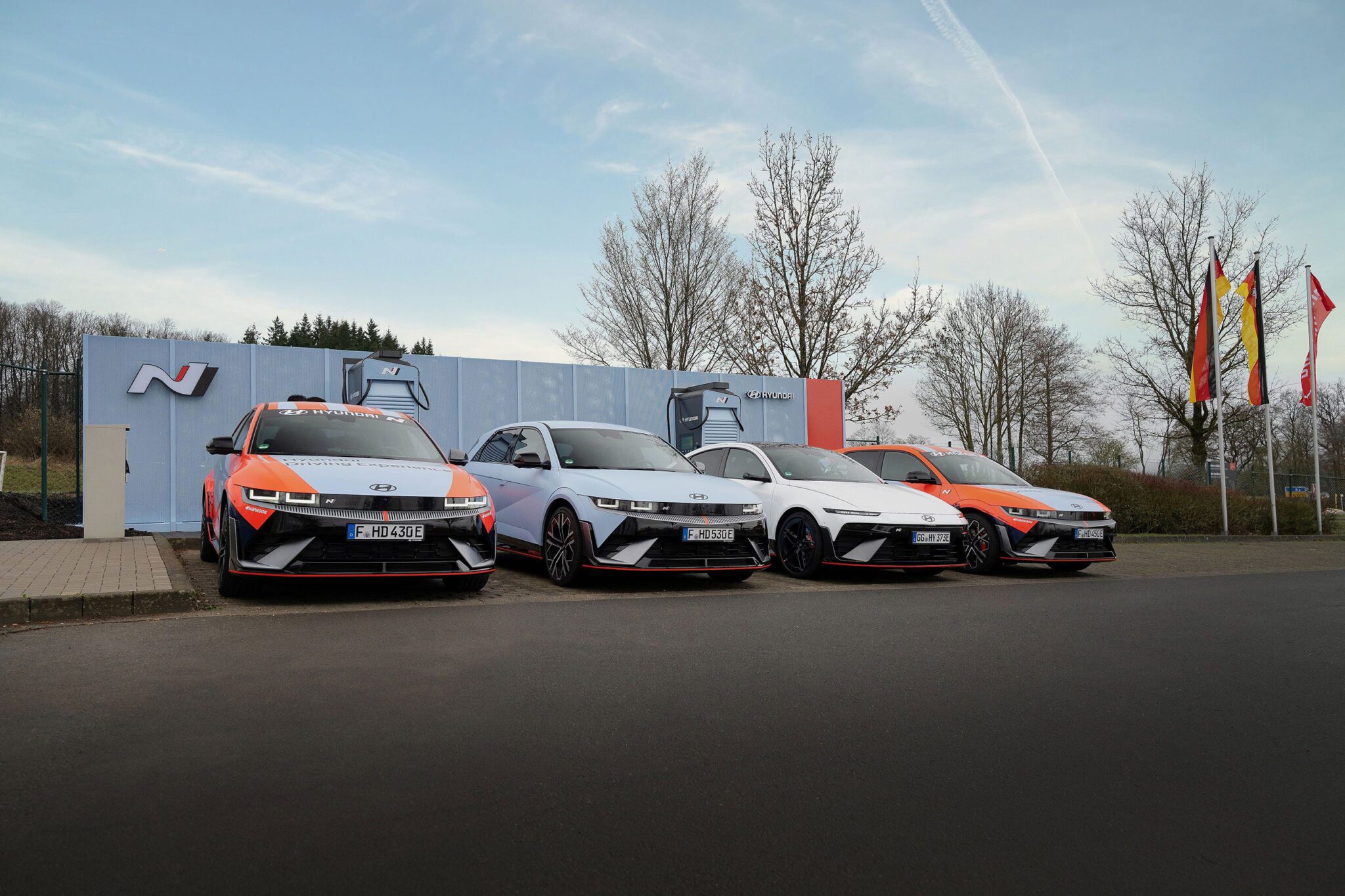
Two 400-kW DC fast chargers now sit at the entrance to the Nürburgring’s Tourist Drive, and they wear Hyundai N badges. The Korean automaker flipped the switch on March 14, just in time for the 2026 track season, placing its brand squarely at the doorstep of the circuit that gave the N division its name.
The installation is modest in scale — two units, four charging points — but the symbolism is loud. Hyundai is not just selling electric performance cars. It is building the ecosystem around them, starting at the one track that matters most to enthusiasts.
An IONIQ 5 N or IONIQ 6 N can go from 10 to 80 percent charge in roughly 18 minutes under ideal conditions. That is fast enough to grab a coffee and get back on the Nordschleife before your tires cool down. The chargers are open to all EV brands, but starting in April, Hyundai N owners using the Charge myHyundai app in Europe will charge for free.
Free. At the Nürburgring.
Joon Park, Vice President of Hyundai’s N Management Group, framed it as infrastructure catch-up. The N Hyper Chargers are a part of our efforts to build the infrastructure needed to fully unleash this potential,” he said. “We hope this milestone empowers more car enthusiasts to conquer every corner of this ‘Green Hell.'”
The move follows Hyundai’s first high-performance charging station at Inje Speedium in South Korea, installed back in 2023. Going from a domestic circuit to the Nürburgring is a deliberate escalation — a statement that the N brand’s electrification push is no longer a regional experiment.
The timing is no accident either. The same week Hyundai announced these chargers, the company revealed it would debut the all-electric IONIQ 3 at Milan Design Week in April. Meanwhile, the group’s HTWO hydrogen brand just made its Japanese debut at the H2&FC EXPO. Hyundai is spreading its chips across the table — battery electric, hydrogen, performance, infrastructure — faster than most competitors can pick one lane.
The real play here is not two chargers bolted to a German hillside. It is the precedent. Porsche has its Turbo Charging network, Tesla built Superchargers into a cultural phenomenon, and BMW, Mercedes, and the rest are shareholders in Ionity.
Hyundai is taking a different route: branded, track-adjacent, performance-focused charging that ties the experience directly to its hottest products. Nobody else is offering free electrons to owners at a racetrack. That is a customer retention tool dressed up as infrastructure.
The question is whether this scales. Four charging points at one circuit do not solve range anxiety or reshape the competitive landscape. But they do something arguably more valuable for a brand still fighting the perception gap against European performance royalty: they plant a permanent Hyundai N presence at the most sacred ground in motorsport.
Every weekend warrior who pulls into the Tourist Drive entrance will see those chargers. Every Porsche Taycan owner, every BMW iX M60 driver, every Tesla Model S Plaid pilot looking for a top-up will plug into a Hyundai-branded station. That is marketing you cannot buy with a billboard.
Hyundai built the IONIQ 5 N into a credible track weapon that earned genuine respect from drivers and press alike. Now the company is making sure the infrastructure exists so those cars can actually be used the way they were designed. It is a small step measured in kilowatts, but a big step measured in intent.


Share this Story