
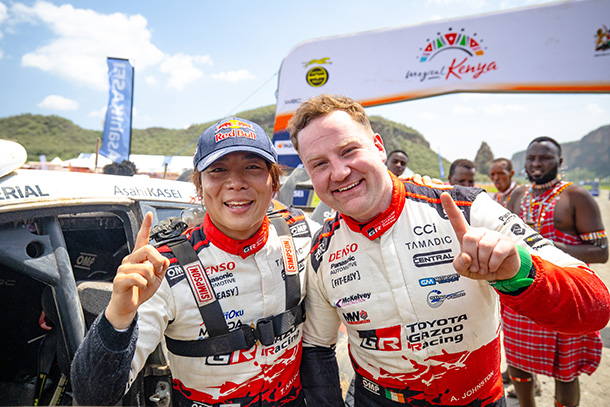


Takamoto Katsuta sat seventh on Friday night, nearly two minutes off the lead, nursing the frustration of a double puncture. By Sunday afternoon he stood on the top step of the podium at Safari Rally Kenya, the first Japanese driver to win a World Rally Championship round in 33 years.
The margin was 27.4 seconds over Hyundai’s Adrien Fourmaux. The path to get there was pure Safari — brutal, chaotic, and deeply unforgiving.
This was not a rally won on outright speed. It was won on survival. Heavy rain before and during the event turned Kenya’s stages into the most demanding Safari of the modern WRC era.
Only four Rally1 cars completed every stage without major mechanical failure. Toyota had five entries running inside the top five early on. By Saturday afternoon, three of them were broken on the side of the road.
The thick mud on Saturday morning’s third stage was an execution chamber. Elfyn Evans retired with suspension damage. Oliver Solberg and Sébastien Ogier both stopped when mud contaminated their alternators.
Sami Pajari lost five minutes to tyre damage. In the space of a few hours, Toyota’s stranglehold turned into a scramble for points.
Katsuta, running quietly and cleanly, inherited the lead at Saturday’s midday service. He built a cushion of 1 minute 25.5 seconds by nightfall and then did exactly what the Safari demands — he didn’t throw it away.
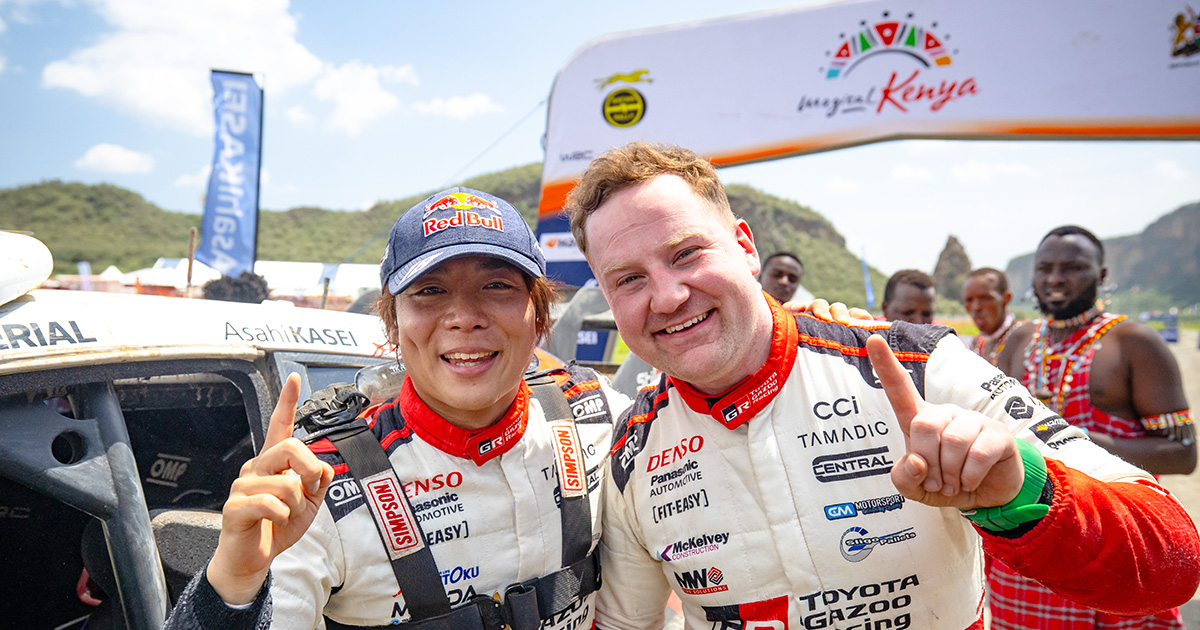
The victory is deeply personal. Katsuta was a circuit racer with almost no rally experience when he joined Toyota’s WRC Challenge Program in 2015. A decade of grinding through the ranks, learning dirt and gravel the hard way, culminated in a moment that had eluded him through three Safari podiums, a heartbreaking retirement last year, and a runner-up finish at Rally Sweden just weeks ago.
He becomes only the second Japanese driver to win a WRC round, after Kenjiro Shinozuka’s back-to-back victories at Rallye Cote d’Ivoire in 1991 and 1992. Yoshio Fujimoto won the Safari for Toyota in 1995, but that was a 2-Litre World Rally Cup event, not a full WRC counting round.
Akio Toyoda, the team’s chairman, framed it in generational terms. “I have always hoped that a Japanese rally driver who can win on the world stage would one day become an inspiration for children in Japan,” he said. Deputy team principal Juha Kankkunen — whose own first WRC win came at the Safari 41 years ago — called it “something quite special to do it on such a difficult event.
Toyota’s dominance at the Safari since its 2021 return is now six wins from six attempts, and a record-extending 14th overall victory on the event. But this year’s triumph came with bruises. Three retirements on a single Saturday stage is not a statistic the team will celebrate privately, no matter how many Sunday bonus points Solberg, Ogier, and Evans clawed back.
Pajari salvaged third overall, his second straight podium and third in five events, backed by five stage wins across the weekend. The 23-year-old Finn keeps quietly building a case for himself as the team’s future anchor.
In the championship, Evans still leads by eight points over Solberg and 11 over Katsuta. Toyota holds a 43-point advantage in the manufacturers’ standings over Hyundai. The numbers are comfortable. The weekend was anything but.
The WRC moves to Croatia on April 9 for a return to asphalt. The roads around Rijeka will reward precision, not attrition. Kenya rewarded something rarer — patience forged over a decade of waiting.
Katsuta, fighting tears at the finish, put it simply: “We’re here because we never give up.”
After 10 years, that stopped being a cliché and became a fact.

Share this Story