
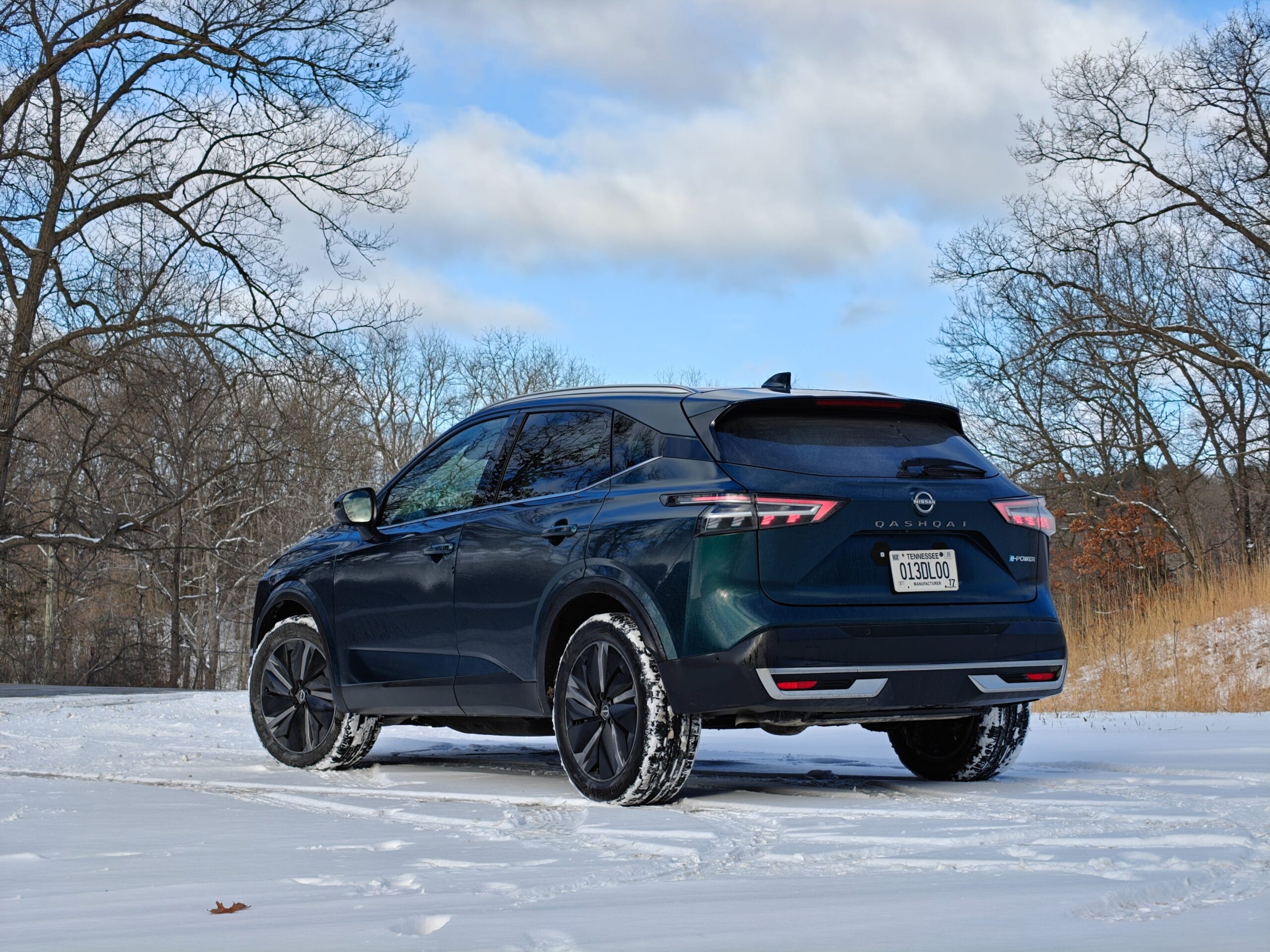


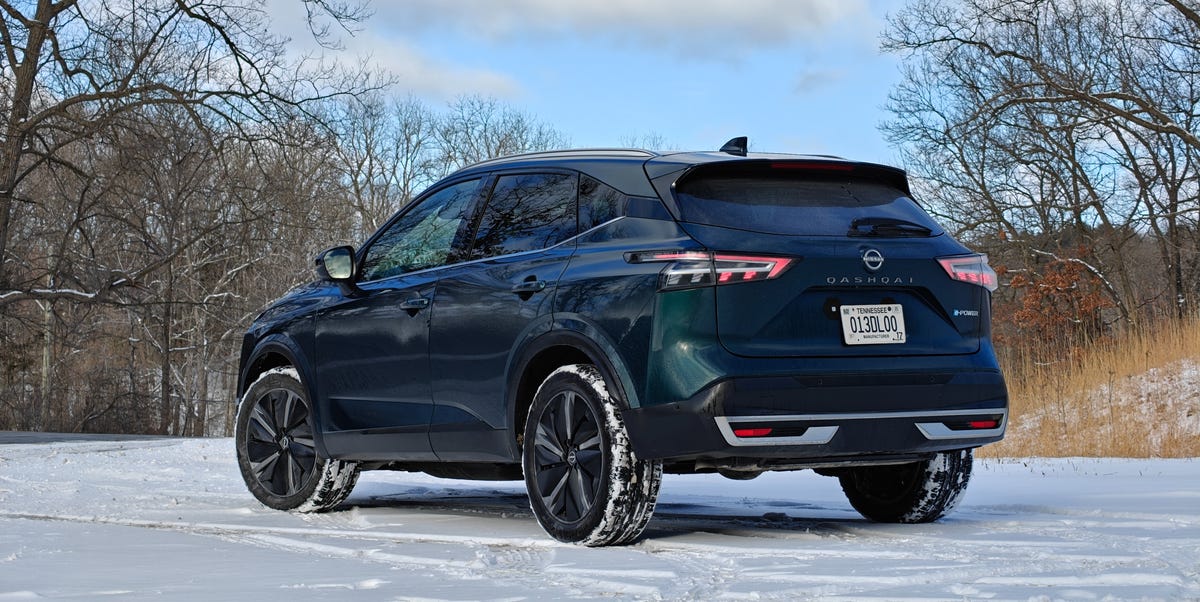
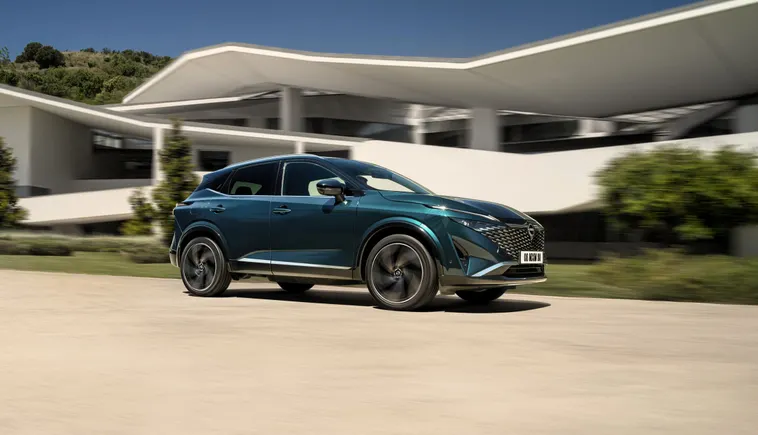
Ten years after debuting in Japan, Nissan’s e-Power series hybrid system is finally crossing the Pacific. The 2027 Rogue will be the first American Nissan to get it, and based on a first drive of the European-spec Qashqai carrying the same third-generation hardware, the system works. Whether it works well enough to matter in a segment already crowded with proven hybrids is another question entirely.
Nissan brought a fleet of Qashqais to Farmington Hills, Michigan, for journalists to sample the powertrain on familiar roads. The concept is straightforward: a turbocharged 1.5-liter three-cylinder engine acts solely as a generator, feeding electricity to a motor that drives the front wheels. The gas engine never touches the wheels directly. Think diesel-electric locomotive logic shrunk to crossover scale.
It’s a layout Honda has been executing brilliantly for years with its two-motor hybrid system. The key difference is that Honda adds a direct mechanical link from engine to wheels for highway cruising, boosting efficiency when you need it most. Nissan skips that connection entirely, betting instead on a turbocharged engine tuned to run at low rpm during sustained speeds.
Powertrain engineer Kurt Rosolowski says the turbo approach offers better highway efficiency than a naturally aspirated setup, which matters in a country where 70-mph commutes are the norm.
On the road, the Qashqai e-Power felt competent but not electric-car quick. Launch from a standstill was sluggish — the motor didn’t deliver its full punch until 15 to 20 mph. From a roll, things improved considerably, with acceleration roughly matching a CR-V Hybrid.
The turbocharged three-cylinder stayed impressively quiet, its note muffled and distant compared to Honda’s sometimes buzzy four-cylinder. Nissan calls its engine-speed calibration “Linear Tune,” designed to keep revs roughly in step with acceleration so the disconnect between sound and speed doesn’t annoy passengers.
At wide-open throttle, though, the engine pinned its revs high and held them there, producing a sensation uncomfortably reminiscent of the rubber-band drone Nissan’s CVT-equipped cars have been criticized for over the past decade. Old habits, apparently, die hard.
Fuel economy numbers from the preview were promising but not dominant. Highway cruising at 75 mph returned roughly 40 mpg on the trip computer, with stop-and-go driving pushing slightly past 44 mpg. The Rogue will be bigger, heavier, and available with a second electric motor for AWD — all of which will drag those figures down.
Realistic combined estimates likely land somewhere around 37 mpg, competitive with the CR-V Hybrid but short of the RAV4 Hybrid’s 42 mpg combined. That’s respectable but not category-leading for a system arriving in 2027.
The 2.1-kWh lithium-ion battery is tiny, meaning the electric-only mode is essentially decorative. Ask for anything beyond gentle city crawling and the engine fires immediately. There’s no plug-in option, no meaningful EV range, and no true one-pedal driving mode despite the inclusion of Nissan’s e-Pedal Step feature.
Regenerative braking felt grabby during the transition from regen to friction, a calibration issue Nissan will need to sort before the Rogue launch.
Nissan touts a new five-in-one modular unit combining the electric motor, generator, inverter, reducer, and increaser into a single package. That consolidation saves weight and simplifies manufacturing, which could help keep the price premium manageable. Both e-Power and the existing VC-Turbo powertrain will be offered in the U.S. Rogue, giving buyers a choice.
The real tension here is timing. Nissan is arriving to the American hybrid fight with a system its competitors have been refining for years. Toyota’s hybrid dominance is entrenched, and Honda just launched the Prelude while continuing to expand its hybrid portfolio.
Nissan’s e-Power is genuinely clever engineering, and the third-generation hardware is clearly a leap over earlier versions. But clever doesn’t automatically translate to competitive when the Rogue has to sit on a dealer lot next to a RAV4 Hybrid that gets better mileage and a CR-V Hybrid with sharper driving dynamics.
Nissan needed this powertrain five years ago. It’s getting it now. The margin for error is gone.

Share this Story