
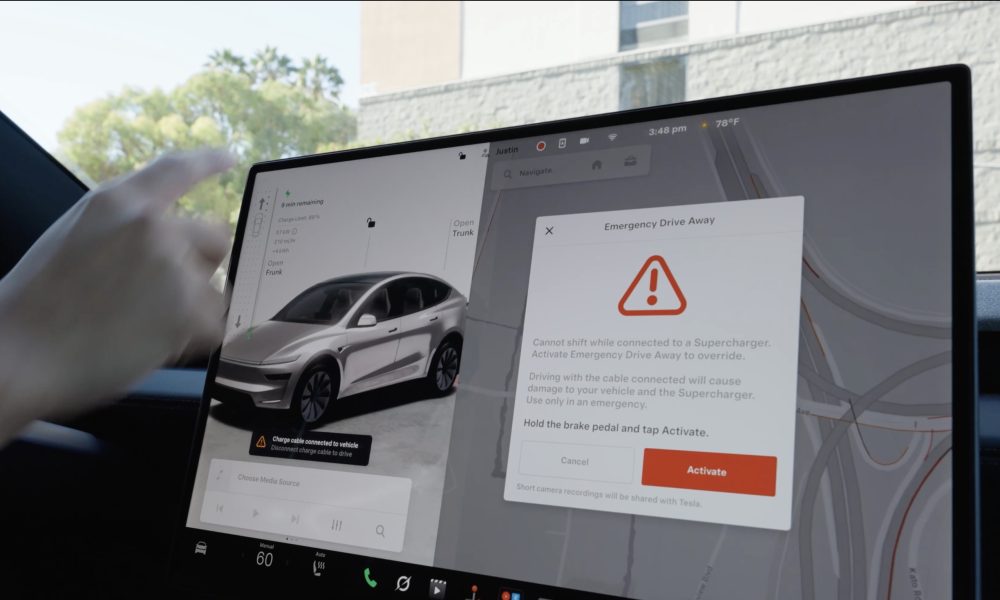


A new Tesla software feature called Emergency Drive Away lets drivers shift into Drive and pull away from a Supercharger with the charging cable still connected to the car. Until now, Teslas locked out the drivetrain whenever a cable was plugged in. The charging team announced the feature on X without tying it to any specific incident.
But the timing is hard to ignore.
On August 1, a gunman opened fire at a Supercharger adjacent to an In-N-Out in Twin Falls, Idaho, targeting three people in two Teslas. A 66-year-old man from Salt Lake City was killed. A fatal shooting also occurred at a Supercharger station near Denver in 2023.
In both cases, vehicles were tethered to stalls with no factory-supported way to leave in a hurry.
Owners flooded social media after Twin Falls demanding exactly this kind of escape hatch. Many pointed to EVject, an aftermarket breakaway connector that Tesla sued in 2024, alleging it lacked overtemperature protection. The two sides later settled, and EVject recalled its original connectors in favor of a redesigned version with thermal sensors.
Tesla’s own solution is blunter. Floor it, and the cable rips free.
The in-car warning leaves no room for creative interpretation: “Driving with the cable connected will cause damage to your vehicle and the Supercharger. Short camera recordings will be shared with Tesla.” The company added that “deliberate misuse” will result in “additional penalties,” though it declined to specify what those penalties are.
That camera footage is the enforcement mechanism. Tesla is betting it can review clips and distinguish a genuine threat from someone too impatient to wait for the latch to release. Whether that review process holds up at scale, or whether it creates a new wave of disputes between owners and the company, remains an open question.
The feature ships with software update 2026.38.3 and works at every U.S. Supercharger without hardware changes to the stalls. Model S and Model X vehicles built before 2021 are excluded. Canada and other international markets are not supported at launch, with Tesla saying U.S. availability is “for now.”
It is a rare admission that the charging experience carries physical risk beyond electrons and kilowatts. Superchargers sit in parking lots, rest stops, and shopping centers, often in poorly lit corners chosen for electrical access rather than personal safety. A car physically locked to a post is a car that cannot flee.
That vulnerability was theoretical until people started dying next to them.
The feature also lands during a broader push by Tesla to position its vehicles as active safety tools. Days earlier, the company began rolling out Automatic Collision Evasion with FSD v14.3.9, which can seize steering control to dodge an imminent crash. That system works on highways. Emergency Drive Away works at zero mph, in a parking lot, when the threat is human rather than mechanical.
Tesla built a car that could accelerate faster than almost anything on the road, then bolted it to a charging post with no override. It took two years of owner complaints and at least two fatal shootings before the software caught up to a scenario that never required new hardware, just permission to leave.
The rollout is live. The first misuse dispute is probably not far behind.

Share this Story