
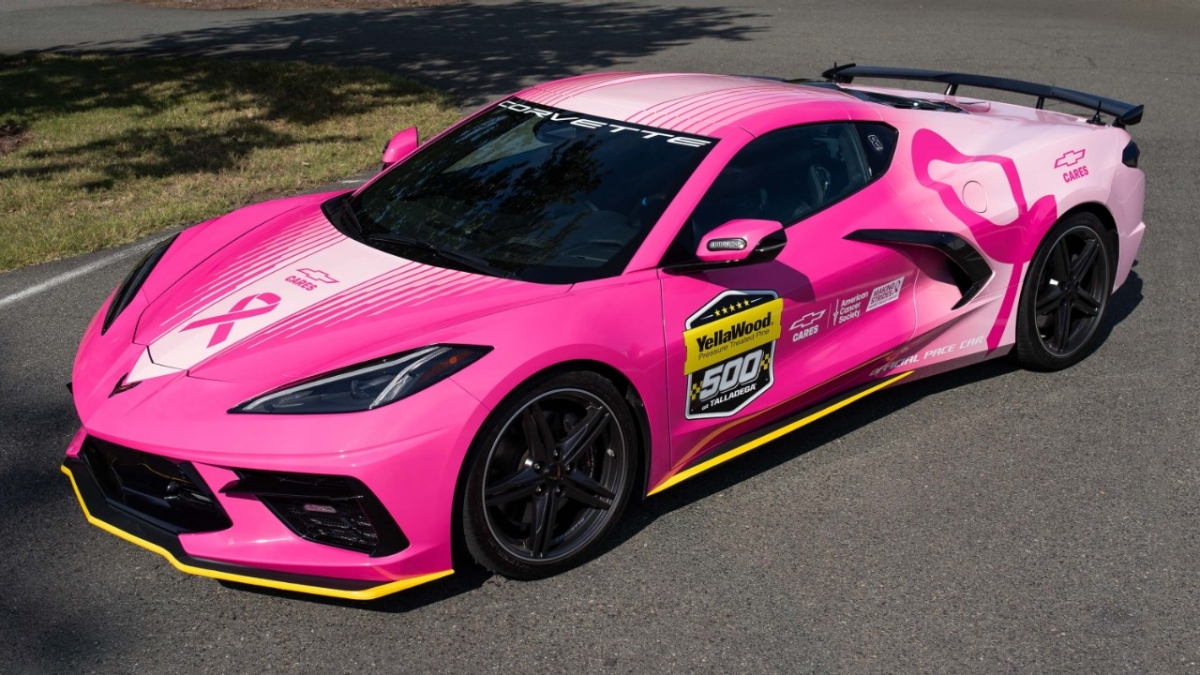


Chevrolet will roll out its pink Corvette Stingray pace car for a 16th consecutive October, leading the NASCAR Cup Series field at Talladega Superspeedway on Oct. 25 and Martinsville Speedway on Nov. 1 as part of its ongoing partnership with the American Cancer Society.
The numbers tell a story, though not always the one the press release wants you to hear. Chevrolet raised more than $1.7 million for the American Cancer Society in 2025. The NASCAR-specific portion of that haul? Just $32,500.
For 2026, Chevy has expanded its NASCAR donation program from three races to five. The automaker will kick in $1,500 for every Team Chevy driver finishing in the top 10 at Las Vegas, Charlotte, Phoenix, Talladega, and Martinsville. The cap across all five races is $25,000.
Separately, Chevrolet will donate $500 for each caution lap led by the pink Stingray at Talladega and Martinsville, capped at another $25,000. So the maximum possible NASCAR payout in 2026 is $50,000. That is roughly what GM spends on coffee in a week at the Renaissance Center.
The campaign kicks off at the South Point 400 in Las Vegas on Oct. 4, where donation eligibility begins but the pink pace car stays parked. The Stingray itself doesn’t hit the track until Talladega three weeks later. Martinsville, the penultimate race of The Chase, wraps it up on Nov. 1.
“Each October, our motorsports platform gives us a powerful opportunity to turn the visibility of NASCAR into meaningful support for Making Strides Against Breast Cancer,” said Alyssa Haba, Chevrolet’s senior manager of Motorsports Marketing and Activation.
Visibility is the operative word. The pink Corvette is a marketing vehicle in every sense. It generates social media clips, broadcast close-ups, and goodwill that no 30-second commercial buy could replicate.
The actual dollars flowing to cancer research through the NASCAR program are modest by any corporate philanthropy standard, but the awareness math works differently. Chevrolet’s broader relationship with the American Cancer Society clearly extends well beyond what happens on race weekends. That $1.7 million total from 2025 came primarily from other channels, dealership activations, and corporate contributions.
The NASCAR piece is the tip of a much larger spear, designed to be seen rather than to carry the financial weight. The caution-lap donation structure is a clever bit of engagement engineering. It turns yellow flags, normally a source of frustration for fans and teams, into something with a charitable upside.
Whether that softens the mood during a 15-lap caution at Talladega remains to be seen, but it gives the broadcast team something to talk about besides tire debris. Sixteen years is a long run for any cause-marketing partnership. Most corporate tie-ins flame out after three or four seasons when the next executive reshuffles priorities.
Chevrolet has stuck with this one through multiple leadership changes, a bankruptcy, an EV pivot, and a pandemic. The pink Stingray won’t set any lap records. It won’t decide a championship.
But it will circle Talladega and Martinsville under caution while millions watch, and Chevy will write a check that lands somewhere between $32,500 and $50,000. The bulk of the real money flows quietly elsewhere, far from the cameras and the 200-mph straightaways. Whether the expanded five-race format moves the needle financially depends entirely on how many Chevy drivers crack the top 10 during playoff pressure.
Last year’s $32,500 suggests the per-race math can be thin.
Share this Story