
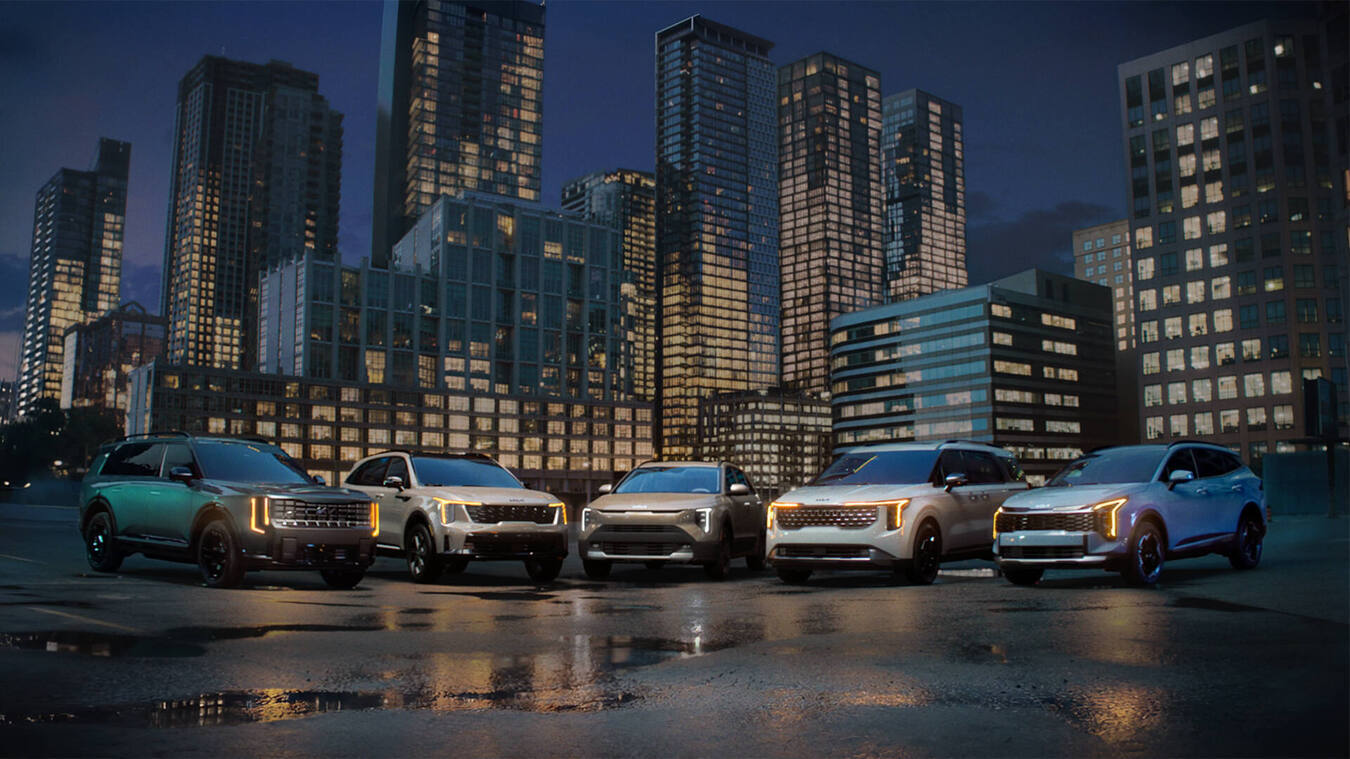


Kia now claims the second largest hybrid lineup in the American market. That’s a deliberate shot across Toyota’s bow, and the new ad campaign rolling out this week makes clear the Korean automaker isn’t interested in playing quiet about it.
The 30-second spot, titled “Hybrids That Move to a New Beat,” features five hybrid SUVs and utility vehicles converging on a city highway while building lights pulse to a Gesaffelstein track. It’s slick, it’s loud, and it’s selling a message that would have been unthinkable from Kia a decade ago: we have more hybrid options than almost anyone.
The lineup is genuinely broad. The 2027 Telluride Turbo-Hybrid anchors the top with three rows, 329 horsepower, and a claimed 564-mile total range. The Sportage Turbo-Hybrid covers the compact SUV segment.
The Carnival Turbo-Hybrid MPV, a minivan Kia refuses to call a minivan, boasts a 608-mile total range. Add the Sorento HEV and Niro HEV, and Kia has five hybrid nameplates covering virtually every family vehicle category.
That range number on the Carnival deserves a pause. Six hundred and eight miles on a single tank of gas and a hybrid battery, in an SUV-shaped people mover. The fine print notes it comes from fueleconomy.gov and assumes you burn every last drop, which nobody should do. But even discounted for real-world driving, that number puts serious pressure on competitors still pushing conventional powertrains in the segment.
The timing is no accident. American buyers have been quietly but firmly shifting toward hybrids over the past two years, even as the EV conversation dominates headlines and policy debates. Hybrids don’t require charging infrastructure, they don’t trigger range anxiety, and they cost less than battery electrics.
Kia clearly reads this as its opening. Russell Wager, Kia America’s marketing VP, framed the campaign around breadth and choice. Whether you’re in the market for a 3-row SUV like the capable Telluride, a compact SUV such as Sportage or the versatility and power of the Carnival Turbo-hybrid MPV, Kia has a hybrid model for every driver,” he said.
It’s standard marketing language, but the underlying strategy is sharp: don’t make the customer come to you with a single product. Cover every lane. The 360-degree campaign spans broadcast, print, digital, out-of-home, and social media, so Kia is spending real money here, not testing the waters.
What’s interesting is where this leaves Kia’s EV ambitions. The company still builds the EV6 and EV9 at its Georgia plant and has made large investments in electrification. But the marketing muscle is clearly flexing behind hybrids right now, and that tells you something about where the volume is and where Kia expects it to stay for the near term.
Toyota built its empire on the hybrid proposition and still leads the pack. Kia positioning itself as the clear number two, with turbocharged hybrid powertrains across five models, is an aggressive play from a brand that spent years being underestimated. The ad campaign is just window dressing; the product portfolio is the real statement.
Whether Kia can sustain dealer inventory and competitive pricing across all five models will determine if this strategy holds. Building the cars is one thing. Keeping them available at the right price, in a market where tariffs and supply chain disruptions remain volatile, is another problem entirely.
Kia’s next quarterly sales numbers will tell us whether the hybrid bet is landing or just making noise.


Share this Story