


The modern truck wars have devolved into a horsepower and torque arms race that borders on absurdity. Ram’s Cummins turbo-six now makes 1,075 pound-feet of torque. Ford and Chevy are right there swinging alongside it. But a YouTuber just proved that real truck work doesn’t require four-digit torque figures — not even close.
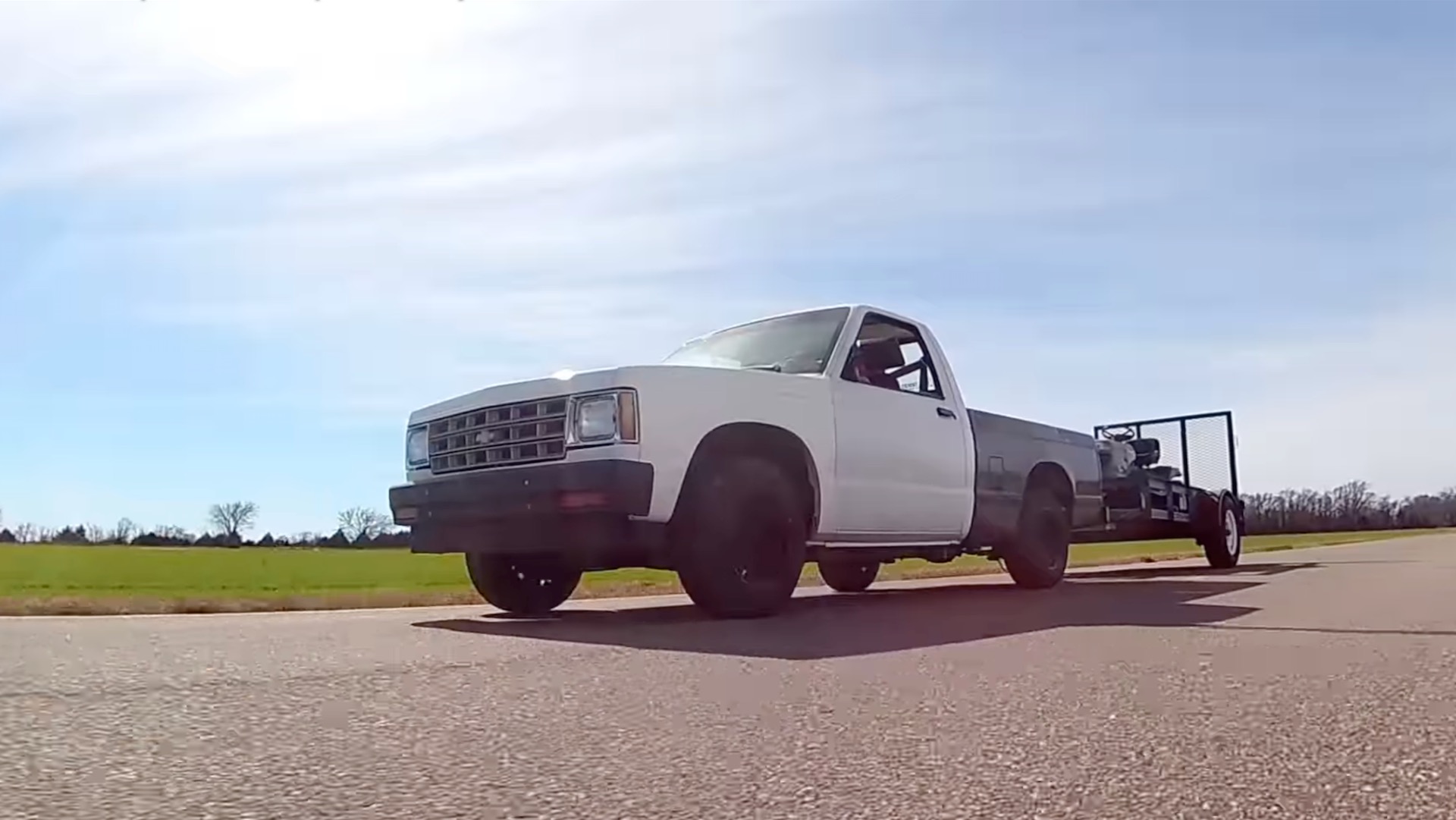
Robot Cantina pulled the original engine from a 1989 Chevy S-10 and replaced it with a 1.6-liter naturally aspirated diesel four-cylinder from a 1985 Volkswagen Golf. The result is a compact pickup making exactly 54 horsepower. That’s roughly what a riding lawn mower produces, and yet this thing actually works.
The swap required an adapter plate to mate the VW engine to a five-speed manual transmission driving the S-10’s rear wheels. It’s a proper budget-engineering project, documented across multiple videos on the channel. But the real test wasn’t whether it would run — it was whether it could haul.
First, the bed got loaded with roughly 300 pounds of a Chevy 350 engine block and miscellaneous parts. Then a trailer carrying a lawn tractor got hitched to the back. Total rig weight came in at 4,140 pounds.
Subtract the truck’s own 2,520-pound curb weight and you’re looking at 1,620 pounds of combined payload and trailer. That’s not nothing for any compact pickup, let alone one powered by an engine that belongs in a European econobox from the Reagan era.
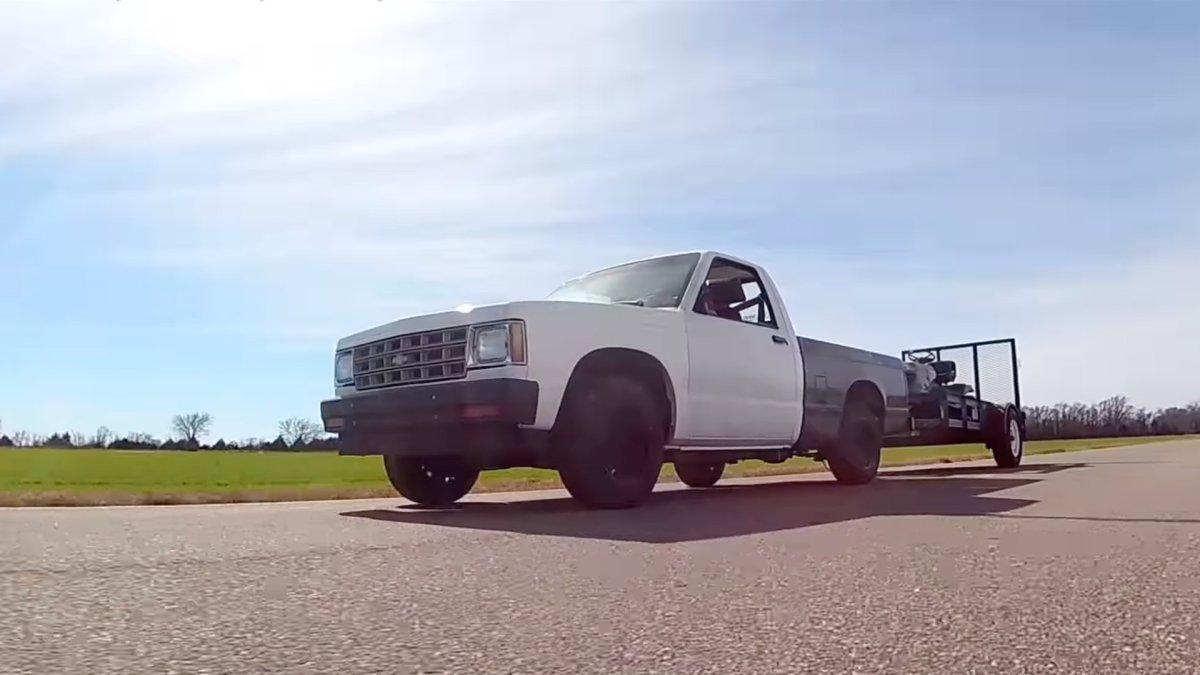
Around town, the loaded S-10 behaved more or less normally. Acceleration was sluggish, sure, but that’s par for the course with any truck pulling a real load. The trouble started above 45 mph.
Exhaust gas temperatures climbed, and acceleration slowed to a crawl. Getting from 45 to 55 mph with the trailer attached took roughly 21 seconds on flat Kansas roads. The aerodynamic drag from the trailer’s upright tailgate was simply more than the little diesel could efficiently overcome.
The numbers tell the story in brutal detail. Unladen, this diesel S-10 hits 60 mph in 28.3 seconds — already glacial by any modern standard. Add the payload alone and that stretches to 34.8 seconds. With the trailer, the owner didn’t even bother attempting a zero-to-60 run — it took 48.1 seconds just to reach 55 mph.
Those flat Kansas roads actually isolated the problem neatly. Hills weren’t a factor. It was pure aerodynamic drag and the engine’s fundamental lack of power that set the ceiling. The owner is now considering a turbocharger, a larger engine, or both. A swap to a 4.10 rear-axle ratio from the stock 3.73 gears might also buy some usable low-end pulling power.
But here’s what matters more than the obvious limitations: this setup actually worked. A 54-horsepower diesel hauled over 1,600 pounds of stuff down public roads at legal speeds. It didn’t overheat. It didn’t break. It just did the job slowly.
The truck industry has spent two decades convincing buyers they need 400-plus horsepower and $80,000 price tags to haul a weekend’s worth of landscaping supplies. Most truck owners never tow anything heavier than what this wheezy VW diesel handled without drama. The average F-150 buyer uses maybe a third of their truck’s capability on the hardest day they’ll ever ask of it.
Robot Cantina’s S-10 isn’t practical transportation for most people. But it’s a loud, slow, rattling reminder that the gap between what trucks can do and what trucks need to do has become a canyon — one the industry is happily filling with profit margin.

Share this Story