
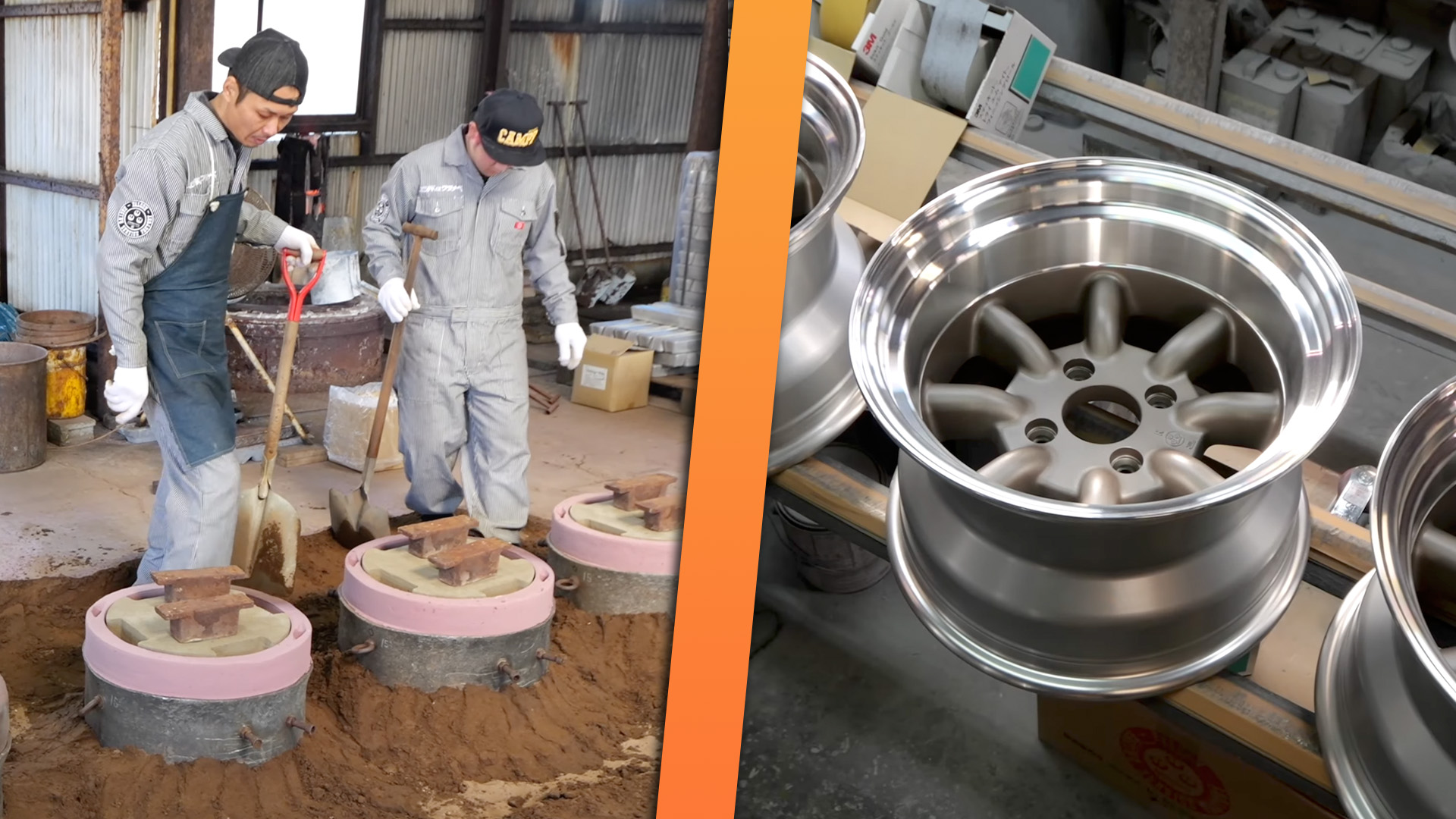


A fifty-minute YouTube video just pulled back the curtain on one of Japan’s most secretive wheel shops, and what it reveals is almost absurdly analog. Racing Service Watanabe, maker of the eight-spoke wheels that defined an era of Japanese performance cars, still casts its products in small furnaces sitting on the floor among stacks of molds and hand tools. The waiting list stretches two years, and after watching how these things are made, that timeline makes perfect sense.
The video, produced by the Japanese Industry Process channel, walks through every stage of manufacturing for both aluminum and magnesium variants. There are no robotic arms, no automated pouring systems, no clean-room aesthetics. Molten aluminum hits 1,292 degrees Fahrenheit, gets scooped out of furnaces in graphite-coated buckets, and poured by hand into two-piece molds with a central core shaped as a mirror image of the wheel’s hub and spokes.
The magnesium process is even more primitive. Sand casting, a technique that predates the internal combustion engine, requires molds made from compacted sand, carefully heated and dried to eliminate moisture. Get that wrong with magnesium, and you get a violent reaction instead of a wheel.
The molds are buried in sand piles, the molten metal goes in, and the mold gets chipped away by hand to free the casting. What comes out looks nothing like a finished RS Watanabe. Excess material gets hammered and sawed off, surfaces are sanded, and imperfections are built back up with a TIG welder then ground smooth again.
A lone CNC machine handles some finishing work, a jarring flash of modernity in a shop that otherwise looks like it could exist in any decade since the 1960s. Stud holes are still drilled one at a time by a person standing at a drill press. A coat of gray paint, a cardboard box, and out the door.
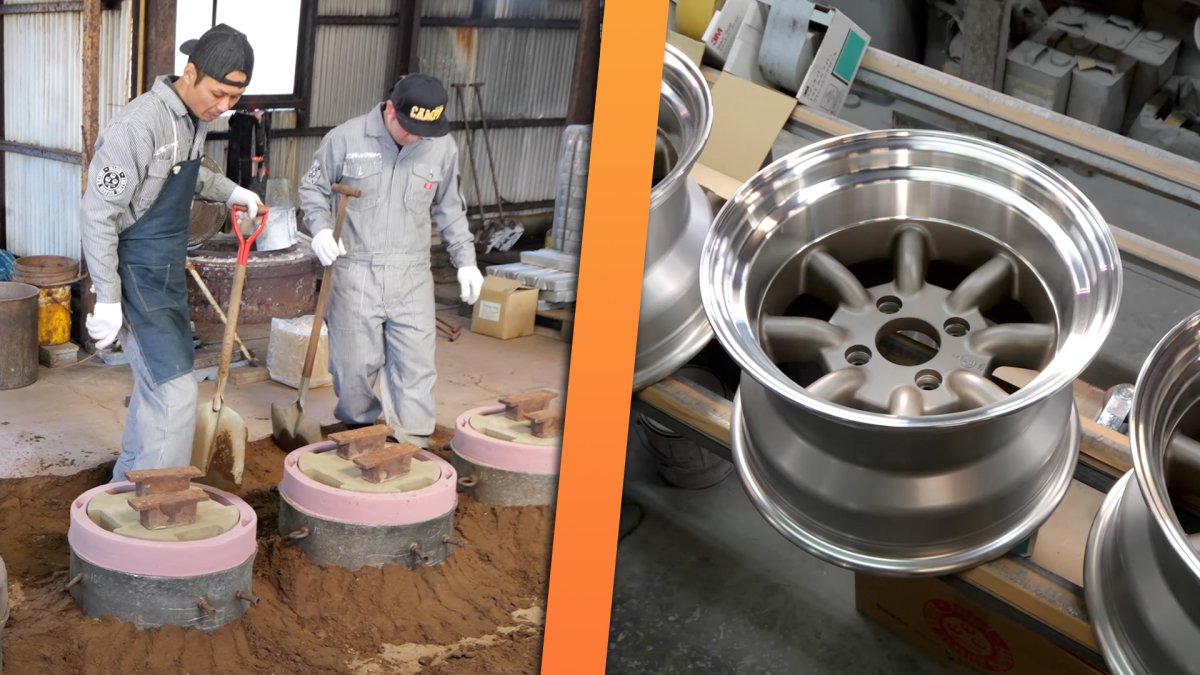
RS Watanabe wheels have been inseparable from the golden age of Japanese motorsport since the company started producing them. Bolt a set of eight-spokes onto a Hakosuka Skyline GT-R, a 240Z, or a TE27 Corolla, and the car is instantly, unmistakably correct. Decades of reproduction attempts by other manufacturers have never quite captured the look, partly because the originals carry the subtle irregularities of handwork baked into their DNA.
That’s also why supply will never catch demand. This isn’t a process that scales. You can’t add a second shift and double output when every casting is hand-poured, every flaw is hand-repaired, and every hole is hand-drilled.
The two-year backlog isn’t a failure of business planning. It’s the direct, unavoidable consequence of refusing to change a manufacturing method that most companies abandoned decades ago.
In an industry racing toward gigacasting, lights-out factories, and automated quality control, a small Japanese workshop is still melting scrap metal in floor-mounted furnaces and pouring it into molds by hand. The result is a wheel that sells before it’s made, commands prices that climb every year on the secondary market, and remains the definitive aftermarket design for an entire genre of car culture.
Nobody at RS Watanabe appears interested in speeding things up. Given that the waiting list itself has become part of the product’s mystique, why would they?




Share this Story