
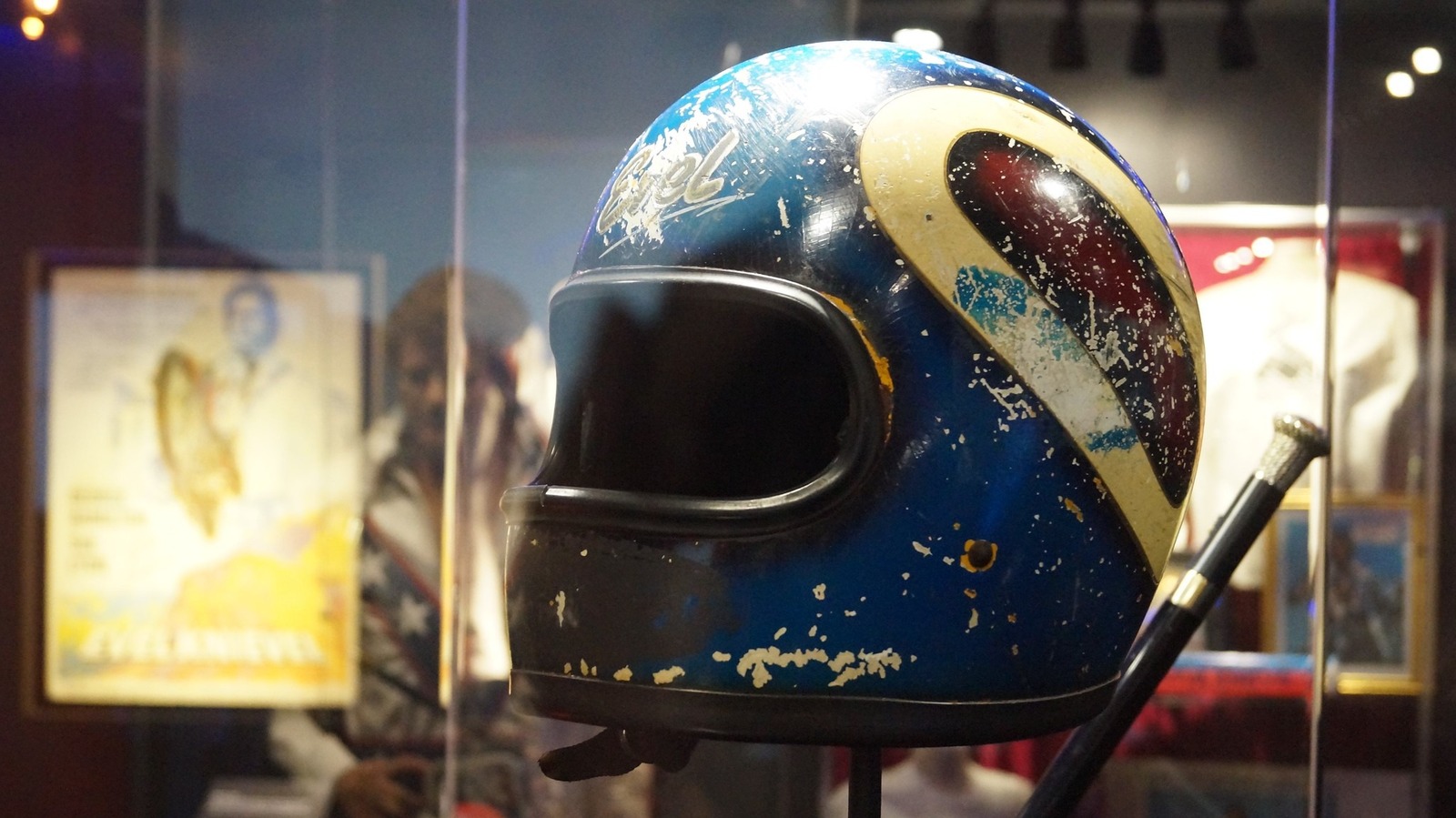


The helmet that kept Evel Knievel alive after he came up short jumping the Caesar’s Palace fountains in 1967 and spent 29 days in a coma is moving to a new home — just a few miles from where he nearly died wearing it.
The Evel Knievel Experience opens June 27 in the downtown Las Vegas arts district, a relocation and expansion of what was previously the Evel Knievel Museum in Topeka, Kansas. Tickets are already on sale. The move is less about honoring a legacy and more about putting that legacy where people will actually see it.
Topeka, for all its charms, is not a place tourists stumble into. Las Vegas is. And Knievel’s story — the spectacular crashes, the white jumpsuits, the sheer lunacy of trying to rocket across a canyon — belongs in a city that has always understood spectacle better than anywhere else in America.
The collection is serious. Motorcycles Knievel actually jumped are on display, along with the jumpsuits he wore mid-flight. Big Red, his Mack truck and trailer that hauled him, his crew, and his bikes from one bone-shattering event to the next, anchors the exhibit after a full restoration.
Big Red was originally supposed to become a rolling memorabilia show before the Topeka museum materialized. Now it gets a permanent home under a real roof.
The crown jewel might be the X-2 Skycycle, the steam-powered rocket that was supposed to carry Knievel across Snake River Canyon in 1974. It didn’t. The parachute deployed prematurely, and Knievel drifted down into the canyon instead of across it.
The launch ramp still stands in Twin Falls, Idaho, a concrete monument to ambition outrunning engineering. Stuntman Eddie Braun eventually completed the jump in 2016 using a replica, proving the concept worked — just not for Knievel, not that day.
The rebrand from “museum” to “experience” signals the Las Vegas version won’t just be glass cases and placards. A virtual reality simulator puts visitors on a motorcycle and launches them over 16 cars. A jump planner lets you design your own stunt and find out digitally whether you’d survive it.
Because Knievel’s career was defined as much by failure as triumph, a “Bad to the Bones” exhibit catalogs the staggering injuries he accumulated — 433 bone fractures by some counts, a body held together by metal plates and willpower.
Knievel died in 2007, but his influence still ripples through motorsports. Travis Pastrana has recreated several of his most famous jumps, including the Caesar’s Palace fountain leap in 2018, successfully this time. Pastrana broke bones doing it, naturally, because that seems to be part of the inheritance.
There’s a logic to this move that goes beyond foot traffic and ticket revenue. Knievel built his career on spectacle performed in front of live crowds, often in stadiums, often on television, always with the understanding that failure might be fatal. Las Vegas runs on that same currency — the thrill of the bet, the drama of the outcome.
A quiet museum in Kansas honored the man. Dropping his story into the neon heart of Vegas honors what he actually did for a living.
June 27 is the date. The arts district downtown is the address. Bring your appetite for broken bones and bad odds.


Share this Story