
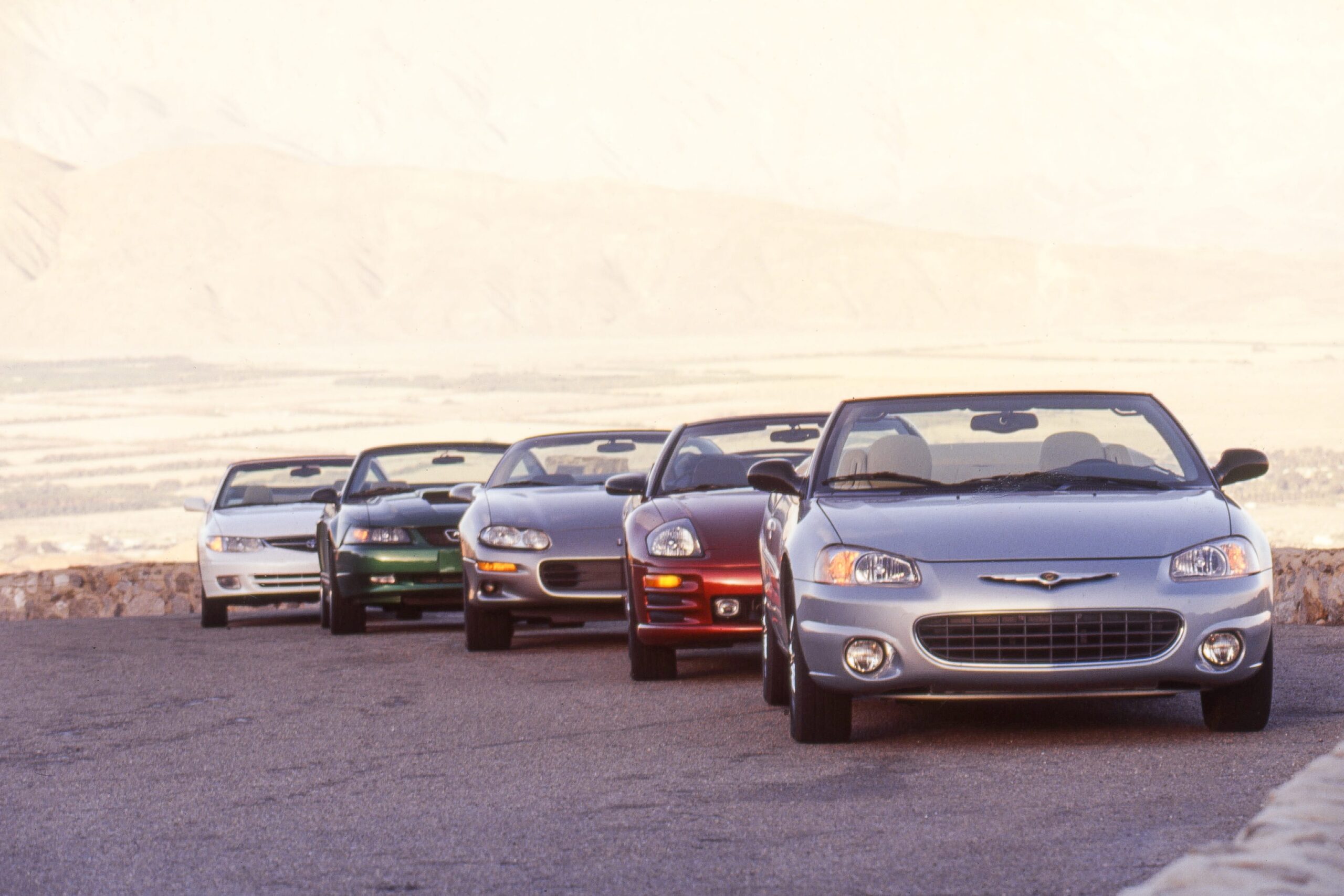


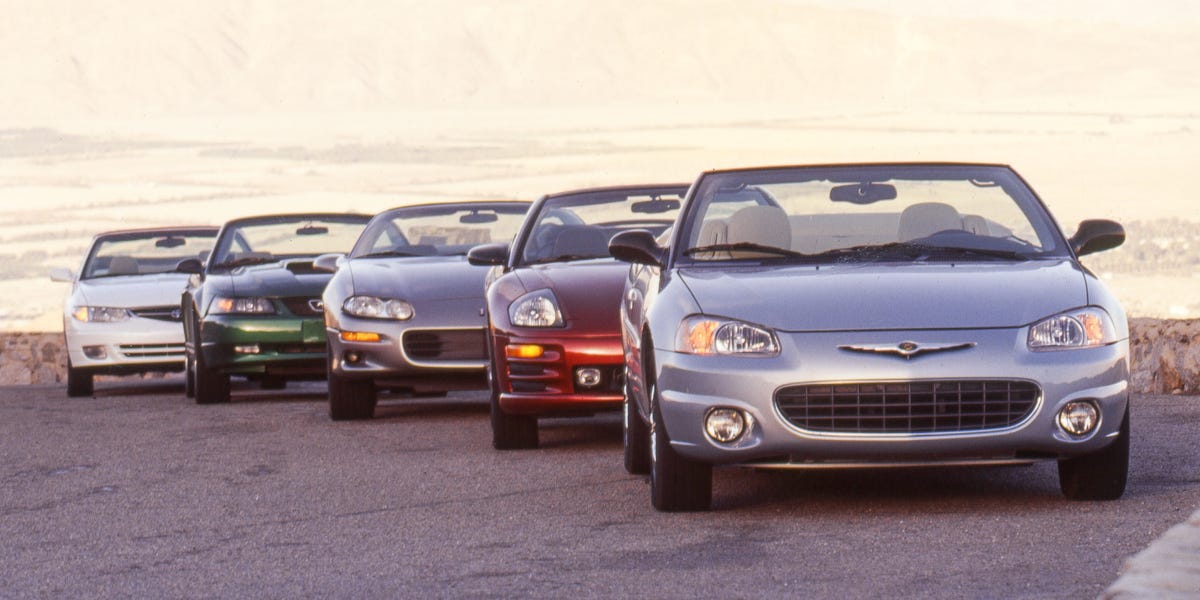
Twenty-four years ago, Car and Driver lined up five four-seat convertibles under a $30,000 ceiling and drove them 700 miles across Southern California, from L.A. freeways to mountain switchbacks to desert flats. The result was a test that pitted two fundamentally different philosophies against each other: refined front-drive V-6 cruisers versus old-school rear-drive V-8 bruisers. The bruisers won.
The Chevrolet Camaro Z28 took first place. Its 310-horsepower LS1 V-8, limited-slip differential, and sharper suspension made it the quickest, the grippiest, and the most involving car in the group. The Z28 convertible squeaked under the $30,000 price cap with room to spare and delivered performance none of the others could touch.
Pontiac didn’t even bother showing up. The $30,000 limit meant a V-6 Firebird, not a Trans Am, and Pontiac’s PR team did the math and stayed home. Smart call, given the 110-horsepower gap between a base V-6 and the Z28’s LS1.
The real surprise was second place: the Mitsubishi Eclipse Spyder GT. A front-drive V-6 convertible that, by the testers’ account, blended comfort and reflexes well enough to push the Camaro to the final tally. Nobody expected a Mitsubishi to nearly topple a Z28, but the Eclipse’s combination of decent power, manageable size, and willing chassis made it the giant-killer of the group.
Chrysler’s freshly redesigned Sebring Limited landed third. It rode beautifully, had the quietest cabin, operated its top faster than anything else in the test, and offered the best value. But its new 2.7-liter V-6, despite a 32-horsepower improvement over the outgoing Mitsubishi-sourced engine, still couldn’t muster enough punch. Nine seconds to 60 mph and nearly 26 to reach 100 left testers writing about “wistful yearning for more snort.”
The Ford Mustang GT finished a startling fourth. This was, and remains, America’s iconic convertible. A 260-hp V-8, a limited-slip rear end, Bullitt-inspired wheels, and build quality that genuinely impressed the staff. It hit 60 in six seconds flat, ran the quarter in under 15, nailed the best lane-change time, and stopped almost as well as the Camaro.
None of that mattered because the seats were terrible. Every single tester complained. The cockpit was too small for tall drivers, the pedal spacing defied human anatomy, and the rear seat was medieval. You can forgive a lot of sins in a car you’ll spend hours in with the top down, but not seats that make you want to stop.
The Toyota Camry Solara SLE brought up the rear without a single advocate on staff. It had the best back seat, the most features, and the highest price. It also had the worst skidpad grip, the most body roll, the slowest lane-change time, and a chassis so flexible it made the whole car shudder over bumps. Every Camry virtue was present, and every one of them evaporated the moment the road got interesting.
What jumps out reading this test in 2025 is how nakedly it exposed the split personality of the convertible market at the turn of the century. The comfortable cars weren’t fun. The fun cars weren’t comfortable. Only the Eclipse managed to thread that needle, and Mitsubishi would eventually abandon the segment entirely.
The Camaro would be killed off two years later. The Mustang would be reborn in 2005 on a platform that finally addressed most of its ergonomic sins. The Solara would die quietly in 2008, and the Sebring would stumble through one more generation before being replaced by the 200, which itself is now gone.
Every single car in this test has been discontinued. The convertible segment under $30,000, once crowded enough for a five-car comparison, has essentially ceased to exist. That 700-mile California drive was a snapshot of a market that was already shrinking, captured just before the walls closed in for good.


Share this Story