
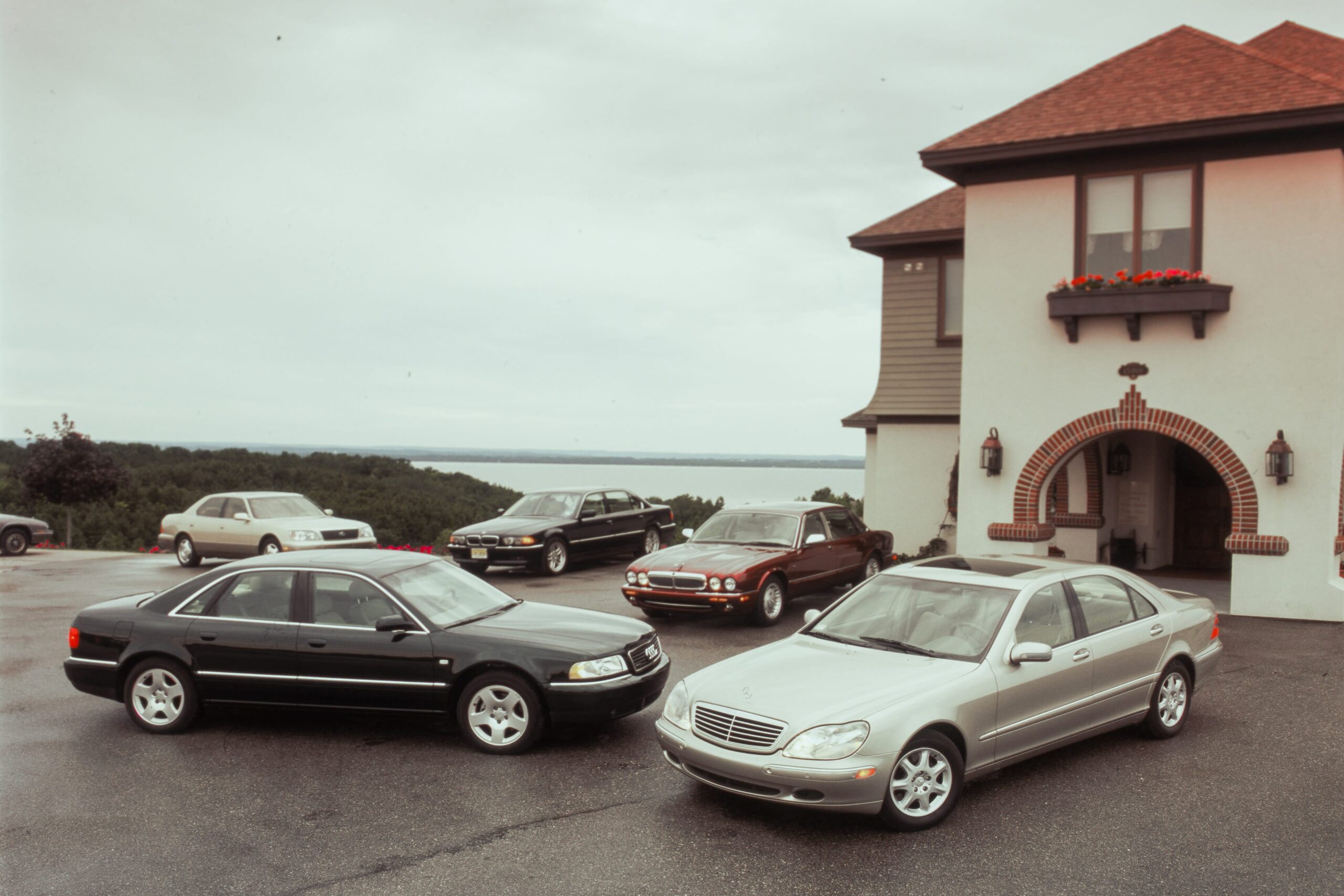


The Dow was flirting with 11,200, dot-com millionaires were picking out driveways, and Car and Driver lined up five $70,000 luxury sedans to see which one deserved to sit in them. It was November 1999. The BMW 740iL won, and twenty-five years later, that result still tells you something about what separates a great luxury car from a merely expensive one.
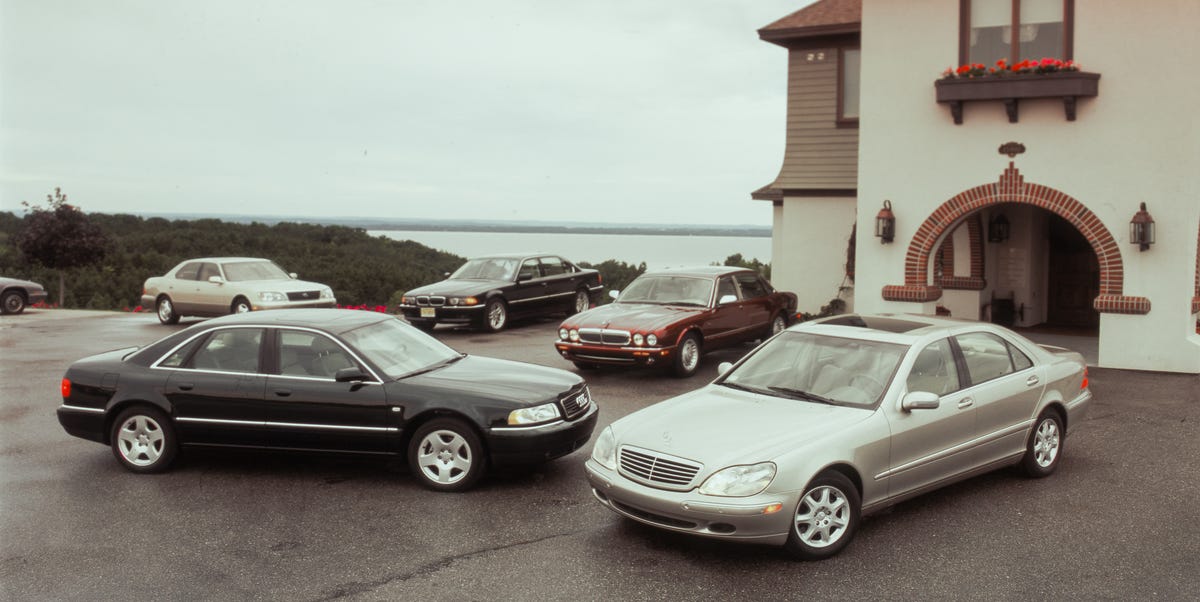
This was the golden age of the big V-8 four-door. Five sedans, all pushing 300 horsepower, all wrapped in leather and burled wood, all carrying five-speed automatics and early-generation navigation systems that made a QWERTY keyboard look intuitive. The BMW 740iL, Lexus LS400, Audi A8 4.2 Quattro, Mercedes-Benz S430, and Jaguar Vanden Plas, separated by just five points across four places.
The Audi was quickest to 60 mph at 7.0 seconds flat, courtesy of a freshly upgraded 310-hp, 40-valve V-8. It had the best cockpit ergonomics, the most intimate driving environment, and Quattro all-wheel drive wrapped in an aluminum body. But Continental tires that squealed too easily and sang too loudly on the highway, plus brakes that needed 202 feet from 70 mph, kept it in third.
The brand-new Mercedes S430 looked like the obvious frontrunner. Its interior was a revelation — warm, sensuous, almost tropical in its departure from the cold Teutonic Mercedes of the early ’90s. Rain-sensing wipers, self-closing doors, power thigh support, a rear sunshade rising from the package tray.
It was a technology showcase that finished fourth. Slowest to 60, slowest to 100, weakest on the skidpad at 0.76 g, and cursed with a dead zone at the top of the brake pedal. Mercedes had built a gorgeous living room that happened to have wheels, and the driving experience couldn’t cash the checks the interior was writing.
The Jaguar Vanden Plas landed fifth, and it wasn’t close. Beautiful in the way old British furniture is beautiful — Connolly leather, pinstripe wood inlays, airline-style fold-down tables for rear passengers angled just right to dump soup in your lap. The body flexed over rough pavement, the cabin was too narrow, and the dash buttons demanded eyes off the road.
The Lexus LS400 took second place by doing what Lexus has always done: delivering Rolls-Royce refinement at a fraction of the cost. Silence, composure, grace. It was the sedan you chose when you wanted the world to disappear, but never the sedan you chose when you wanted to feel the road beneath you.
That distinction belonged to BMW. The 740iL won because it refused to choose between luxury and driving involvement. Where the Lexus isolated, the BMW communicated. Where the Mercedes dazzled with gadgets, the BMW dazzled with steering feedback.
Where the Audi hustled but tripped over its tires, the BMW delivered the whole package — enough power, enough comfort, enough technology, and a chassis that made a 4,000-pound sedan feel like it wanted to be driven hard. The margin was razor-thin. Five points across four cars.
But BMW’s win reinforced a hierarchy that would define luxury sedans for the next decade: technology and opulence alone don’t win. The car that makes the driver feel most alive, most connected, most in control — that’s the one that takes the crown.
It’s worth remembering what $70,000 bought in 1999. Adjusted for inflation, that’s north of $130,000 today. These were serious machines for serious money, and the test exposed a truth the market was slow to accept.
Mercedes was chasing emotion over engineering. Jaguar was living on heritage fumes. Lexus was perfecting a formula that would eventually plateau. Audi was building the right car with the wrong rubber.
BMW simply built the best driver’s sedan money could buy. The stock market crashed not long after. The 740iL held its value better than most portfolios.


Share this Story