
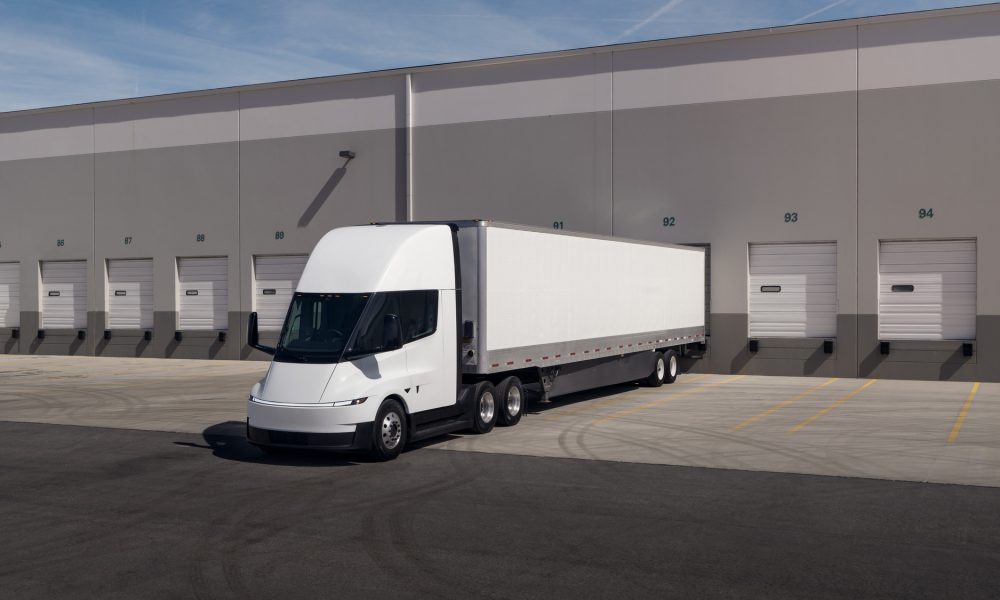


IMC Logistics ordered 50 Tesla Semi trucks and either took delivery last week or will receive them this week, according to the company’s VP of Marketing and Public Relations. That makes IMC one of the first commercial fleets to get production units after Tesla’s September handover event in Sparks, Nevada.
IMC is not a small operator looking for a green halo. The company runs drayage and landside logistics across more than 50 locations in the United States, with over 2,700 asset trucks already in its fleet. Fifty Semis represent a fraction of that total, but the intent is pointed.
Jim Gillis of IMC said the trucks will help the company move toward “zero-emission service for long-haul lanes.”
The order follows what Tesla described as the first truly public phase of its Semi program. For years, the electric truck existed in a prolonged pilot with PepsiCo and Frito-Lay, a test bed that generated data but no meaningful commercial volume. That changed in September when Tesla began handing over production units to multiple fleet customers at a dedicated event at its Sparks factory.
IMC’s 50-unit buy lands just weeks after Tesla reportedly secured what was called the biggest electric truck deal in U.S. history. The pace of orders suggests pent-up demand that Tesla kept bottled behind production constraints for the better part of three years.
Diesel prices and logistics costs are doing Tesla’s sales pitch for it. Fleet operators care about cost per mile, and battery electric drivetrains slash fuel expense in a way that makes the upfront premium easier to justify on a spreadsheet. Tesla has also dangled the future promise of Full Self-Driving integration, which could reduce driver fatigue on long hauls and push utilization rates higher.
That remains a forward-looking claim, not an operational reality for Class 8 trucks today.
The Semi factory in Sparks is still ramping. Tesla has not disclosed a production rate, and observers remain skeptical about whether the company can build these trucks fast enough to meet the growing order book. Battery cell supply, which constrained the Semi for years, appears to have loosened, but Tesla has offered no specifics on cell sourcing or annual capacity targets for the line.
What makes the IMC deal worth watching is the customer profile. Drayage fleets operate short, repetitive routes between ports, rail yards, and warehouses, exactly the duty cycle where battery electric trucks perform best. Range anxiety barely enters the equation when a truck runs the same 100-mile loop every day and charges overnight at a depot.
IMC is buying into the use case that the math already supports.
Tesla still faces competition it did not have when it first unveiled the Semi in 2017. Daimler’s eCascadia is in customer hands. Volvo’s VNR Electric has been logging miles for paying fleets.
Nikola’s bankruptcy cleared the deck of one rival, but others have filled the space with real trucks and real service networks. Tesla’s charging infrastructure advantage through its Megacharger program could be a differentiator, though the company has said little about how many Megacharger sites are operational.
Fifty trucks for IMC. Production units flowing out of Sparks. Orders stacking up. The Semi is no longer a concept that Tesla shows off once a year and then puts back in the garage. Whether the factory can keep pace with the demand signal is a question Tesla has not yet answered.
Share this Story