
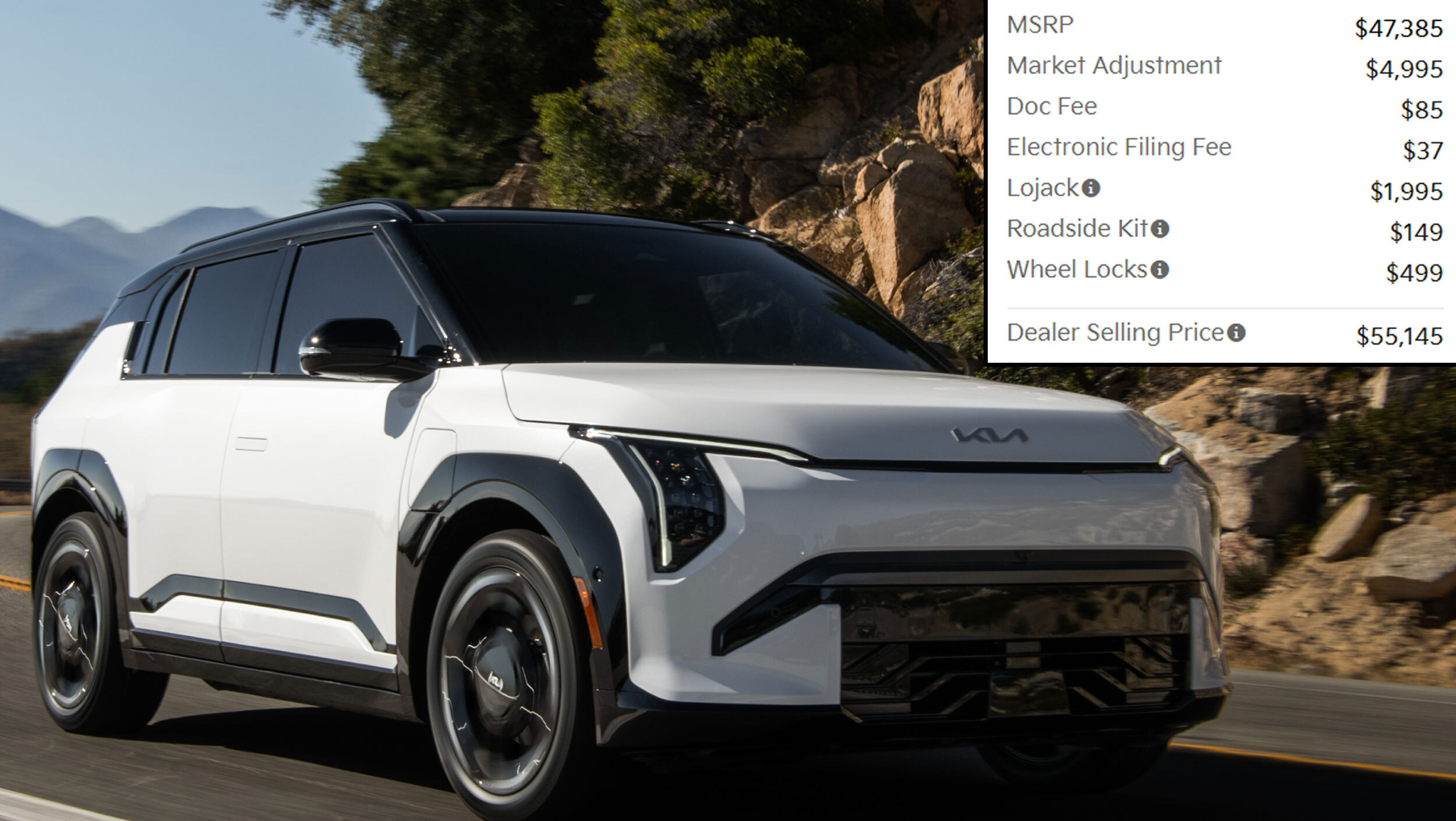


The Kia EV3 starts at $29,890. One California dealership wants $55,145 for a GT trim. That gap tells you everything about the franchise dealer model’s inability to leave a good thing alone.
Car Pros Kia Glendale tacked a $4,995 “market adjustment” onto their EV3 GT, which already stickers at $47,385. Then came the accessories nobody asked for: $1,995 for Lojack, $499 for wheel locks, $149 for a roadside kit. By the time the document and filing fees landed, the total hit $7,760 over MSRP. For context, a 2026 EV6 GT-Line, a larger and more capable vehicle, starts at $48,700.
This isn’t a one-dealer problem. Hendrick Kia of Concord, North Carolina padded their EV3 GT-Line with $997 in dealer-installed options like window tinting, an infotainment screen protector, and door edge guards. Sunset Kia of Sarasota wrapped $995 in nitrogen tire fills, oil changes, and DuPont coating into a “value package” bolted onto the price.
The playbook is familiar. Bundle low-cost accessories at inflated prices, present them as non-negotiable, and pocket the margin. Dealers have been doing it for decades, but the practice stings harder on a vehicle whose entire sales pitch is affordability.
Kia built the EV3 to crack open the affordable EV market in America. The $29,890 base price undercuts the Chevrolet Equinox EV and slots well below Tesla’s cheapest offering. The car exists to pull buyers off the fence, people who want electric but cannot stomach $45,000 entry points. Dealer markups torch that strategy at the curb.
Not every store is playing the game. Ourisman Kia of Bethesda, Maryland has a $1,834 discount on a $36,685 EV3 Wind. Stack $1,500 in Kia factory cash on top, and the out-the-door number drops to around $33,351 before a processing fee. Courtesy Kia of Brandon, Florida is cutting $2,098 off the same trim, more than covering their $998 in pre-delivery charges.
The spread between the worst and best dealers on the same car is approaching $10,000. That is not a rounding error. It is a structural failure in how new cars reach consumers.
Kia corporate can build an attractive product, price it competitively, and run national advertising campaigns promising value. None of that matters when an independent franchise operator decides the local market will bear five grand extra. The manufacturer has limited tools to stop it.
Franchise laws in most states protect dealer pricing autonomy, a legal framework designed decades ago to shield small business owners from factory overreach. Today it mostly shields margin-stuffing.
This tension between manufacturer intent and dealer execution is exactly why companies like Tesla and Rivian chose direct sales. It is why Hyundai and Kia’s own Genesis brand experimented with fixed pricing. And it is why customers who do their homework will drive past three dealerships to reach the fourth one selling at sticker or below.
The EV3 is arriving in volume now. Inventory will build. The dealers adding markups today will be the same ones running clearance ads in six months, begging for floor traffic. The question is how many buyers they scare off in the meantime, customers who will remember the experience long after the price adjusts.
Share this Story