
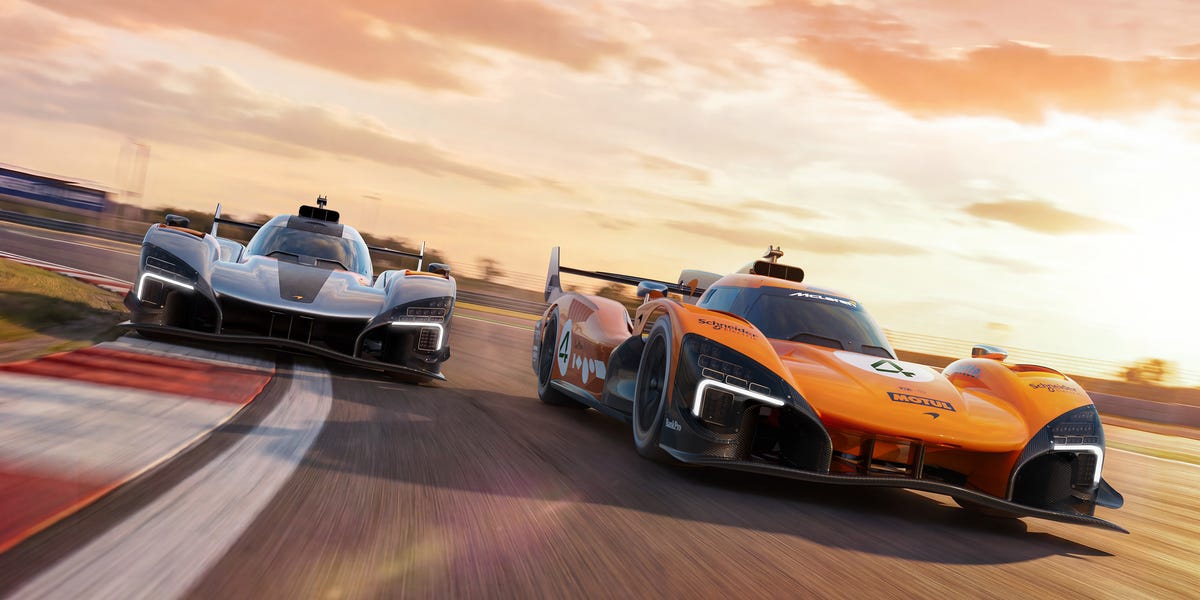


Nearly 700 horsepower, a 2.9-liter twin-turbo V-6, a carbon fiber monocoque, and a papaya livery that nods to Bruce McLaren’s 1960s Can-Am dominance. The MCL-HY, revealed Monday, is McLaren Racing’s ticket back to the top class at Le Mans. It’s also the foundation for one of the most exclusive track toys money can buy.
Testing begins this month. The 2027 FIA World Endurance Championship debut looms. And if Zak Brown’s ambitions hold, this car completes the puzzle for McLaren’s pursuit of the Triple Crown — Monaco, Indianapolis, Le Mans — a trifecta no organization has ever held simultaneously.
That’s the big-picture pitch. The details tell a more nuanced story.
Built to LMDh regulations, the MCL-HY race car pairs its twin-turbo V-6 with a mandated hybrid motor-generator unit, producing 697 horsepower through the rear axle. Minimum weight sits at 2,270 pounds. It’s a proper endurance prototype, engineered to balance raw pace with the grueling fuel and tire arithmetic that decides races at La Sarthe.
The customer variant, dubbed MCL-HY GTR, ditches the hybrid system entirely. Without the MGU and its associated hardware, the track car actually makes more power — roughly 720 horsepower — while weighing less than the race car’s regulated floor. McLaren frames this as a “purer driving experience,” but it’s also a shrewd calculation about what billionaire collectors actually want: fewer electronics to maintain and more visceral feedback through the steering column.
This is not a new playbook. The 1995 McLaren F1 GTR wrote the template — race car for the factory, barely detuned version for the garage. What’s different now is the ecosystem McLaren has built around the purchase.
Owners get a two-year, six-event track program at elite circuits worldwide, with dedicated pit crews, engineering support, and professional coaching. It’s arrive-and-drive for people whose definition of a weekend hobby involves seven-figure machinery.
Deliveries start toward the end of 2027, which means McLaren needs its Le Mans debut that June to go well. Nothing sells a track toy like a Sarthe trophy. Nothing kills the momentum like a DNF.
The competition is daunting. Toyota, Porsche, Ferrari, BMW, Cadillac, Peugeot, Alpine, and Lamborghini already populate WEC’s hypercar grid. Several of them have years of development baked into their programs. McLaren is arriving late to a party that has never been more crowded or more technically demanding.
Works driver Mikkel Jensen will lead the testing effort, supported by development drivers Gregoire Saucy and Richard Verschoor, plus United Autosports veteran Ben Hanley. The car must be homologated by winter, leaving roughly six months to shake down a brand-new chassis, powertrain, and aero package. That’s tight for any team, let alone one building an endurance program from scratch.
McLaren’s press materials lean heavily on heritage — Can-Am, the F1 GTR, Bruce McLaren’s unrealized dream of bringing the M6GT to Le Mans. It’s effective storytelling. But heritage doesn’t set lap times. Porsche has more Le Mans victories than anyone and still got beaten by Toyota and Ferrari in recent years.
The MCL-HY is a beautiful machine draped in a beautiful narrative. Now it has to prove it can run 24 hours without breaking, in a field full of cars that already know they can.
Share this Story