
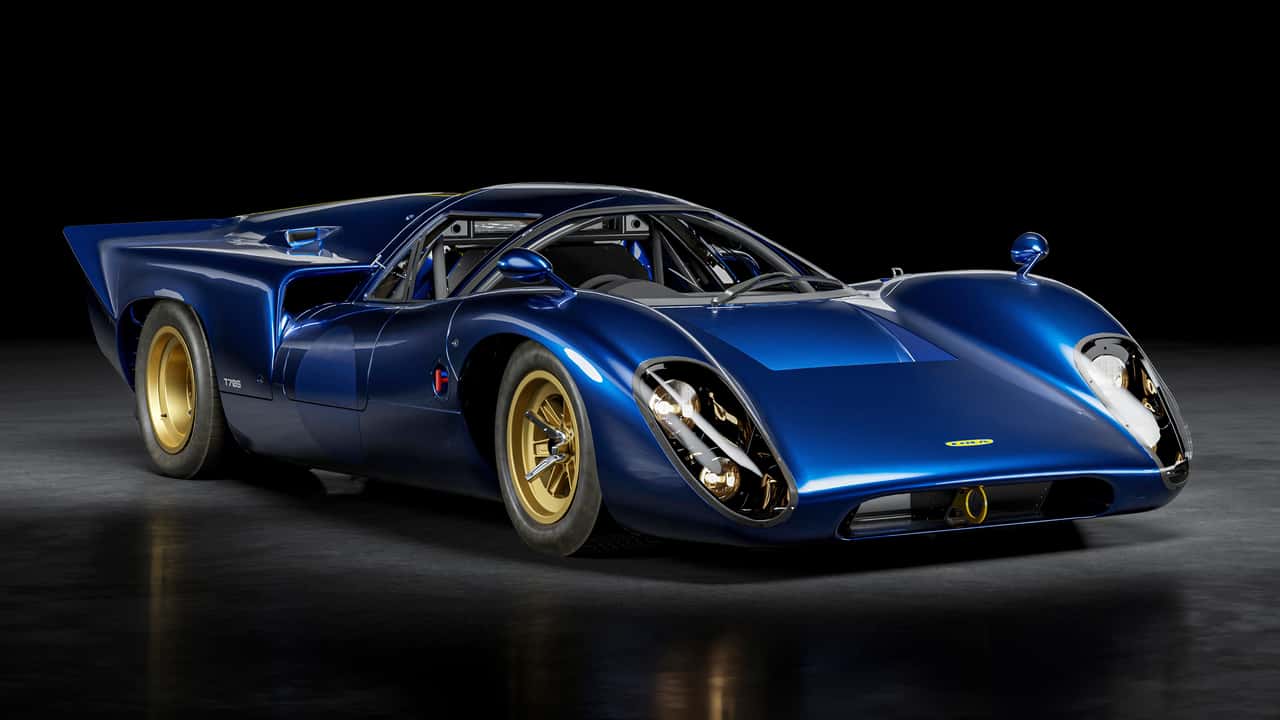


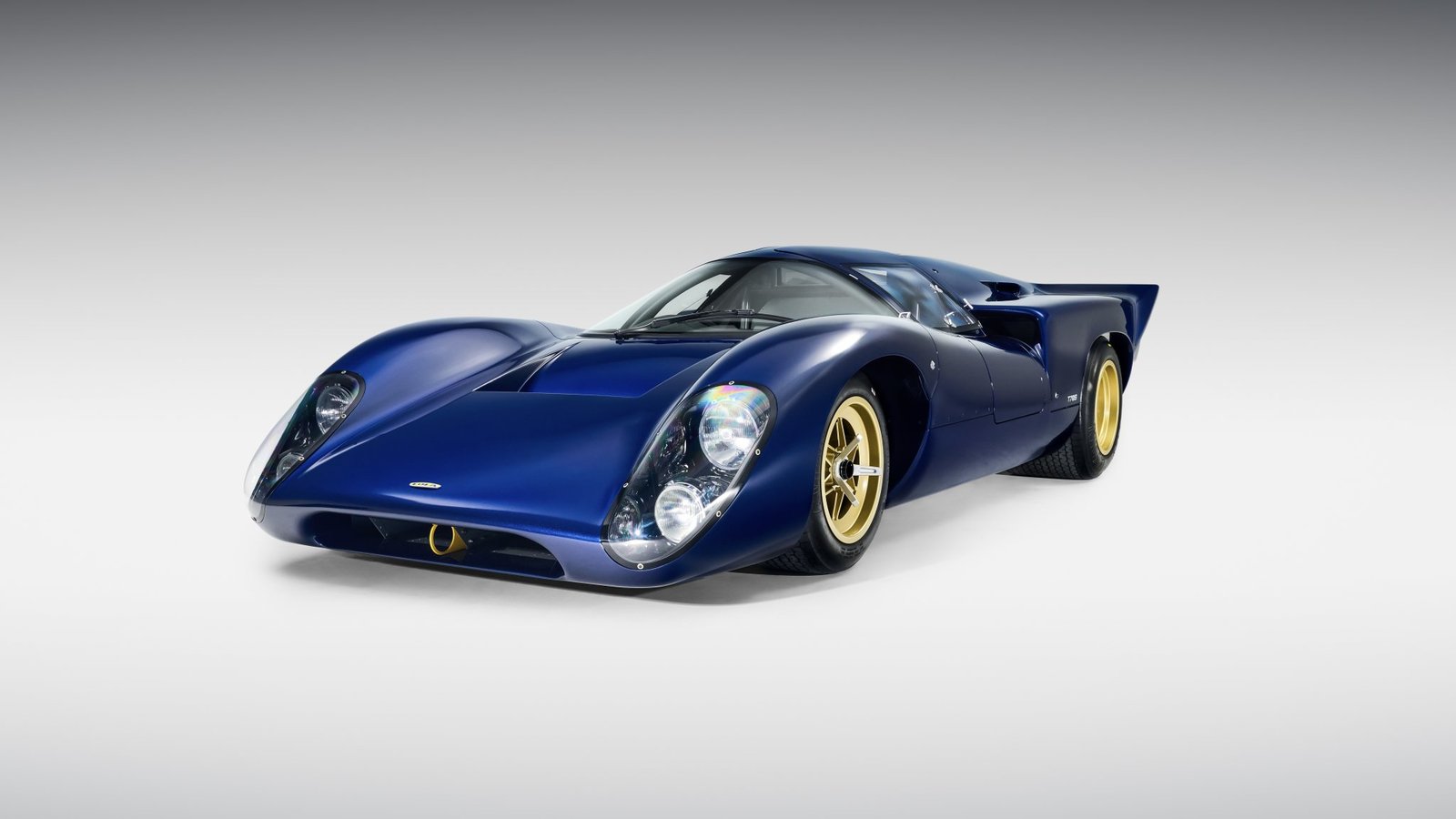
Sixteen cars. That’s all Lola is building of its revived T70S, matching the original production run of the legendary T70 Mk III from the late 1960s. Packed into that tiny number is a startling collision of old and new — a Chevrolet V8 nestled inside bodywork made from flax, basalt fiber, and renewable resin, with not a drop of petrochemical in the panels.
Lola Cars, the storied British racing constructor that went into administration in 2012, returned under entrepreneur Till Bechtolsheimer’s ownership and initially planted its flag in Formula E. Sensible, forward-looking, and about as emotionally stirring as a spreadsheet. The T70S is something else entirely.
The car exists in two forms. A track-only competition version runs a race-built 5.0-liter Chevy small-block making 530 horsepower, enough for a 2.5-second sprint to 60 mph and a 203-mph top speed. It’s been designed from archival drawings and laser scans of the original, with period-correct double-wishbone suspension and transaxle gearbox. Lola says it’ll be eligible for FIA-sanctioned historic racing, which means the details aren’t approximate — they’re exact.
Then there’s the road-legal T70S GT, powered by a modern 6.2-liter Chevy V8 tuned to meet global emissions standards while delivering 500 horsepower. Climate control, refined dampers, and what Lola diplomatically calls “limited” luggage space — enough for a helmet — make it theoretically livable. A 2.9-second 0-60 time and 200-mph top speed suggest it won’t feel domesticated.
The real story, though, is how the thing is made. Lola has patented what it calls the Natural Composite System, replacing carbon fiber’s petroleum-based resins with a combination of flax and basalt fibers bonded with renewable resin. The roughly 100 kilograms of magnesium in the car isn’t smelted in a traditional foundry — it’s extracted from seawater using solar power. Lola claims the overall manufacturing carbon footprint is 54 percent lower than conventional methods, and the company is publishing a full life-cycle assessment to prove it.
That’s a gutsy move for a car with a big V8 rumbling in the middle of it. Lola isn’t pretending the contradiction doesn’t exist — it’s leaning into it, planning to run sustainable fuel during the testing phase.
The transmission is perhaps the most curious piece of engineering in the package. It presents itself as a traditional H-pattern manual with a clutch pedal, but there’s no mechanical linkage between the shift lever and the gearbox. A shift-by-wire system reads the driver’s inputs through sensors and executes changes instantaneously. Lola promises it’ll feel like the real thing. That’s a promise the 16 buyers will hold them to.
At its core, this is a proof of concept wearing the skin of a gorgeous 1960s sports racer. Lola technical director Peter McCool frames it as “a blueprint for the future of historic motoring and motorsport,” and he’s not wrong, even if the language is a bit grand for a run of 16 cars. The natural composites, the solar-extracted magnesium, the wire-controlled manual gearbox — any of these could migrate into larger production if they prove durable under the stress of actual racing.
Lola’s gamble is that the future of combustion-powered performance cars doesn’t require abandoning combustion. It requires rethinking everything around it — materials, manufacturing processes, fuel sources. The T70S doesn’t apologize for its V8. It just builds a cleaner house around it.
Whether that’s enough to matter at scale remains an open question. But for now, Lola has done something genuinely rare: it has made a nostalgia play that actually points forward.





Share this Story