
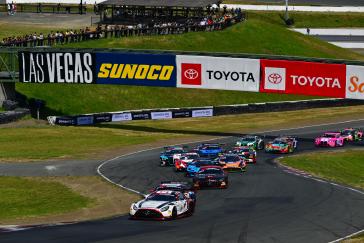


The margin was 0.922 seconds. That’s all that separated JMF Motorsports from the pack after three hours of racing at Sonoma Raceway on Sunday, but the number flatters the competition. Mikael Grenier and Michai Stephens controlled the inaugural three-hour GT World Challenge America race from the moment the green flag dropped, turning the series’ new endurance format into a statement win for the second-year Mercedes-AMG squad.
SRO America’s shift from sprint races to three-hour endurance events is the biggest structural change the series has made in years. Every round except the season-ending Indianapolis 8 Hour will now run this format. It rewards depth in engineering, driver management, pit strategy, and tire conservation, and punishes the kind of small-team sloppiness that sprint racing can sometimes hide.
JMF showed up prepared. Stephens started from pole, briefly lost the lead at the end of the first hour, took it back, and handed the car to Grenier before the halfway mark. Grenier never relinquished it.
The win mirrored 2025, when this same pairing won at Sonoma in JMF’s series debut. A year later, with a harder test in front of them, they delivered again. GMG Racing’s Porsche took the Pro-Am victory while AF Corse’s Ferrari claimed Am honors, but the overall belonged to the No. 34 Mercedes-AMG GT3 without serious dispute.
JMF’s ambitions are bigger than one car now. The team expanded to two GT3 entries this season, with Jason Daskalos and Lorcan Hanafin qualifying third overall and winning the Pro-Am pole in the No. 27 car. That effort unraveled in the pits.
A pair of pit stop penalties, one self-inflicted per Daskalos’s own admission of a gear selection mistake during his stop, buried them to ninth in Pro-Am. The speed was there. The execution wasn’t.
“I made a mistake coming into the pits. I left it in second gear instead of going down to first. That’s on me,” Daskalos said. Honest self-assessment from a gentleman driver who knows he can’t afford another one when each weekend now offers just a single shot at points.
TR3 Racing’s Mercedes-AMG GT3 had its weekend wrecked by early contact, forcing a trip to the paddock for repairs and relegating Will Bamber and Brayton Williams to a laps-down finish. Williams put on a brave face. “The car is a lot of fun,” he said. It’s easier to say that when the bodywork is intact.
In Pirelli GT4 America, the support races told a rougher story for Mercedes-AMG’s customer teams. Dome Motorsport expanded to two cars and came with genuine pace, with Allen Patten winning the Pro-Am pole in his debut, but both entries got caught up in contact incidents across Friday and Saturday that had nothing to do with their speed.
Eddie Killeen salvaged a podium and a fifth-place finish in the Am class with new co-driver Laura Hayes, who had never sat in a Mercedes-AMG GT4 before Wednesday. She didn’t know she was leading until she saw a screenshot. Welcome to the deep end.
The pattern across the entire Mercedes-AMG customer racing portfolio at Sonoma was consistent: qualifying speed is not the problem. The No. 34 proved it can convert that speed into results under pressure. Everyone else in the stable left points on the table through pit lane errors, first-lap tangles, or bad luck they couldn’t outrun in a three-hour race.
Grenier framed it clearly. We have to score as many points as possible early in the year, which we didn’t do last year.” In a format that offers one race per weekend instead of two, every result carries double the weight. One bad pit stop, one overeager competitor in Turn 1, and the math gets ugly fast.
Round 2 heads to Circuit of The Americas in late April. JMF arrives with maximum points and the kind of institutional confidence that compounds. The rest of the Mercedes-AMG customer roster arrives knowing they had the cars to compete and didn’t. That gap between potential and execution is the story of this young season.

Share this Story