
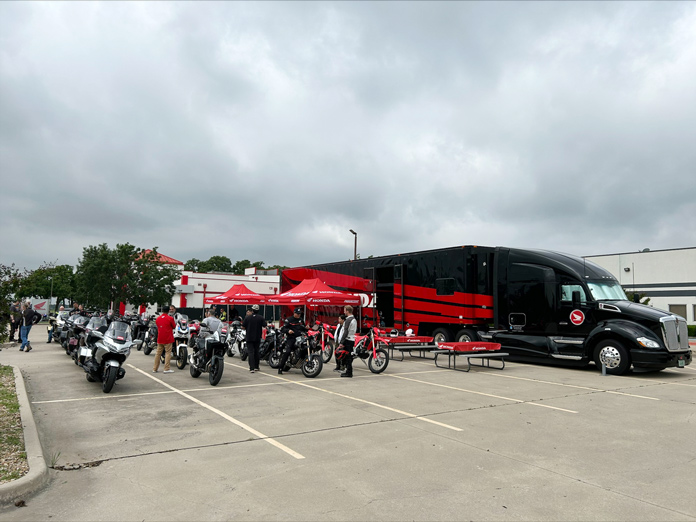


Two trucks, 50 dealerships, and 18 motorcycles. That’s Honda’s formula for solving a problem that no spec sheet, YouTube review, or Instagram reel can fix: getting undecided buyers to actually twist a throttle.
American Honda announced its 2026 Ride Red Demo Days program this week, a year-round nationwide tour kicking off April 3-4 at RideNow Peoria in Arizona before fanning out across the country. One truck covers the East, one covers the West, and each hauls a fleet spanning six categories of Honda’s on-road lineup.
The model list reads like a deliberate cross-section of Honda’s entire street portfolio. Gold Wing for the mile-eaters. NT1100 for the sport-touring crowd. Africa Twin and Transalp for the adventure riders who actually leave pavement. CRF450RL and CRF300L Rally for the dual-sport contingent. Rebel 1100 and Rebel 300 E-Clutch for cruiser shoppers. And a deep bench of sport and standard machines, from the CBR1000RR down to the CB300R, with several E-Clutch-equipped models in between.
That E-Clutch presence is no accident. Honda has been pushing its automated manual clutch technology hard since its introduction, and demo days are the ideal proving ground for a feature that sounds strange on paper but clicks immediately in practice. You can explain E-Clutch in a brochure. You can sell it in 15 minutes of riding.
The broader play here is dealer traffic. Motorcycle showrooms have struggled with foot traffic for years, caught between online shopping habits and a buyer demographic that increasingly does its research before ever walking through a door. Honda is manufacturing reasons for people to show up, sweetening the deal with food, giveaways, and family-friendly activities at many stops.
April alone includes events in Tucson, Albuquerque, and Littleton, Colorado, with more dates being added on a rolling basis through Honda’s events page. Fifty stops across a full calendar year means roughly one event per week. That’s a serious logistical commitment signaling Honda views this as more than a marketing checkbox.
Colin Miller, Honda’s experiential marketing manager, offered the predictable line about the best way to understand a motorcycle being from behind the handlebars. He’s not wrong, even if it’s a rehearsed truth. The motorcycle industry has known for decades that test rides convert browsers into buyers at a rate nothing else touches. The challenge has always been scale.
Harley-Davidson pioneered the rolling demo concept years ago and still runs it aggressively. BMW, Indian, and others have followed with their own programs. Honda’s version leans on its dealer network as co-hosts rather than running standalone events at neutral venues, which keeps costs shared and puts potential buyers directly inside the store where they’d sign paperwork.
The 18-model lineup is notably deep compared to most competitor demo programs. It also skews heavily toward the middleweight and entry-level segments where purchase decisions are most fluid. A rider shopping for a CB500R is far more likely to be cross-shopping other brands than someone who already knows they want a Gold Wing. Getting that rider onto the Honda first is the whole game.
There’s no off-road hardware in the fleet, which means Honda’s CRF-R motocross and CRF-RX enduro bikes stay out of the conversation. This is a street-focused effort, aimed squarely at licensed riders who want seat time on public roads near their local dealer.
Whether 50 stops is enough to move the needle on Honda’s U.S. market share remains the open question. But in a business where the single most expensive customer acquisition cost is getting someone to throw a leg over your product, Honda is doing the math and deploying the trucks.
Share this Story