
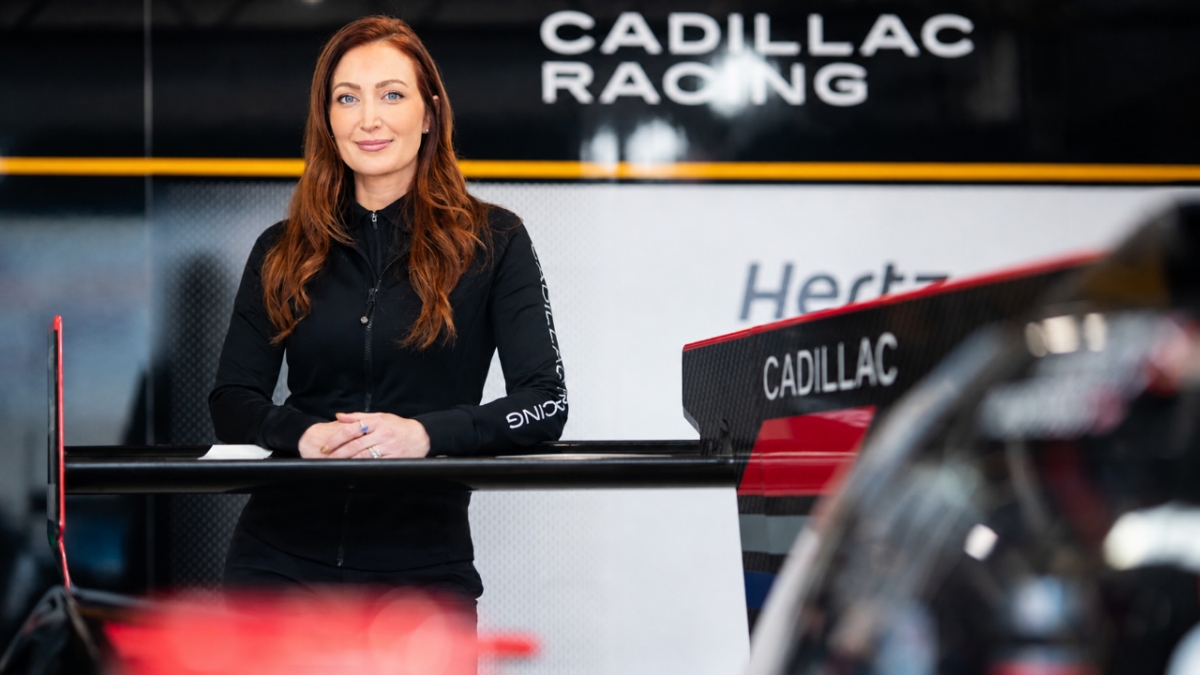


Keely Bosn was racing mini-sprints on dirt tracks by age 12. By her mid-twenties, she was managing a $42 million budget and keeping hovercraft vessels operational for Marine shore landings. Today she runs Cadillac’s V-Series.R endurance racing program across two global championships, and the thread connecting all three chapters is the same: the work nobody sees is the work that wins.
Bosn’s path to motorsports program manager took a seven-year detour through the U.S. Navy Supply Corps. She originally signed up to fly. A medical issue killed that plan mid-way through Officer Candidate School, forcing a pivot into logistics.
The Supply Corps wasn’t glamorous, but it matched her engineering degree and business minor. It put her in charge of budgets, equipment, and people in environments where failure carried real consequences.
Two Middle East deployments supporting Naval Special Warfare operations did the rest of her education. She kept SEAL teams mission-ready, which she defines with blunt precision: “If the phone rings at two in the morning, you’re not scrambling. The equipment’s already maintained and funded, and everyone knows their role.”
That sentence could describe a 24-hour race at Le Mans just as easily as a special operations staging area.
Bosn now coordinates Cadillac’s three partner teams competing in both IMSA and the FIA World Endurance Championship. No off-season. Race cars shipping across continents on tight deadlines, with customs paperwork, tariff exposure, and transport risk that she says feels exactly like planning a deployment.
“If the logistics are shaky, it doesn’t matter how talented your people are,” she says. “You won’t execute trackside without what you need, in working order, when you need it.”
The parallels between expeditionary military logistics and global endurance racing are closer than most outsiders would guess. Both involve moving specialized, high-value hardware around the world under pressure. Both demand backup plans for the backup plans.
Both punish hesitation and reward the kind of relentless preparation that looks boring until the moment it saves you.
Before the Navy, Bosn had interned with Corvette Racing during a co-op at Kettering University. She loved it but never expected to find her way back. “After the detour into the military, I never thought I’d find a clear path back,” she says. The detour turned out to be the qualification.
Her leadership philosophy is a product of that military experience. She focuses on clearing roadblocks, giving her team honest information, and owning outcomes when things go sideways. “It taught me to lead by making other people successful,” she says.
During race weekends, Bosn and her team are sometimes trackside for 35 straight hours. Things break. Weather changes. She treats it the same way she treated operations in the Middle East: rely on the team, communicate clearly, focus on the next right decision instead of the last mistake.
Cadillac’s 2026 racing season has taken Bosn from São Paulo to Spa to Le Mans, where the team picked up a Sustainable Endurance Award. She’s a long way from that dirt track in her childhood, and an even longer way from that barracks renovation she got dumped on as a junior officer with no construction background.
She got that done too. The pattern holds. Bosn keeps getting handed things she wasn’t fully prepared for, and she keeps delivering.
Cadillac is betting that pattern holds at the highest levels of global motorsport, where the margin between winning and losing often comes down to whether the right part arrived on the right continent at the right time. The 2026 WEC season still has races left to run.




Share this Story