


Ferrari CEO Benedetto Vigna just admitted something no supercar maker has ever had to say out loud: his company’s first electric vehicle accelerates hard enough to mess with the human brain.
In an interview with Autocar India, Vigna revealed that Ferrari consulted multiple medical centers and NASA to determine the threshold at which sustained linear acceleration becomes, in his word, “disturbing” to the driver. The Luce, Ferrari’s upcoming four-motor EV grand tourer with over 1,000 horsepower and a claimed 2.5-second sprint to 60 mph, apparently crossed that line during development.
“Sometimes it is disturbing our brain,” Vigna said. “We did a lot of study with different medical centers and also with NASA to understand what is the level of acceleration that is disturbing the people.”
He didn’t share the number. He didn’t explain exactly how Ferrari applied what it learned. But the implication is clear: raw EV thrust, delivered without the drama of revs or gearshifts, can overwhelm the vestibular system in ways that combustion cars never did.
At a certain point, Vigna said, the driver stops enjoying the experience and simply waits for the force to stop.
This is Ferrari publicly acknowledging that the EV horsepower wars have a ceiling, a biological one. Rimac can quote 1,914 horsepower. Lucid can chase quarter-mile records. Ferrari is saying the human body has a vote, and it chose to listen.
That philosophy extends beyond straight-line speed. Vigna outlined five generators of driving thrills, and cornering was high on the list. EVs are notoriously heavy, and that mass creates a disconnect between what the eyes see and what the inner ear feels during lateral loading.
“The eyes want to corner but the gyroscope in the ears, because of the weight of the car, feels that you are drifting,” he said.
Ferrari hasn’t disclosed the Luce’s curb weight, but the message is clear: they’re obsessed with managing how the car feels, not just how it performs on paper. Maserati took a similar approach with the GranTurismo Folgore, packaging its battery closer to where an engine and transmission would sit to preserve traditional weight distribution. Ferrari may be doing something more radical, but Vigna isn’t saying yet.
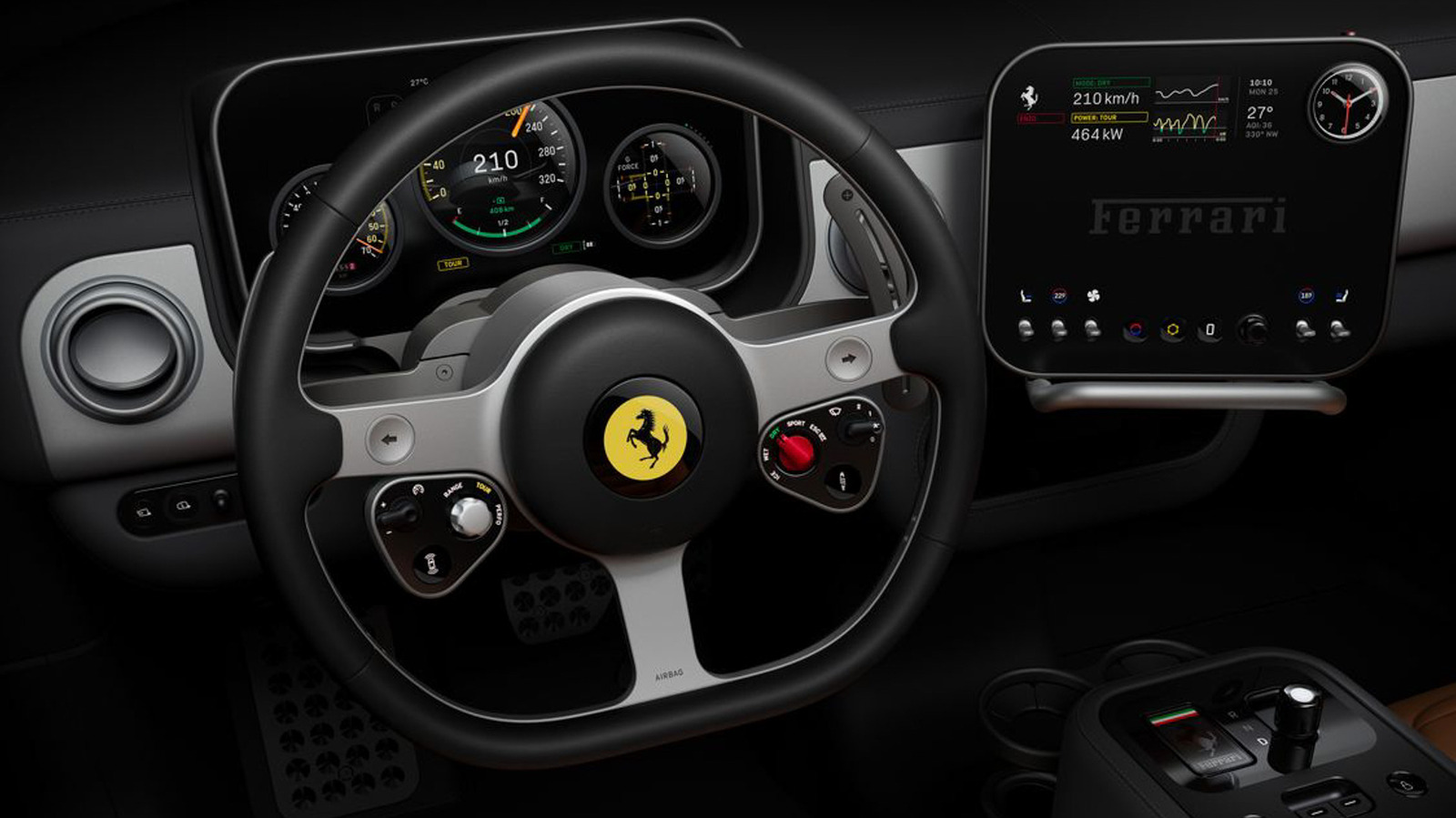
Then there are the paddle shifters. The Luce’s recently revealed interior, clean, minimal, vaguely Apple-inspired, features prominent metal paddles behind the steering wheel. In most EVs, paddles control regenerative braking levels. Vigna was explicit: these have nothing to do with braking.
Instead, they deliver what he called “true torque shift engagement.” He stopped short of confirming a multi-speed gearbox, which would be unusual but not unprecedented in an EV. Whatever the mechanism, Ferrari clearly wants to inject drama and driver involvement into a powertrain that, by nature, has neither gear changes nor a climbing tachometer to stir the soul.
The Luce is set for its official unveiling in May 2026, and it will arrive as a four-door electric grand tourer, a body style Ferrari has never built. Pricing hasn’t been confirmed, but this is Maranello. Expect north of $500,000.
What Ferrari is really building here isn’t the fastest EV. It’s a bet that the next phase of the performance car isn’t about who can produce the most violent launch, but who can make acceleration feel like something worth savoring.
Calling NASA to figure that out is either the most brilliant engineering flex in recent memory or the most expensive marketing stunt. Probably both.
The rest of the EV hypercar field is chasing numbers. Ferrari is chasing neuroscience. That’s either the future of the segment or the most Italian thing that’s ever happened to electricity.

Share this Story