



The laptop in the passenger seat of a beat-up Honda is a universal automotive signal: that thing is tuned, and it’s probably faster than you. Jake Symonds took that concept and shrunk it down to a handheld gaming device suction-cupped to his windshield.
Symonds runs a Valve Steam Deck as the primary tuning interface for his 1987 Nissan 300ZX. It talks directly to the car’s standalone MicroSquirt ECU through TunerStudio, controlling fuel maps, ignition timing, boost levels, and everything else that matters when you’re running a VSRacing 6762 turbo with 550cc injectors.
The connection requires zero modifications to either device. One USB-C-to-serial adapter bridges the gap between a $400 gaming gadget and an aftermarket engine management system. That’s it.
“So far, the biggest obstacle has been learning how to use Linux, but that hasn’t been too bad,” Symonds said. He 3D-printed a custom holder and attached it to a GoPro-style suction mount on the windshield, putting the screen nearly at eye level while driving. A wireless keyboard with a trackpad handles inputs so he doesn’t have to fumble with the Deck’s built-in gaming controls while making pulls.
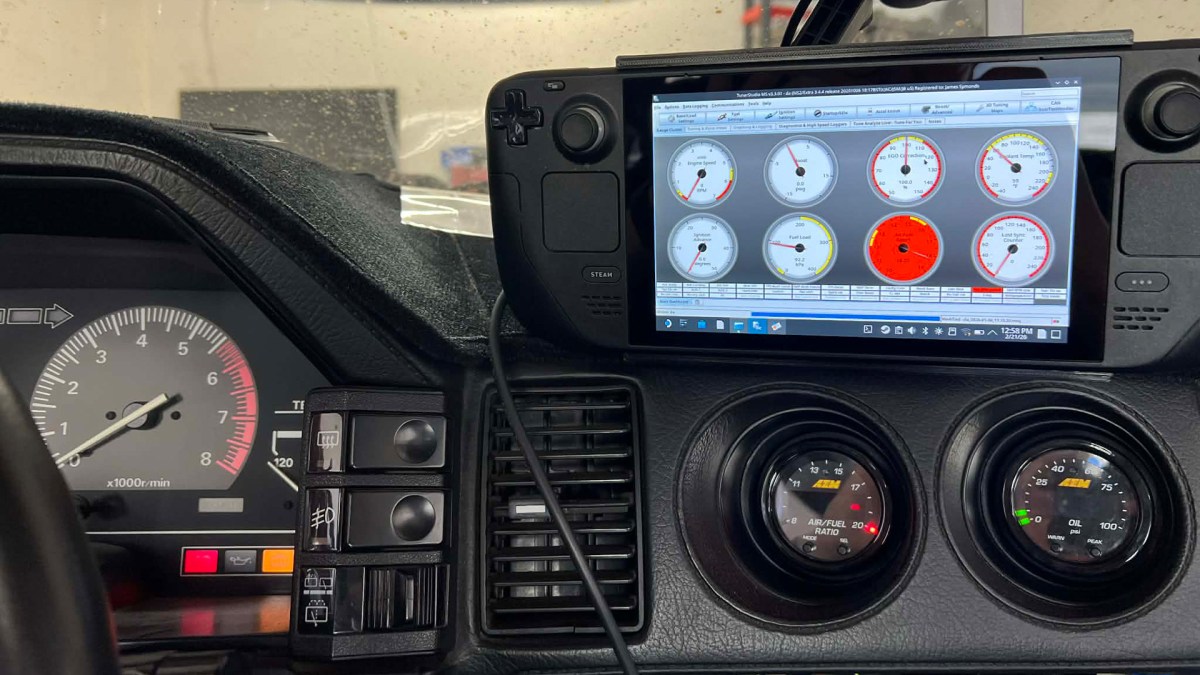
The setup is genuinely practical. TunerStudio’s gauge display is fully customizable, so Symonds can monitor whatever parameters he needs in real time. When he’s done at the track or the dyno, he unplugs the serial cable, takes the Steam Deck inside, and reviews datalogs on a full desktop setup.
The portability is the whole point. One device does double duty as a tuning laptop and a gaming machine. He’s been playing Fallout and Terraria on it lately.
This is a 40-year-old car running modern standalone engine management controlled by a device Valve designed for playing Half-Life on an airplane. The Z31 chassis was never meant to see this kind of technology, but the MicroSquirt ECU doesn’t care what computer talks to it, and Linux doesn’t care what hardware it runs on. The whole thing works because open platforms tend to find uses their creators never imagined.
Symonds’ Z isn’t just a tuning experiment, either. The turbo setup with those 550cc injectors puts it well beyond stock output. Powertrix coilovers handle the suspension duties, and a set of Z32 wheels fill the fenders. It’s a cohesive build, tasteful, purposeful, and clearly driven hard.
The DIY tuning community has a long history of repurposing consumer electronics. Years ago, someone rigged a Game Boy Advance as a boost controller. Before that, people were running MegaSquirt setups off refurbished Thinkpads bought for $50 at surplus sales.
The Steam Deck fits neatly into that lineage because it’s a compact Linux PC with a seven-inch screen, decent processing power, and a price point that undercuts most dedicated tuning tablets.
What makes this notable isn’t the novelty, it’s the accessibility. A MicroSquirt ECU, a Steam Deck, a USB adapter, and a 3D printer are all any reasonably handy person needs to replicate this. No proprietary software licenses. No dealer-locked hardware. No four-figure touchscreen tuning tablets.
Symonds built a rolling proof of concept that the barrier to standalone engine management keeps dropping. The tools are cheaper, the software is open, and apparently, you can still frag deathclaws in the Mojave Wasteland on the drive home.





Share this Story