
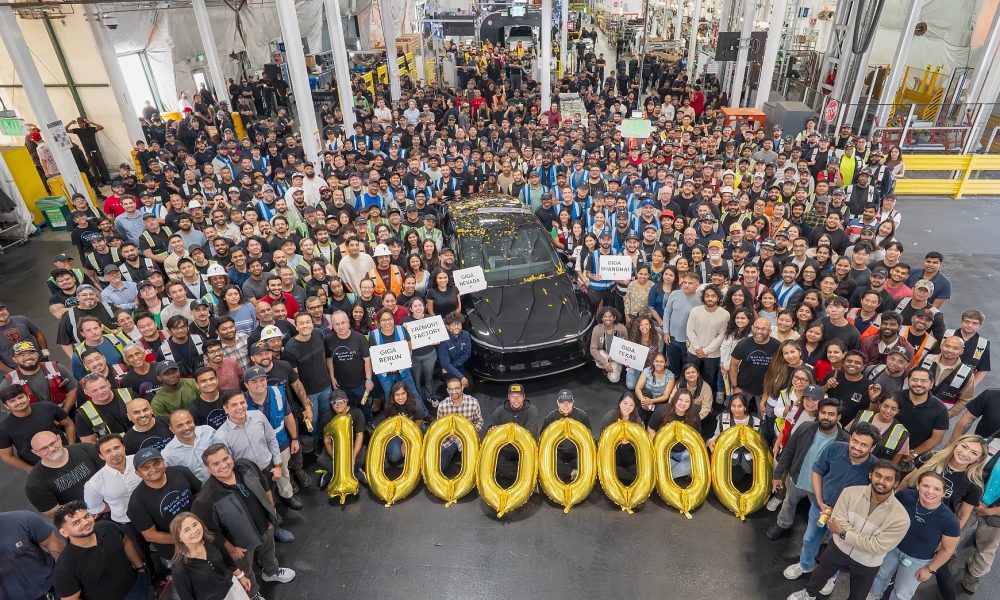


Tesla confirmed on July 30 that it has built its 10 millionth vehicle, a Diamond Black Model Y that rolled off one of its four global production lines. The milestone spans output from Fremont, Shanghai, Berlin, and Austin, accumulated over roughly 18 years since the original Roadster.
Ten million is a big number. It is not, however, a big number measured against the companies Tesla supposedly disrupted.
Toyota builds about 10 million vehicles a year. Volkswagen Group does roughly the same. Hyundai-Kia clears seven million annually. Tesla needed nearly two decades to match what the old guard stamps out every 12 months, and that context matters more than any victory lap.
Credit where it is due. No startup in modern automotive history has scaled this fast from zero. The first Tesla Roadster was a modified Lotus Elise with a battery pack and a prayer.
The company nearly went bankrupt at least twice. Production hell for the Model 3 in 2017 and 2018 became such a well-worn phrase it could have been a trim level. The fact that Tesla clawed its way to eight-figure cumulative production is real, and it is earned.
But the narrative that legacy automakers are flailing in Tesla’s wake deserves some pushback. Ford’s F-150 Lightning stumbled, yes. GM pulled back on its Ultium timeline. Stellantis remains a mess on electrification.
None of that changes the fact that these companies still sell vehicles by the tens of millions, still generate revenue that dwarfs Tesla’s automotive gross margin, and still control dealer networks and service infrastructure across continents.
Tesla’s Supercharger network is a genuine competitive moat, and the adoption of its NACS plug standard across the industry was a masterstroke. Software remains a clear advantage. But self-driving claims continue to outpace self-driving reality, and the technology still requires driver supervision in every jurisdiction on Earth.
The more interesting tension is what happens next. Tesla’s growth rate has slowed. Deliveries in 2025 disappointed Wall Street, and the stock took a sharp hit after the most recent earnings report.
The refreshed Model Y boosted numbers in some markets, but China is a knife fight now, with BYD, Xiaomi, and a dozen domestic brands clawing for share with cheaper, feature-rich EVs. Europe has its own headwinds, from tariff politics to softening EV demand in key markets like Germany.
Ten million cars also means ten million cars worth of warranty exposure, service demand, and customer retention challenges. Early Tesla buyers were evangelists. The tenth million includes fleet purchases, rental cars, and buyers who simply wanted a good deal on a used Model 3.
Brand loyalty looks different at scale.
The 10 millionth car is a fact. It is a milestone Tesla earned through relentless execution, vertical integration, and a willingness to move faster than any legacy manufacturer thought possible.
It is also a snapshot of a company that now faces the same grinding, unglamorous realities that define every high-volume automaker: margin pressure, market saturation, aging product lines, and customers who expect their cars to work perfectly from day one.
Tesla spent 18 years becoming a mass manufacturer. The next 10 million will tell us whether it can stay one.
Share this Story