
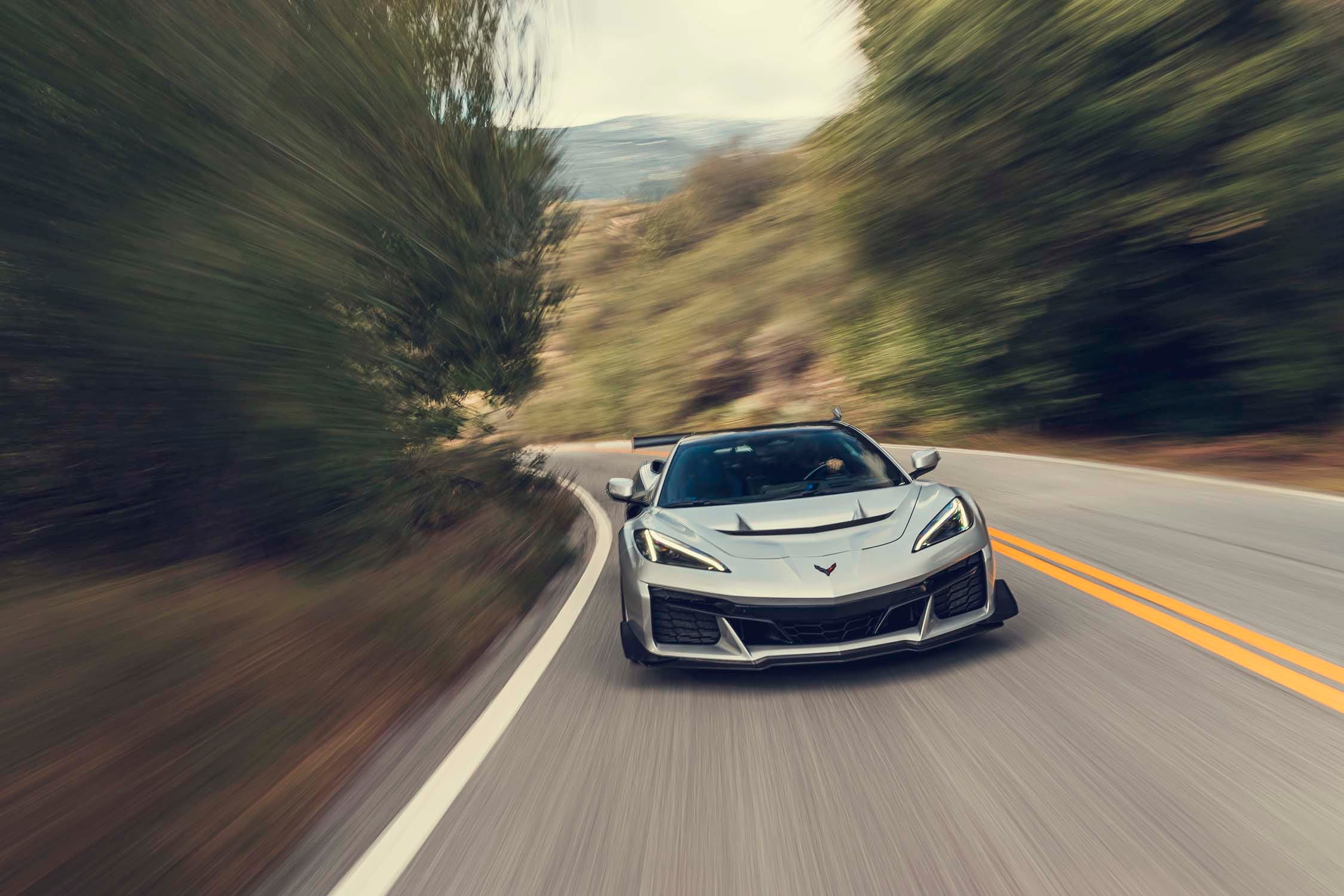


The 1953 Chevrolet Corvette needed 11 seconds to reach 60 mph. Its 150-hp Blue Flame inline-six and two-speed Powerglide automatic made it a looker that couldn’t fight. By 1967, a 427-powered Sting Ray was doing the same sprint in 4.7 seconds, and then the bottom fell out.
That arc — from sluggish showcar to legitimate performer to emissions-strangled shadow of itself — is the Corvette’s real story. Car and Driver’s testing data across seven decades lays it bare in a way no marketing brochure ever would.
The early trajectory was relentless. Chevrolet dropped a 265-cubic-inch V-8 into the 1955 model, and the zero-to-60 time plunged from 11.0 seconds to 8.7. Fuel injection arrived for 1957, shaving another two seconds.
By 1963, the Sting Ray was cracking six seconds flat with a relatively modest 300-hp 327. Three years later, a 427 dragged the number down to 5.4. And the 1967 L89, making 435 horsepower, posted a 4.7-second run that wouldn’t be matched by a production Corvette for decades.
Then came 1968, and everything slowed down.
The third-generation car arrived with a gorgeous Coke-bottle body and newly mandated emissions equipment that strangled its performance. That year’s 400-hp 427 managed only 5.7 seconds to 60. By 1973, a 454-cubic-inch V-8 — the biggest motor Chevrolet had ever stuffed under the hood — was rated at just 275 horsepower under the new SAE net standard.
The nadir came in 1978. A base Corvette with 185 horsepower needed 7.8 seconds to hit 60 mph. That is slower than the fuel-injected 1957 model by more than a full second, despite two decades of supposed progress.
Car and Driver called the 7.8-second run “almost impressive” given the anemic output, which reads less like a compliment and more like a eulogy.
The malaise era wasn’t just about horsepower numbers on paper. The third-generation body that debuted in 1968 soldiered on through 1982 — a 15-year run during which the Corvette’s chassis design dated back even further, to 1963. Chevrolet kept adding weight, refinement, and emissions hardware while subtracting the very thing that made the car matter.
Recovery was slow. The all-new 1984 Corvette brought modern engineering but only 205 horsepower and a 6.7-second zero-to-60 time. That’s roughly where the Corvette sat in 1959, a quarter century earlier.
The pattern across the data is unmistakable. For every era of genuine advancement, there’s a corresponding retreat — driven by regulation, weight gain, corporate timidity, or some combination of the three. The 1966-to-1978 collapse is the starkest example, but smaller regressions dot the entire timeline.
The 1958 model was a full second slower than the 1957, partly because Chevrolet insisted on using its own test driver rather than letting the magazine do the timing. The 1965 was fractionally slower than the 1963 despite 50 more horsepower.
These numbers strip away nostalgia. The golden age everyone romanticizes — big blocks, open headers, Zora Arkus-Duntov riding shotgun — produced exactly two sub-five-second runs across the entire C2 and C3 era. The rest of the time, the Corvette was a car fighting its own growing waistline and Washington’s tightening grip.
Straight-line speed in America has never followed a simple upward curve. It lurches forward, gets knocked back, stagnates, then surges again. The Corvette didn’t just live through those cycles — it defined them. Every stumble and comeback in American performance culture is encoded in its zero-to-60 times, one tenth of a second at a time.


Share this Story